Dearest Rachel –
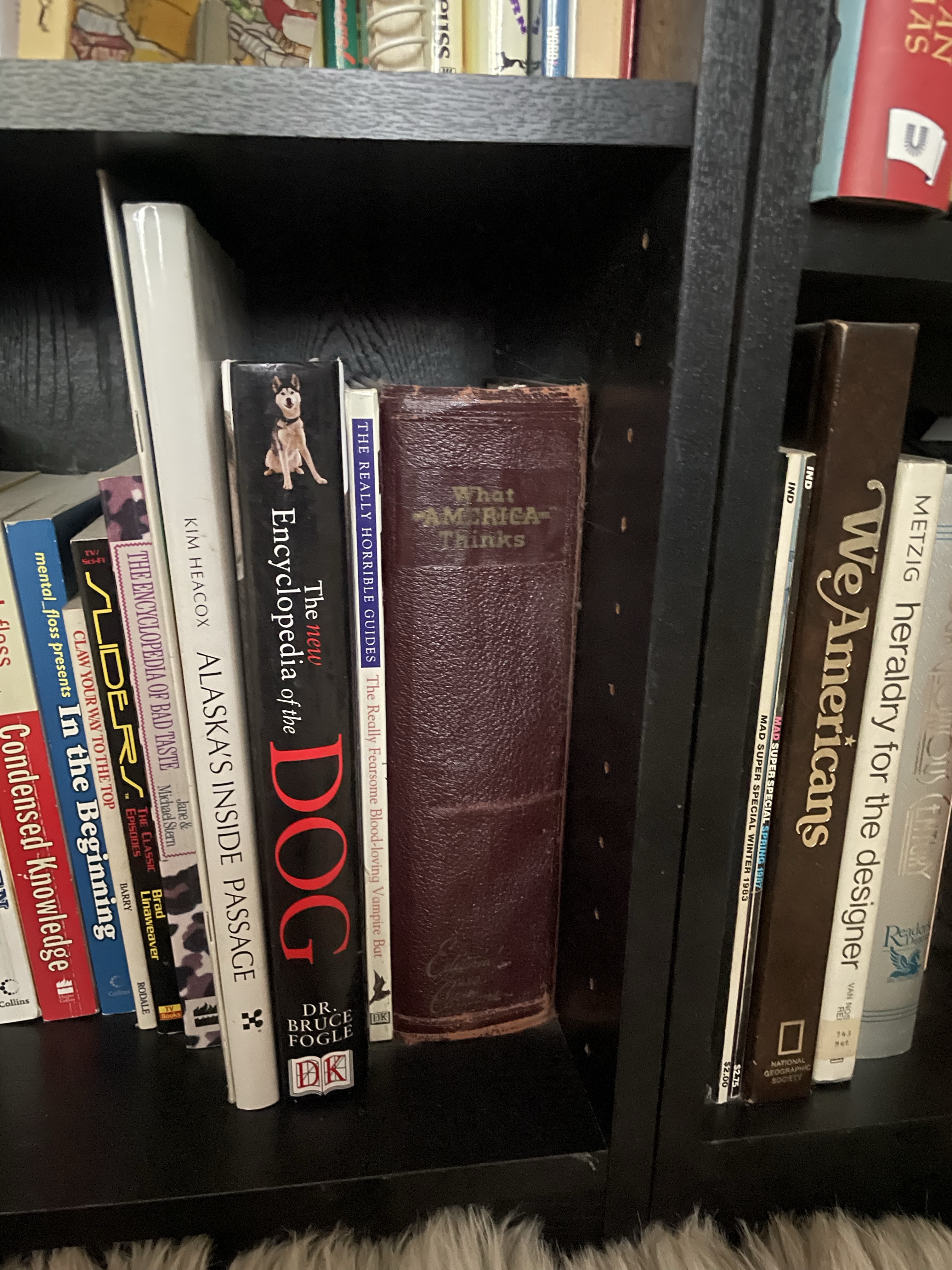
For all I know, this may have escaped your notice back in the day; I certainly couldn’t keep track of your library until I was forced to go through it and determine what could be given away and what I couldn’t part with just yet. But among the many books I brought to our union was an enormous tome entitled What America Thinks. I had inherited it from my paternal grandparents, at whose house I would pore through it for hours on end. It was a collection of editorial cartoons and opinion pieces from the years 1937 through 1940 (and just barely into 1941 – certainly not far enough to get to the real tipping point of the year, or the war), nearly 1500 pages long.
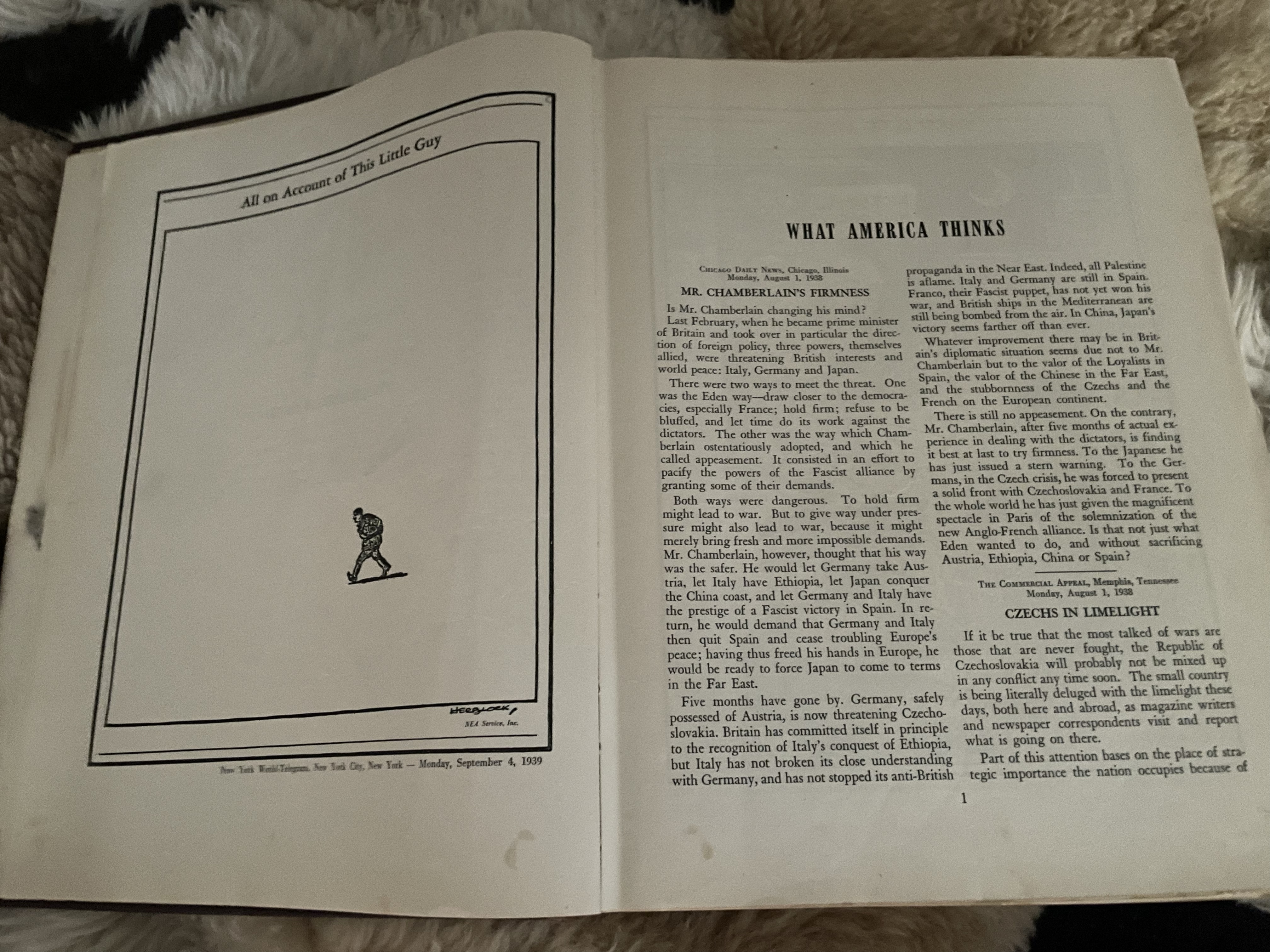
A book like this is a great way to get a perspective on history – although I admit to glossing over the articles in favor of the artwork – especially as seen by the people who were living through it, rather than those of us who know what happened, and what the verdict of history was on the dramatis personae who populated these images. For what it’s worth, it’s an interesting mixed bag, which should be expected, given the vast array of authors and artists, each with their own opinions. It’s clear that this was published before Pearl Harbor, as almost no attention is given to the goings-on in the Pacific. Hitler and Mussolini were not looked at fondly even then (after all, at this point, the blitzkrieg was starting to ramp up into full motion); nor, for that matter was Stalin (who at the time had signed a treaty with the aforementioned ill-thought-of leaders), but in either case, the Jewish situation was given nearly as short shrift as Asia and the Pacific. It’s interesting to see what people back then thought was important compared to what we remember about those years.
It leads to the obvious question about the present: what will future generations think of what we have to say about the things that are happening now? Who will the future think the heroes and the villains were – and will the heroes have won? Actually, scratch that; of course the heroes will have won, as the winners get to write the history books and they will ensure that they come out looking like the heroes they think they are – but it does leave me wondering whether “our” side will be the ones doing the writing, or if we’ll only be the ones written about, and poorly thought of, as a result.
Worse yet, as thoughts go, the question might even be asked as to whether there will be future generations to write and read those histories? It’s said that history doesn’t so much repeat as rhyme, and it feels like we’re getting to the end of a couplet now. Reading What America Thinks gives one a feel for the mindset of a people both realizing they were heading toward something big and disastrous on a global scale, while at the same time fairly confident that they were snugly protected from all the chaos, thanks to an ocean on either side. They were wrong then, and you’d think we would know better now, between events such as Pearl Harbor and 9/11. But no.
History teaches us that man learns nothing from history.
Georg Wilhelm Friedrich Hegel
After Sparks, we were in the parking lot, talking with Ms. Joan and Erin about the situation over in Israel. We all agreed that it was awful, but for varying reasons; Joan was concerned with the tourism industry and pilgrimage sites (having worked at Magdala for a month at a time in the last few years before Covid, and possibly once thereafter, if my memory serves me correctly). Daniel mentioned the spiritual warfare involved behind the scenes, while I was wrought over the demonstrations on this side, in cities and campuses, in favor of the incursive forces attacking such sites as a music festival (imagine a terrorist attack on Lollapalooza like this) and various kibbutzim near the Gaza border. The images from the body armor cameras of the invaders – and the interview footage of the supposed head of the Hamas political party, where the man literally says they want to encourage more attacks like the one on 10/7 until Israel is wiped out – ought to be enough to repulse anyone toward what these people are doing, but no. People are all in on this, it would seem. And while this doesn’t affect me personally, not being Jewish (although Logan and his family are), just the fact that people seem to support this make me wonder what other horrors they might support – and when it might just reach me. I fear it’s sooner than I’d like to believe.
In any event, I got an email last night from Ms. Joan, inviting me to a Kristallnacht remembrance service at another church some ways north and west of us. It’s not something I’d have ever considered going to (and, for all I know, there may not have been any in the past, but now, it seems necessary), but I think I may go there tonight. I’ll ask Daniel if he’s interested, but I think I ought to go regardless of whether he – or anyone else I know – wants to be there.
And of course, it isn’t as if Israel and Gaza are the only conflict going on at the moment, or threatening to. The quagmire that is Ukraine continues apace, and our latest appropriation is apparently supposed to send four times more money to them than to Israel, despite the fact that, as winter sets in, things are going to stop going anywhere for a while up there. Guess the Big Guy can’t get his ten percent as well from Israel as from Ukraine, so the outlays continue. And there’s an ever-present shadow looming over the Taiwan Strait, as Red China continues to look hungrily at it’s alleged “breakaway province.” So yes, we’re dealing with the full force of “wars and rumors of wars” as spoken of by the Savior once upon a time.
All of which leads to late-night thoughts of prophecy, and where we fit into the grand scheme of things, much of which adds to the question of whether there will even be generations to look back at us and evaluate us. Hal Lindsay, in his works on Revelation, saw the letters to the churches as a prophetic look at the church age timeline, and that we were living in Laodicea; materially wealthy and self-satisfied, but spiritually poor, blind and naked. And while I don’t put quite as much stock in post-scriptural prophets, there’s always Saint Malachy’s list of popes that essentially run out with our present one – and think about it; he’s eighty-six years old. If the old saint is right, our time is just about up. We’re sitting on a sand dune in the upper part of an hourglass, thinking we’ve dug ourselves into a sturdy foundation, while at the same time wondering about this little conical indentation nearby, completely unaware that we’re on the verge of being swallowed by the sinkhole being generated by the grains of time sliding down beneath us.
And yet, can we be blamed for our ignorance? On this side of the planet, the ground still seems fairly sturdy under our feet; and despite the chaos of history, this chunk of rock that we orbit the sun on has existed, unperturbed, for so long, even as we have marched over it in one conquest or another. People – and peoples – are born, they rise up, they fight, they dominate, they stumble, they fall, they die, they disappear… and the world goes on. We somehow assume that this cycle will continue forever – that we will continue forever – even as we’re fully aware of our mortality. Somehow, we can’t seem to comprehend the end until it’s upon us.
One of the most recent YouTube videos I was watching from the Tasting History channel had to do with JFK’s last meal; a simple sort of breakfast, with eggs, crisp bacon (which requires a certain amount of time on each side in the oven, as opposed to a skillet – I’ll have to remember that) and toast with marmalade. In a way, it’s little different from your own last meal insofar as it was fairly ordinary (although the idea of a president eating a hot dog, nachos and hot chocolate outside of a campaign setting seems a little déclassé, to be honest). There was no great final send-off for him, because until the last moment, there was no indication that this was going to be anything more than just another day for him – or you – until it wasn’t.
And so it is likely to be for the rest of us, I fear sooner rather than later.
Forty years ago, Randy Stonehill wrote about how “the eighties look like tough times / the world is turning sour” as he reached his thirtieth birthday.
From a distance of over forty years since, that assessment seems ludicrous in comparison to the present. Since then, however – after a brief moment in which it seemed that Pax Americana had reached its apex – the world certainly has seemed to age like fine milk. But without anything else for humanity to quench its thirst with, we continue to drink at its fountain, as we poison ourselves inside. Meanwhile, all we can do is to “keep on serving Jesus / and await the final hour.” That hour keeps getting closer all the time.
And with that in mind, honey, keep an eye on me, and wish me luck. I’m going to need it.

 Letters to Rachel
Memories found in books, treasured and kept close.
LikeLike