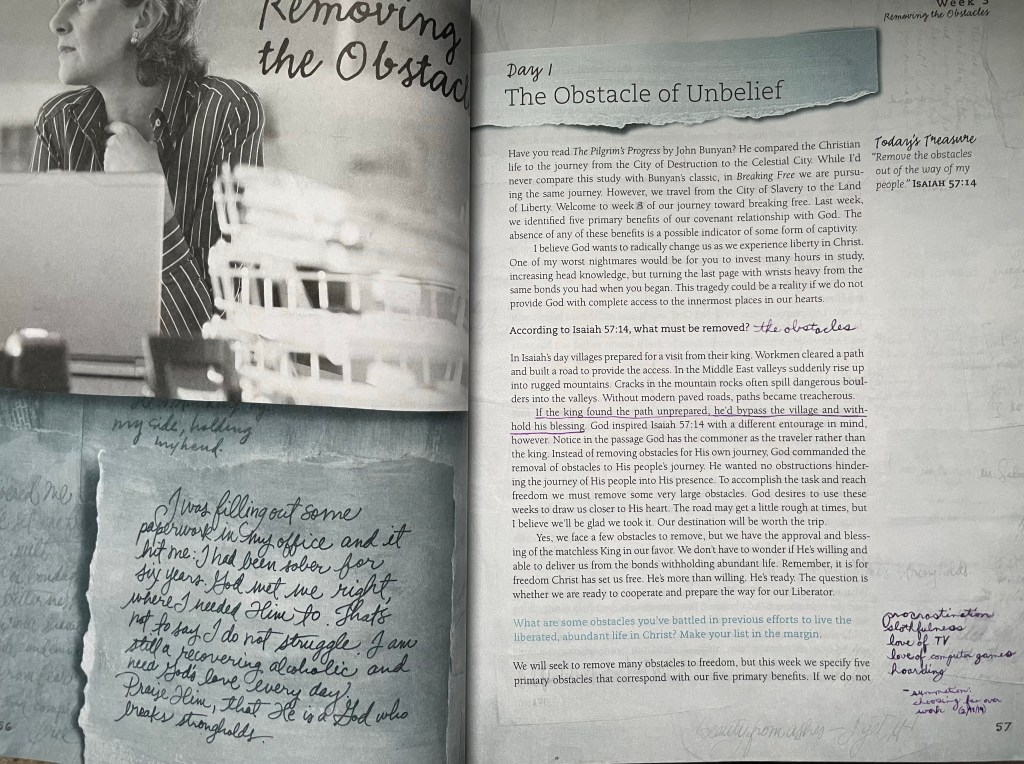
According to Isaiah 57:14, what must be removed? “the obstacles”
If the king found the path unprepared, he’d bypass the village and withhold his blessing.
What are some obstacles you’ve battled in previous efforts to live the liberated, abundant life in Christ?
– “Procrastination
– “slothfulness
– “love of TV
– “love of computer games
– “hoarding
– “summation: choosing fun over work (2/11/14)”
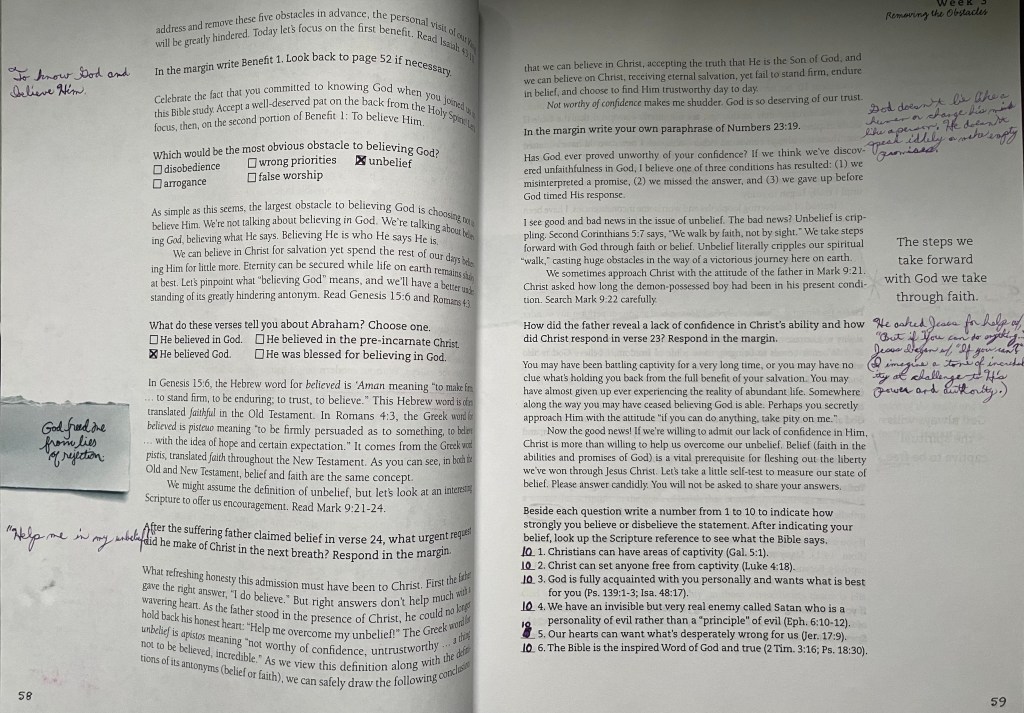
Benefit 1: “To know God and believe Him”
Which would be the most obvious obstacle to believe in God? “unbelief”
What do Genesis 15:6 and Romans 4:3 tell you about Abraham? “He believed God.”
After the suffering father claimed belief in Mark 19:24, what urgent request did he make of Christ in the next breath?
“Help me in my unbelief!”
Write your own paraphrase of Numbers 23:19.
“God doesn’t lie like a human or change his mind like a person. He doesn’t speak idly or make empty promises.”
How did the father reveal a lack of confidence in Christ’s ability and how did Christ respond in verse 23?
“He asked Jesus for help with ‘But if you can do anything…’ Jesus began with ‘“If you can?”’ (I imagine a tone of incredulity at a challenge to His power and authority)”
Beside each question, write a number from one to 10 to indicate how strongly you believe or just believe the statement.
1. Christians can have areas of captivity (Galatians 5:1) “(10)”
2. Christ can set anyone free from captivity (Luke 4:18) “(10)”
3. God is fully acquainted with you personally and wants what is best for you (Psalm 139:1-3; Isaiah 48:17) “(10)”
4. We have an invisible but very real enemy called Satan, who is a personality of evil rather than a ‘principle’ of evil (Ephesians 6:10-12) “(10)”
5. Our hearts can want what’s desperately wrong for us (Jeremiah 17:9) “(10)”
6. The Bible is the inspired word of God and true (2 Timothy 3:16; Psalm 18:30) “(10)”
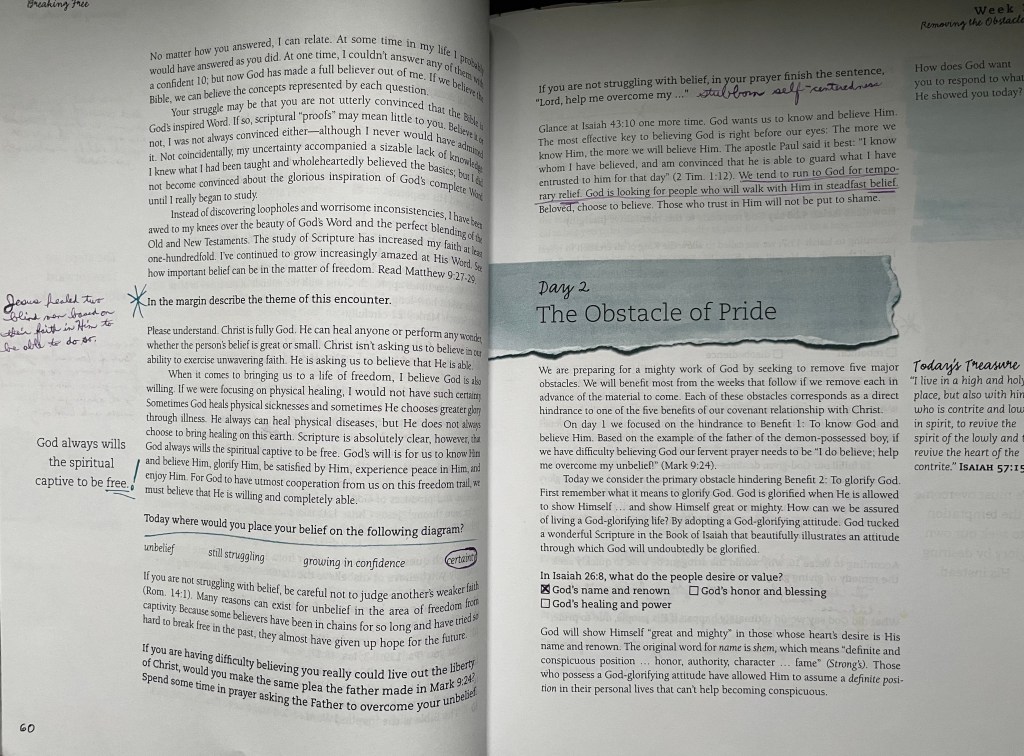
Describe the theme of the encounter in Matthew 9:27-29.
“Jesus healed two blind men based on their faith in Him to be able to do so.”
Today where would you place your belief on the following diagram? “certainty“
If you are not struggling with belief, in your prayer finish the sentence, ‘Lord, help me overcome my…’ “stubborn self centeredness”
We tend to run to God for temporary relief. God is looking for people who will walk with Him in steadfast belief.
Dearest Rachel –
There’s not a whole lot to add to this study, honey; you never had that much difficulty with belief. Given that we have the entirety of God’s story of his dealings with humanity, you would think that would stand to reason for all of humanity.
But, of course, there’s the challenge of putting that belief into action, which will probably be discussed in more detail in future chapters of this study, although you’ve already touched on briefly here at the beginning and end of this one. It is difficult to deal with the intangible when so much of the tangible world is clamoring for your attention – and, as you admit, is more ‘fun’ to deal with most of the time. Studying what God has to say to us, and living that out, tends toward feeling like a chore, not unlike eating one’s vegetables, or going to the gym; we’d be better off for it, but that doesn’t necessarily recommend it to us, given all else that surrounds us.
I appreciate your imagination of an incredulous Jesus repeating the father’s phrase “if you can”; I often find myself mildly amused at His reactions to the lack of faith at even His disciples (such as when they’re dealing with a Galilean storm, which happened more than once). Then again, it’s not as if He has to have faith, as He knows what He’s capable of. Meanwhile, the father has already seen the disciples fail at curing his son, and may not see Jesus as that much more of a man (and make no mistake, he would see Him as a man, not as God – if nothing else, Jewish scripture wouldn’t permit it as part of his worldview) than they were. Honestly, it sometimes seems as if Jesus can’t quite grasp why His “fellow humans” don’t see Him as anything more than a “fellow human.”
But regardless of how offended (or perhaps mock offended?) He is, He is gracious enough to cure the boy, especially as the father acknowledges the limitations of his own belief and asks for that much more faith in order to accept Christ’s power. And as with the paralytic, for whom He forgave sins before addressing the more obvious (but less crippling, from a spiritual perspective) physical problem, Jesus grants the man the faith he begs for, enough so that his son can be healed; and from there, having seen the sign of such healing, that faith is strengthened that much further.

 Letters to Rachel