

Why do you think Hezekiah turned out so differently from his father?
“Maybe he recognized how wrong and wicked his father had been and wanted to be the exact opposite. Maybe Isaiah had the opportunity to influence him in his formative years. Or, perhaps his mother, Abijah, did; (her father was Zechariah – perhaps the same one who advised Uzziah – though not the writer in the Bible.)”
Hezekiah’s grandfather, Jotham, also had been a good and righteous king. What did Hezekiah do, however, that Jonathan failed to do? Compare 2 Kings 15:35 and 2 Chronicles 31:1.
“He led the people to tear down the Asherah poles, the high places, and altars throughout the land.”
What kind of tactics would you say Sennacherib used against Hezekiah and the Southern Kingdom of Judah?
– “He used fear and intimidation.
– “He attempted to overwhelm them with a show of force.
– “He tried to undermine their faith.
– “He sought to cause them to distrust God.”
Satan cannot force us to go where he leads, but he can certainly choose a scenic route for a lure.
From the tone of 2 Chronicles 32:20, Hezekiah and Isaiah were obviously frightened, but what did they do with their fears?
“They cried out to the Lord. They prayed to heaven.”
…faith is tested by what we do with fear, not whether or not we have it.
What are some fairly typical or expected things Hezekiah felt and thought after he found out he was going to die?
“He turned his face to the wall. He prayed to the Lord and reminded him what a ‘good person’ he was. And he wept bitterly.”
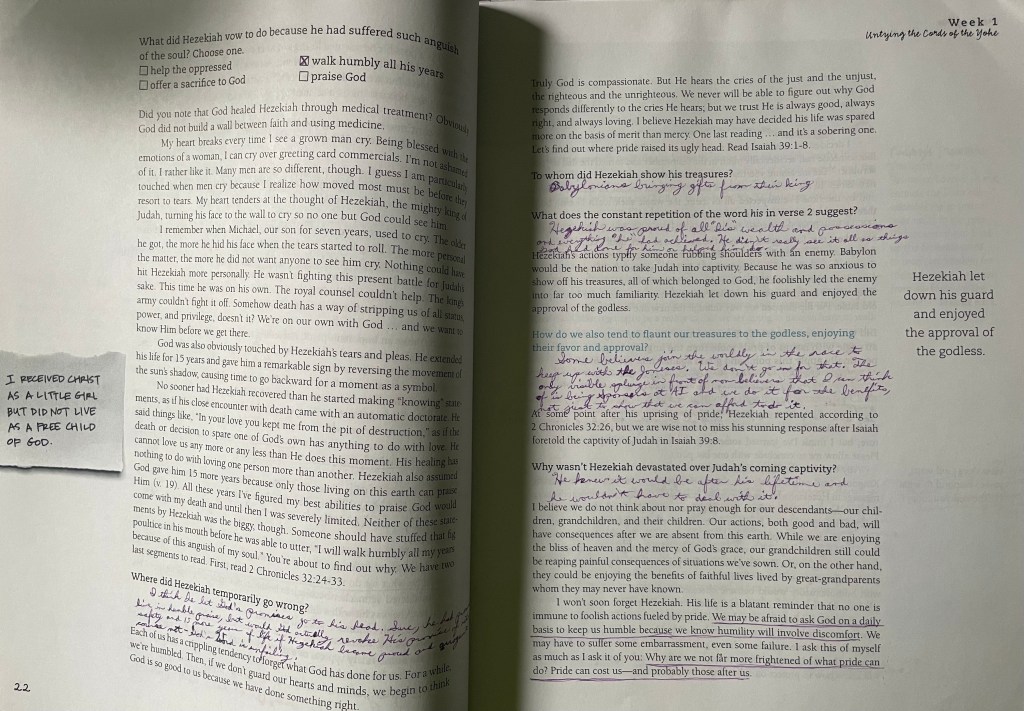
What did Hezekiah vow to do because he had suffered such anguish of the soul?
“walk humbly all his years.”
Where did Hezekiah temporarily go wrong?
“I think he let God’s promises go to his head. Sure, he had promised to live in humble praise, but would God actually revoke his promise of national safety and 15 more years of life if Hezekiah became proud and arrogant? Of course not – God’s word is unfailing.”
To whom did Hezekiah show his treasures?
“Babylonians bringing gifts from their king.”
What does the constant repetition of the word his in verse 2 suggest?
“Hezekiah was proud of all ‘his’ wealth and possessions and everything ‘he’ had achieved. He didn’t really see it all as things God had done for him or helped him do.”
How do we also tend to flaunt our treasures to the godless, enjoying their favor and approval?
“Some believers join the worldly in the race to keep up with the Joneses. We don’t go in for that. The only visible splurge in front of nonbelievers that I can think of is being sponsors at Anime Iowa, and we do it for the benefits, not just to show that we can afford to do it.”
Why wasn’t Hezekiah devastated over Judah’s coming captivity?
“He knew it would be after his lifetime and he wouldn’t have to deal with it.”
We may be afraid to ask God on a daily basis to keep us humble because we know humility will involve discomfort.
Why are we not far more frightened of what pride can do? Pride can cost us – and probably those after us.
Did you notice in our study this week that the godly kings seemed to struggle with issues of pride more than the ungodly kings? How can you personally apply this point and guard against it in your own life?
“Like Beth, I need to acknowledge how much of my behaviors and how many of my daily decisions are based on pride. I need to ask God to show it to me, confess it, and confront it. (Pride of appearance comes to mind, but I don’t want to go to worship looking sloppy either.)”
Dearest Rachel –
It seems mildly ironic to be posting this on Mother’s Day, when, as I look over these past few weeks of your daily homework, there are a series of cases where each father proves to be an example of what not to emulate to his son (although you hint at the possibility, that, at least in Hezekiah’s case, it might have been his mother that proved to be the good example, so there’s that).
Of course, it’s not as if Hezekiah was a perfect king, either. He did get awfully complacent in those last fifteen years, and seemed quite unconcerned about what would happen to his country in the generations after him – and what those subsequent generations would think of him because of it. You’d think that, having explicitly been granted those extra years, Hezekiah would be particularly circumspect about acknowledging what God had done for him, but no. His show of ‘his’ wealth to the Babylonian ambassadors was a fatal display of pride on his part that God called him out for; not that even a dressing-down from Isaiah phased him.
Even on a more immediate level (although it’s not brought up throughout your homework, since Isaiah likely did not survive far into Manasseh’s reign), he seems to have done just as poor a job of raising his own son to follow in his footsteps as his father and grandfather had done with theirs. That end-of-life complacency may have factored into that.
Meanwhile, like you, I need to make sure that I don’t get puffed up regarding whatever good fortune I might have. Admittedly, just the fact that I’m writing to you is a constant reminder that, for all the blessings that I have, my life is still lacking something. Moreover, much of the security that Daniel and I enjoy doesn’t so much come from my own efforts as from yourself and your family, so I’d like to think that I wouldn’t get too proud about it. Nevertheless, there always remains the possibility that I might get too comfortable with it all, and become too accustomed to, and proud of who I might be, and what I might have. As long as I bear that in mind, I can award such pride away, but it’s still challenging.
So, to that end, please keep an eye on me, honey, and wish me luck. I’m going to need it.

 Letters to Rachel