Last night’s trip was a curious one; even though they pulled up the gangplank shortly after six in Hiroshima, we still hadn’t left port even after we ate, retired to the room, and Daniel fell asleep waiting for me to finish assembling certain documents for church and send them off, so we could watch videos together. Even when I realized he wasn’t going to wake up, and shut everything down for the night, we still hadn’t left; it struck me as odd that passengers wouldn’t be permitted to stay out in the city longer and enjoy the nightlife, if we had no plans to leave right away.
And the thing is, the trip for Hiroshima to Takamatsu is a short one; the shortest trip from one city to the next of any of the legs of our journey, at about sixty-six kilometers, or just a little more than forty miles. Even at ‘cruise ship speed,’ which we always used to joke about as we approached church (since that last stretch of Thacker is supposedly a notorious speed trap) the trip shouldn’t take but a couple hours.
But even as we approach eleven o’clock in the morning, we are still progressing through the Seto Inland Sea, en route to Takamatsu. We’ve been at this since at least five, when I woke up, and probably longer. I’m not being impatient, just curious; what’s taking this trip so long, and if this was going to take so long (because the Inland Sea is chock full of islands a ship like this does not want to run into), why not start that much earlier?
Then, I stepped outside to watch, as those islands, peninsulas and capes passed by outside our veranda, and understood. We’re here to see the sights of Japan, but these are part of those sights, too.
In short, the journey itself is part of the destination.
Again, pictures don’t do the view justice. You have to be able to see the entirety of this scene as it fills your visible frame of reference.
There is really no way to explain what everything looks like as it goes by. For all the pictures I’m taking, I’m realizing just how woefully inadequate they are, small as they are in comparison to what it’s like to be entirely surrounded by these images. Still, it’s the best I can do, so I’ll have to throw a few of them in today to describe both the approach and the city we’re visiting.
It’s almost T-shirt weather on deck, but very few of the passengers are taking advantage of it. Not sure if most of them are staying in their rooms like Daniel and I are (probably not), or wandering about the ship, doing this or that.
Even as I’m writing this to you, there’s a crew member chatting up one of the few cuter young passengers as they circle around the jogging track (you can see them in the far left of this picture), discussing philosophy and the like; I’m getting “Love Boat” vibes from the scene (not that that would ring any bells for you, necessarily, since you told me that you didn’t pick up ABC in Macomb very well).
It’s also slightly hazy or maybe that’s my glasses slowly tinting; the skyline of Takamatsu is just barely visible.
But slowly, as we pass Onigashima Island closely on the port side, you can see most of the city on the starboard. Apparently part of the city is on the island, but that’s not where we’re talking. Some places are too small even for this ship.
I’d say Daniel is missing out on this scene, too – I told him I was going on deck to watch us pull in – but he did make his choice. Besides, he can see the city as it comes in just fine.
***
Of course, for all my talk of how the trip itself contains plenty of sights to see in and of itself, we’re still among the first ones waiting to get off the ship, once we’re finally docked and cleared to go ashore. We’re burning daylight here, after all.
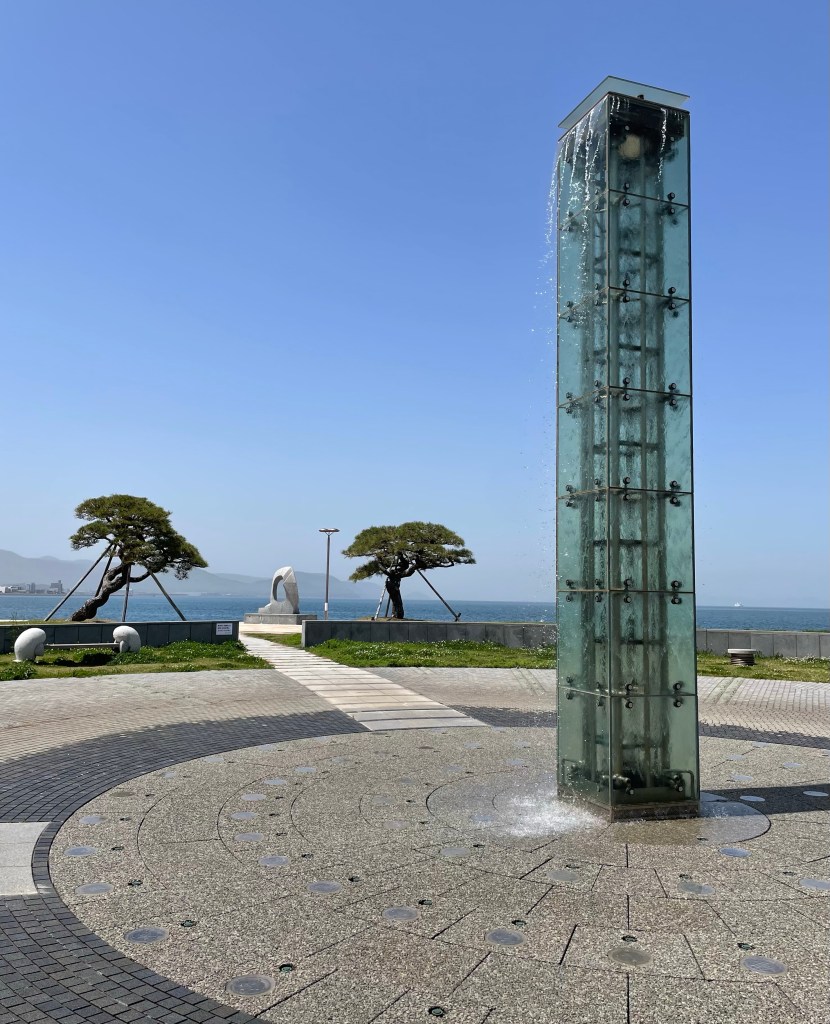
In order to avoid walking on the street, where cars are going back and forth, we duck into a park just about the length of the ship away from itself. Daniel wonders about whether the waterfall tower lights up at night, noting that there are definitely lights on the ground surrounding it.
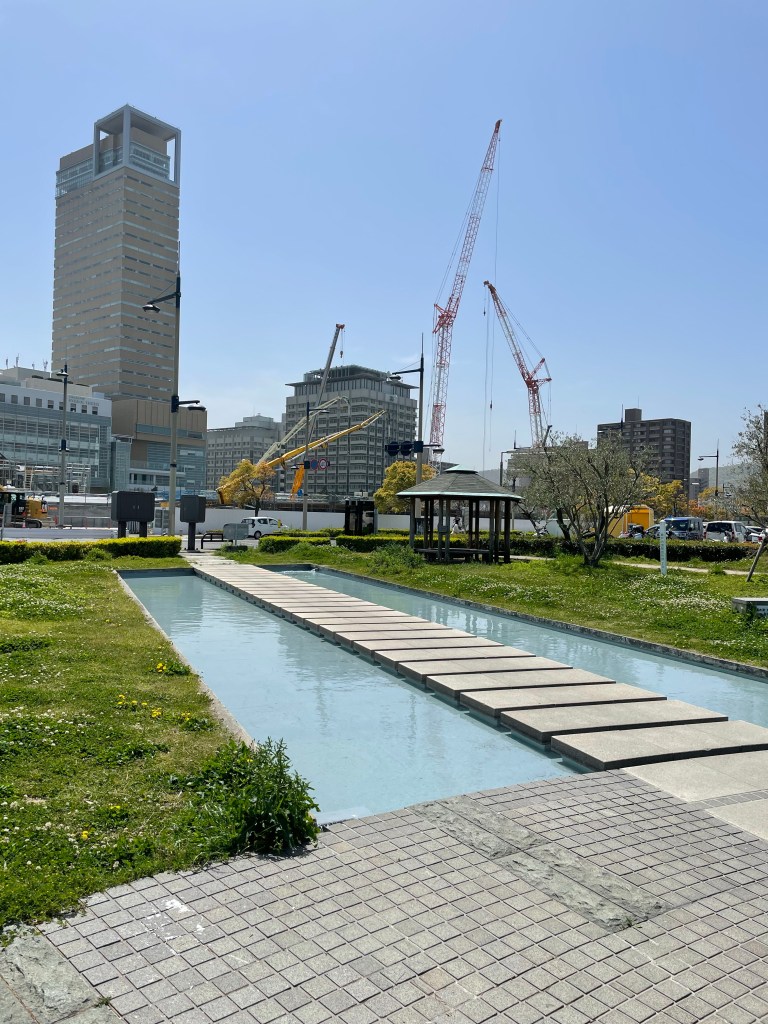
The exit of the park goes over a small man-made pond. You don’t want to step on the cracks here, unless you want to get wet.
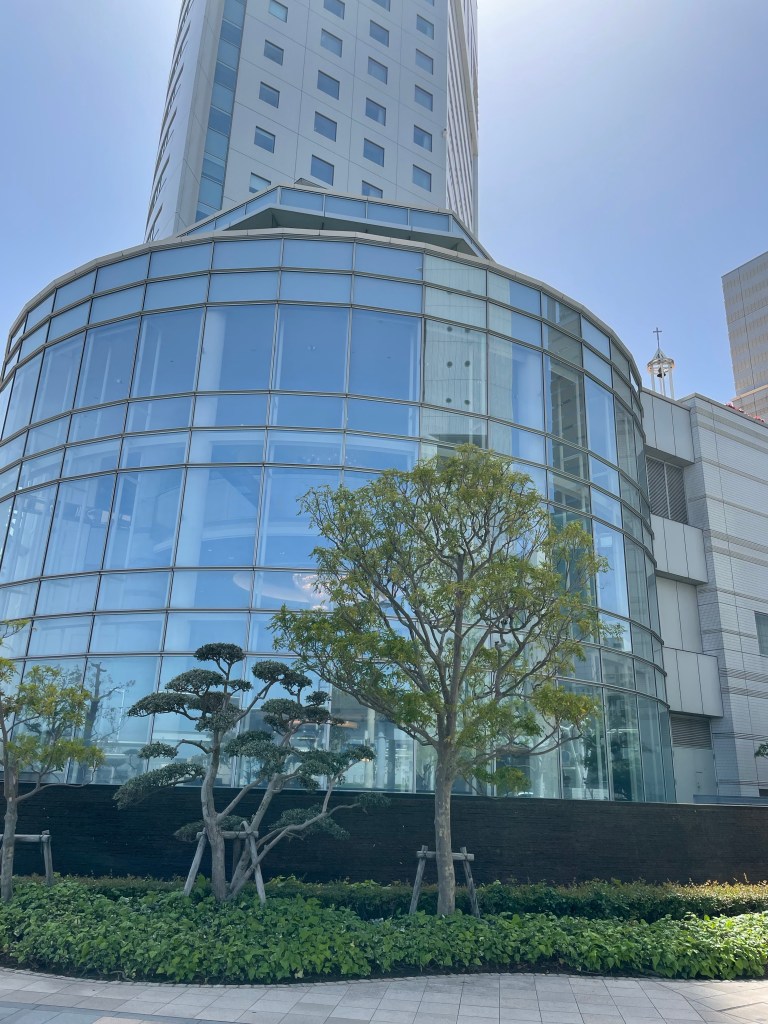
Daniel spots a building with a cross and a bell on top of it. I tell him not to get too excited about it; it’s probably a wedding chapel, rather than a church per se. Note, for instance, the chandeliers inside the main building. Combine that with the view from the harbor, and the well-tended trees out in front, and it looks like a pretty good place for a wedding – or at least, the wedding photoshoot.
We’d been advised that we could grab transportation from the station, but considering that the station was already half the distance to the shopping district, we decide it’s hardly worth it. After all, the journey is part of the destination, right?
Indeed, we arrive there a little sooner than I expect to, at which point, I haul out the map we’d gotten at guest relations in order to check and make sure we’re actually where we want to be. A friendly local offers to direct us somewhere: “Are you going to any place in particular?” We express our thanks for her consideration, but we’re in no need of her assistance, since we are in fact where we want to be.
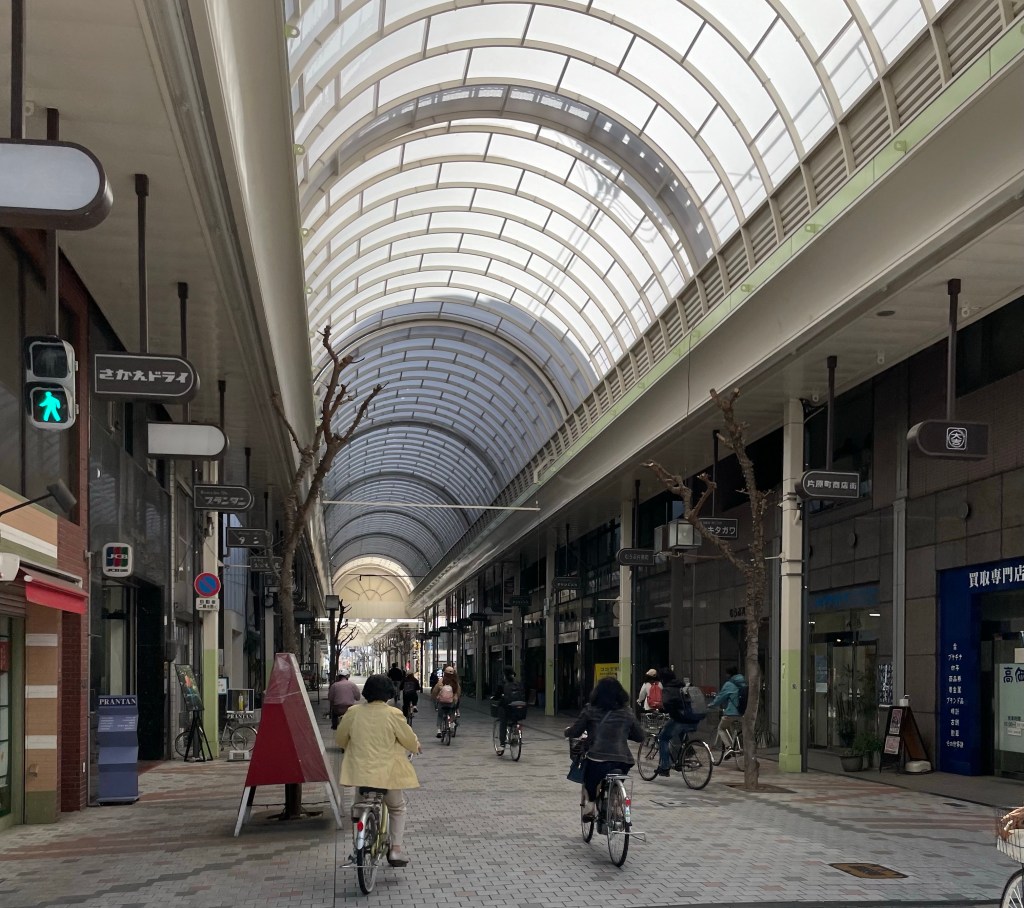
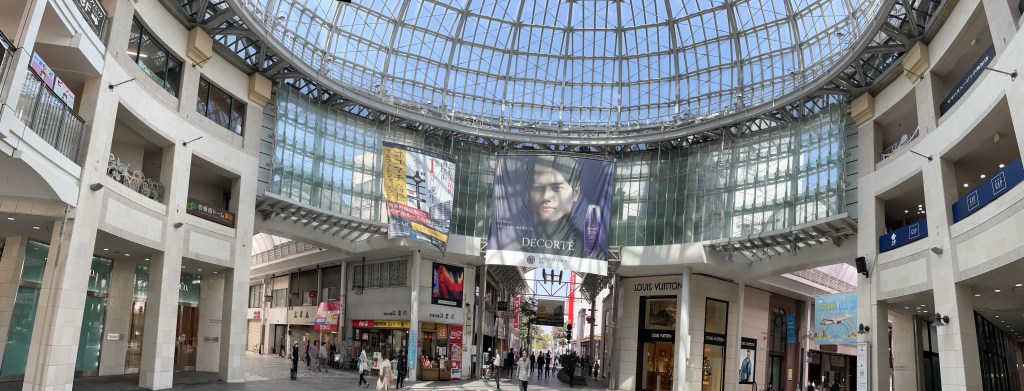
We’re being passed on both sides by bicycles, but it’s much less disconcerting than back in Korea, where we had to look out for cars and motorbikes. Even now, if I hear a motor behind me as we’re walking along, I get nervous. These passages are decidedly wider than in Kitakyushu, allowing for such traffic.
And here is part of the reason I get confused about shopping arcades going on forever; one just blends into the other; Hyogomachi and Kataharimachi are considered as separate shopping centers, but they just meet here and blend into each other.
We wander what seems like endless rows of various shops, here and there, in one arcade or another. At some point we come to a bus/train station, and stop for a sit down. As in Kitakyushu, there’s a piano situated there, and as we rest, one player finishes her piece, and a new pianist takes over from her. There is no applause when one finishes, nor is there a hat or other receptacle for tips; these people are just playing for the sake of playing (unless, of course, they’re employed by the station itself).
From the station, we try to make our way back to the shopping arcades, since there is still plenty that we haven’t been to (obviously), we take a different route back, which leaves us outside of the typical sheltered area. Daniel points out a few of those tall pine trees that give this city its name.
And while the sign is the wrong color, I thought you would be amused to see the name of this beauty salon (heck, you might even be amused by the fact that it’s in blue, not purple)
I have yet to spot a vending machine even so much as selling beer (like I did on my last trip – not that I was interested then or now, but the absence is somehow conspicuous), but at least this one offers something a little different than the usual beverages.
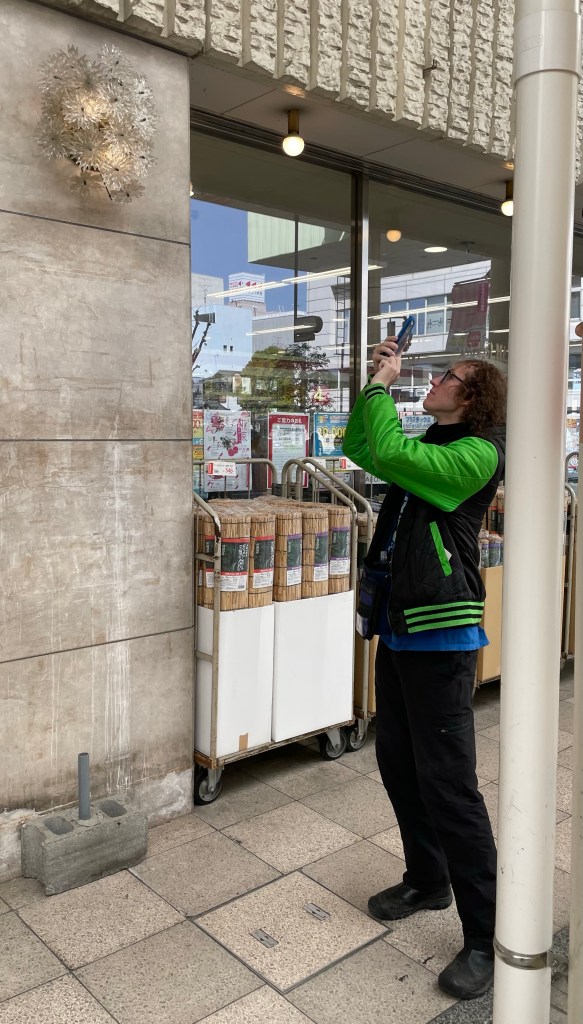
From time to time, I remind Daniel of how much he liked to take pictures of – and collect – lights, noting that he’s not the same kid he once was. Well, every so often, he reminds me that the little light-loving kid is still there; he just doesn’t make an appearance as often as he used to. But this sconce brought him out for a moment.
Now, Daniel and I have already picked out a place to sample the local specialty of sanuki udon, but this place caught my eye as well; and given the name, you (and only you, since I think we’re the only ones I know who have seen and remember that movie) might ask why the place sells karaage, rather than ramen.
It may be the doleful piano music piped in from overhead, or just remembering the scene where the yakuza shushes his girlfriend with “shhh… my last movie is starting,” but as we get to the end of this southernmost shopping arcade, I’m momentarily overwhelmed with a sense of melancholy. We’ve reached the end; and now, we need to make our way back ‘home.’
But not without getting a bite of the local specialty.
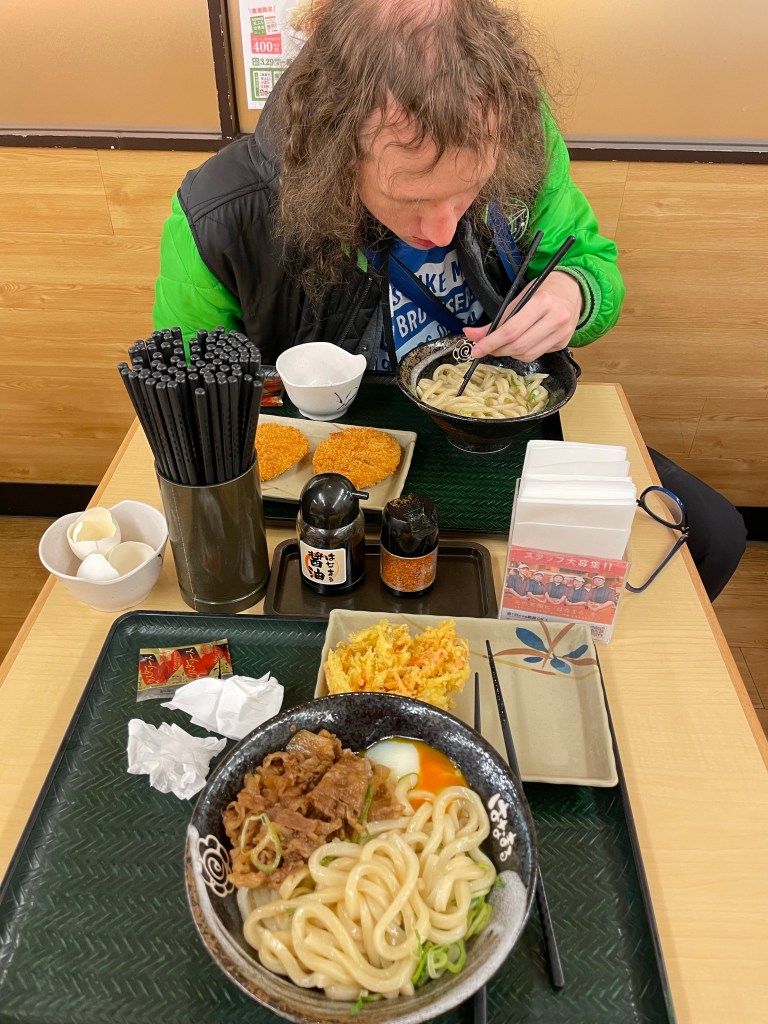
This time, we order mediums, rather than kids’ sizes; we’re going to need something substantial to sustain us on the way back, as we’ve really only travelled the length and breadth of the various arcades. And apart from a few gachapon shops, we haven’t really gone into any of the stores along the way.
We’re each given an egg to crack into our udon. I’m astonished that it’s stone cold, but on reflection, it makes sense; if they were to keep the eggs warm as they waited for a customer, they might well boil hard (not that I would have a problem with that). They’re also easier to crack if they’re not fully boiled. We’re also each given a packet of Worcestershire sauce to place in the soup; it seems like overkill, in terms of flavor, but when we’re here, we might as well do as the natives do.
Although… I’ll never get used to the Japanese custom of slurping ones noodles. I know it’s meant to cool them, which makes perfect sense, but your average megane-ko is going to get her glasses spattered with soup if she’s not careful.
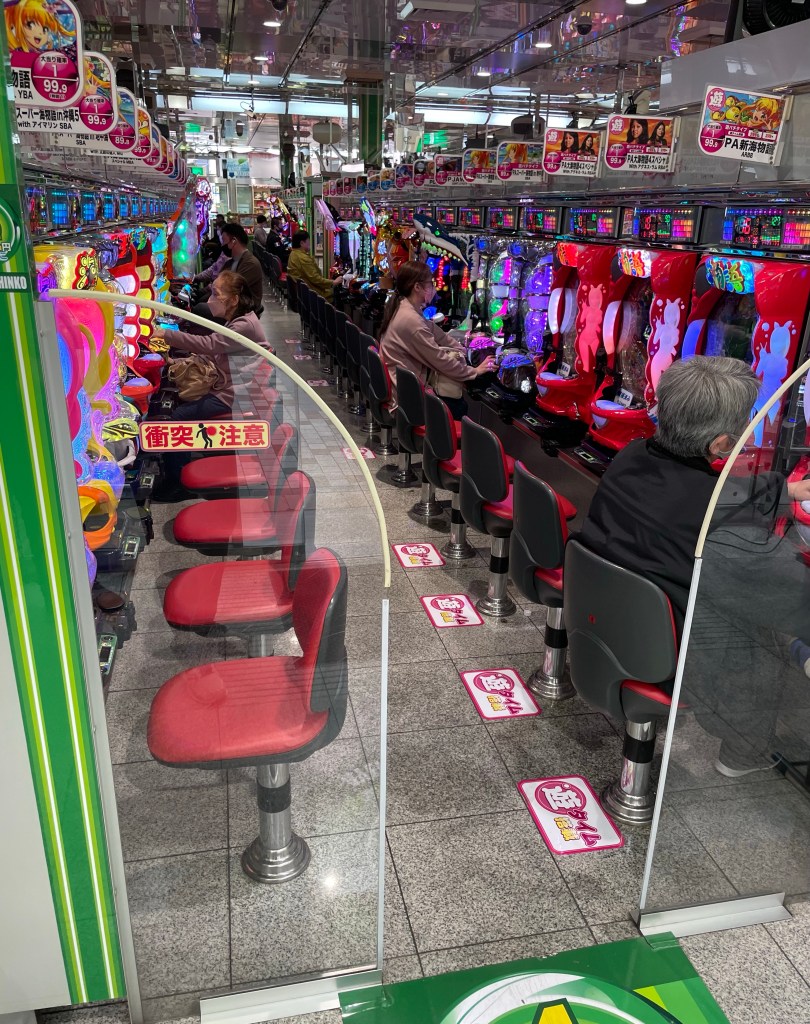
We actually don’t bother going into too many shops on the way back either (there’s not much we want for ourselves, and apart from Kris, we’ve no real idea what to get anyone else), but I have to get at least one picture of pachinko parlor.
We’re surprised at how hot it is in the parlor. Loud, we expected, but this heat? We suspect that they have to do with everything being electronic and digital; all that processing power generates heat, which needs to go somewhere, so it goes into the air. It seems uncomfortable to spend time with, but I guess the patrons get used to it.
We eventually make our way out of the shopping arcade and continue to head north for the harbor.
It seems insufficient for us to be leaving so soon, as the ship is going to be here until nine. But we’re both tired and footsore, and ready to call it a day.
Daniel, in fact, looks as tired as the colors on the fish on the stone to the left. And I can’t say that I blame him.
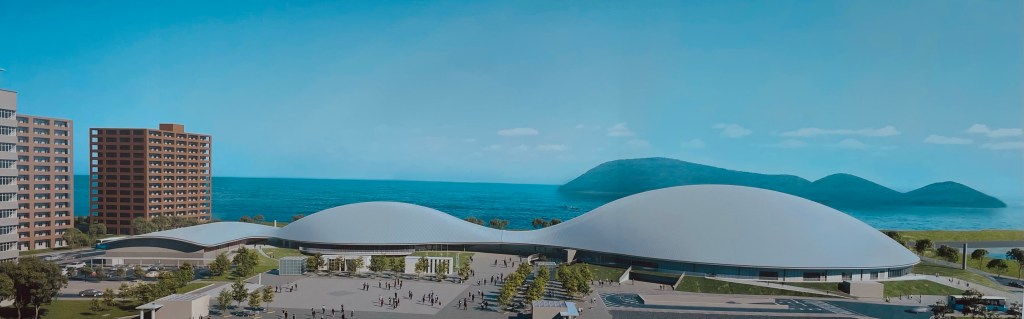
By the way, you might have noticed a flock of cranes across the street from the park shortly after leaving the ship. Not the birds, mind you, but the heavy equipment. It turns out that they’re working on an elaborate new welcome center, to be finished late next year. I don’t expect to ever be back to see it, but there it is… or will be.
So here it is, barely five o’clock; Daniel’s asleep on his bed, and I’m wrapping up this letter for now. Take care, keep an eye on us, and wish us luck; we’re going to need it.
I am Rachel's husband. Was.
I'm still trying to deal with it.
I probably always will be.
View more posts
2 thoughts on “The Journey is the Destination”
What a beautiful and insightful post! I love the idea that the journey itself is part of the destination. It seems like you had a wonderful time exploring Takamatsu. I’m curious, did you notice any cultural differences in the way people interact or navigate public spaces compared to your experiences in other countries?
I’ll be honest; apart from Busan (which we’d just come from a couple days ago), I hadn’t thought about any comparisons as such. As much fun as wandering that city was, dodging motorbikes and the occasional car was particularly alarming. I think I was still dealing with PTSD when the bikes would glide past us.
I also have to admit with some embarrassment that both cities, when we dealt with the natives, were more than able to meet us halfway, linguistically speaking. Of course, they had a financial interest in selling to us, so that may be part of the explanation.









 Letters to Rachel
What a beautiful and insightful post! I love the idea that the journey itself is part of the destination. It seems like you had a wonderful time exploring Takamatsu. I’m curious, did you notice any cultural differences in the way people interact or navigate public spaces compared to your experiences in other countries?
MR W
https://primarytinting.net
LikeLike
I’ll be honest; apart from Busan (which we’d just come from a couple days ago), I hadn’t thought about any comparisons as such. As much fun as wandering that city was, dodging motorbikes and the occasional car was particularly alarming. I think I was still dealing with PTSD when the bikes would glide past us.
I also have to admit with some embarrassment that both cities, when we dealt with the natives, were more than able to meet us halfway, linguistically speaking. Of course, they had a financial interest in selling to us, so that may be part of the explanation.
LikeLike