You may have noticed from the picture I sent you this morning while en route that the sky was dark and cloudy. That was not because it was early in the morning in the sun had risen (although admittedly, it was early in the morning, but the sun was, theoretically, up), but because it was raining. Indeed, by breakfast time, it was so crowded upstairs that we were compelled to find a table outside, which, while it was under shelter and thus dry, came within a hair’s breadth of having the water already falling on deck seeping under our feet.
It’s an unfortunate thing to have to acknowledge, but it’s amazing how the weather in port can influence the traveler’s opinion of the place, despite the fact that this is one thing that is singularly out of the town’s control. I’m sure that I’ll think of Kitakyushu more fondly, for instance than, say, Akita, simply because of how pleasant the weather was for walking about in. It’s not fair to Akita, but that’s how it is; no second chances for first impressions.
The good news is that supposedly it will clear up and become sunny; well, we’ll soon see about that. For now, I’m prepared for the drizzle with my windbreaker and Korean baseball cap.
***
Our guide for today, Keiko-san, introduces herself as a ‘genki,’ or energetic type, and vows to ensure that we stay as energetic as she is for the duration of the day. To that end, she advises us to watch our step as we go about our tour; ‘dojikko,’ or clumsy girls, may be considered cute in manga and anime, but not advisable to aspire to in real life.
As we drive to the ferry to Miyajima, Keiko-san explains about Shinto and Buddhism. There are 80,000 Shinto shrines throughout Japan, compared to 50,000 convenience stores (and that’s with at least three major competitors – 7-Eleven, Family Mart and Lawson). These are places for celebrations, such as New Years, baby dedications and the like. By contrast, Buddhism has a sober, somber atmosphere to it, being the place where most Japanese go for their funerals. It would seem that the expression I’ve heard about Japanese is true: born Shinto, married Christian, and buried Buddhist.
Keiko talks about the wildlife on Miyajima; the deer are tame, yes, but wild is wild, so don’t get too friendly.
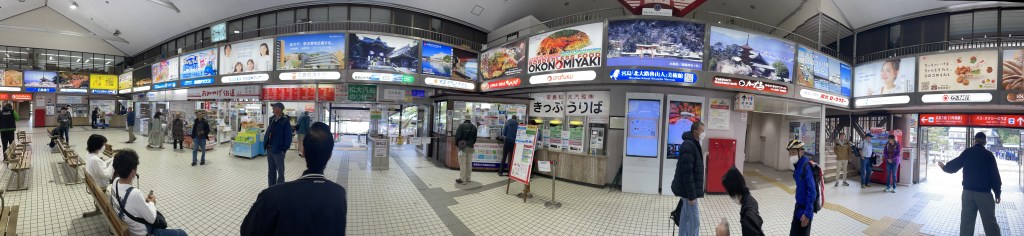
Inside of the ferry terminal… well, almost inside.
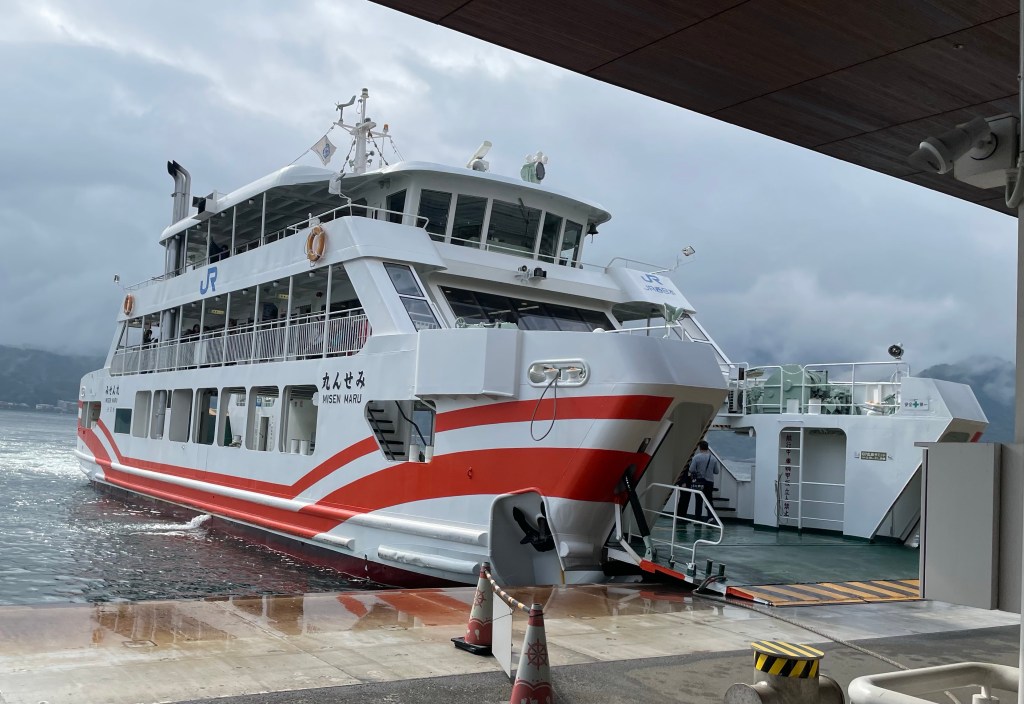
The boat itself looks quite familiar. Daniel compares it to a cross between the Miller Ferry and the Jet Express. Weird to see that the boat is run by Japan Rail, though…
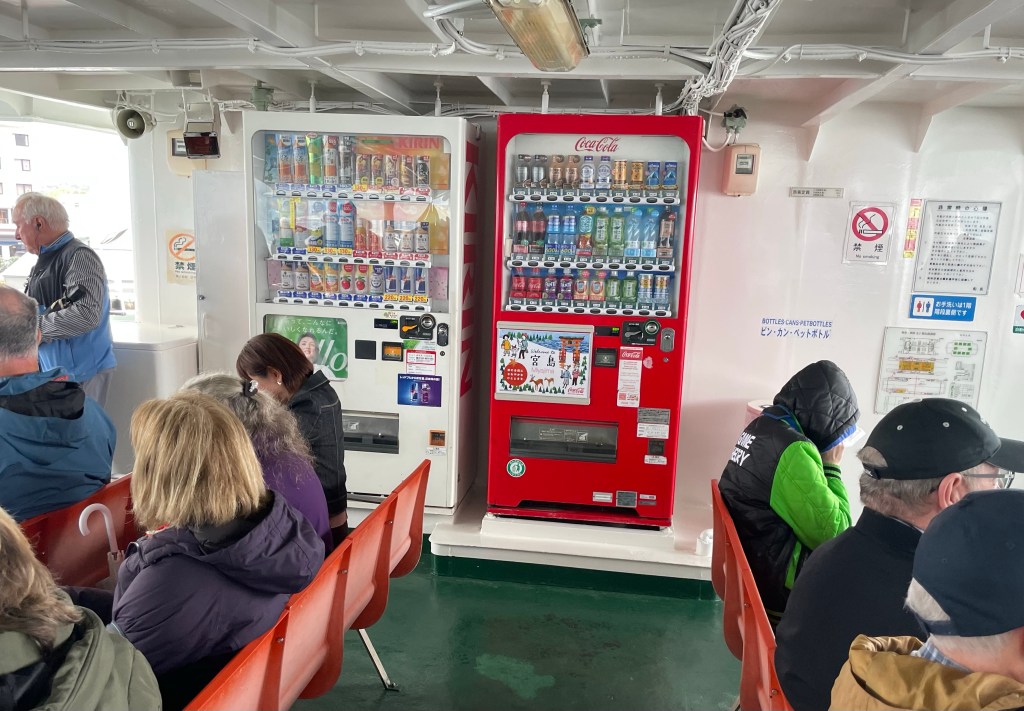
However, it does have its differences, among which include the existence of a third deck (complete with vending machines).
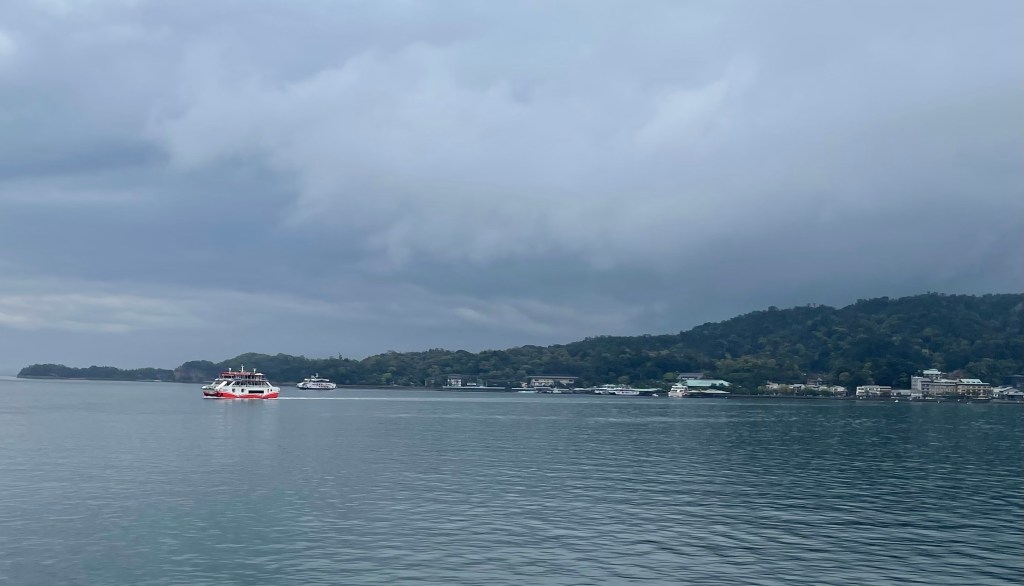
It’s also a much shorter ride; only about ten minutes from the mainland to the island. And it’s by no means the only one plying the waters between the two.
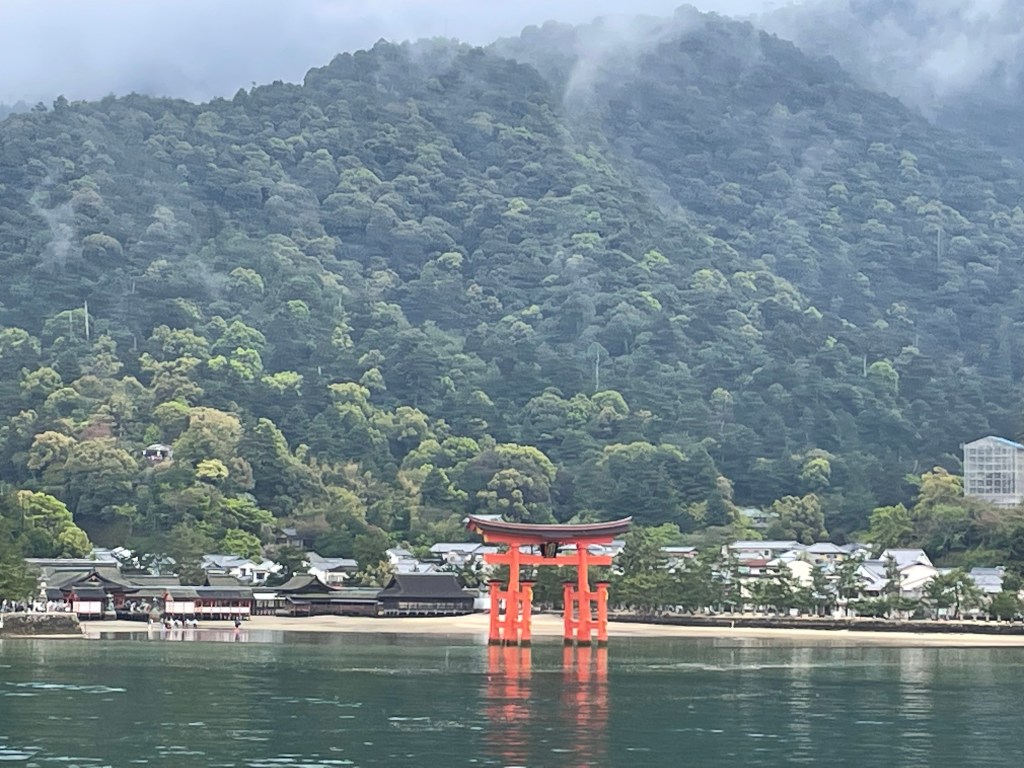
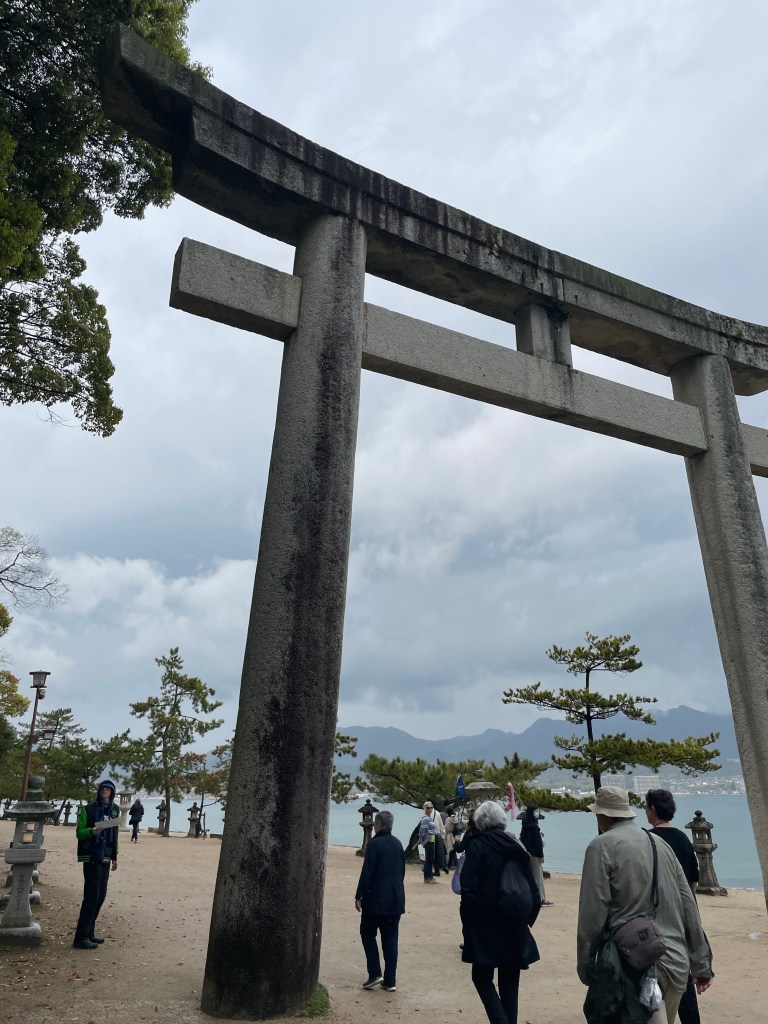
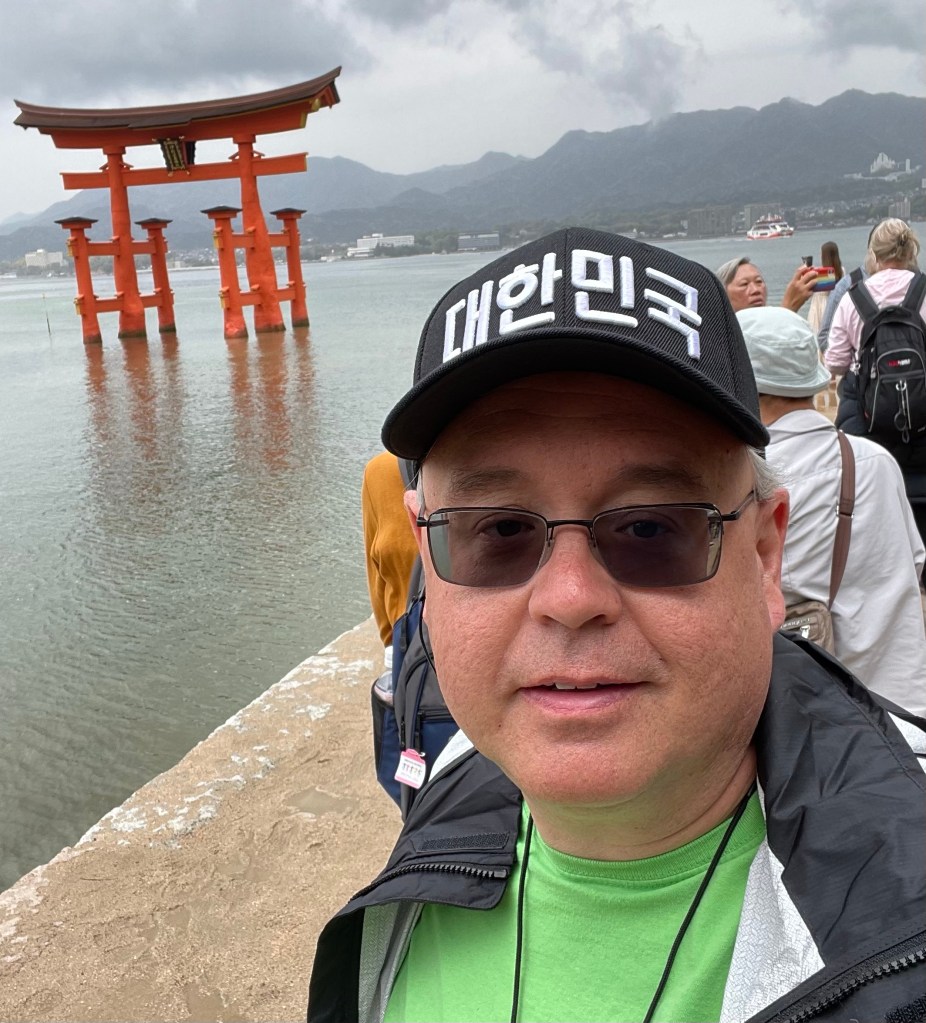
Soon, the Great Torii comes into view.
At the Miyajima island terminal. Considering that it’s so much closer to the city – and a bigger city than either Toledo or Cleveland – it shouldn’t be a surprise that it’s a bit more commercial than Middle Bass (or even, possibly, Put-in-Bay).
I’ve been told that the deer are friendly, but to be honest, they seem a bit more indifferent to tourists than friendly as such.
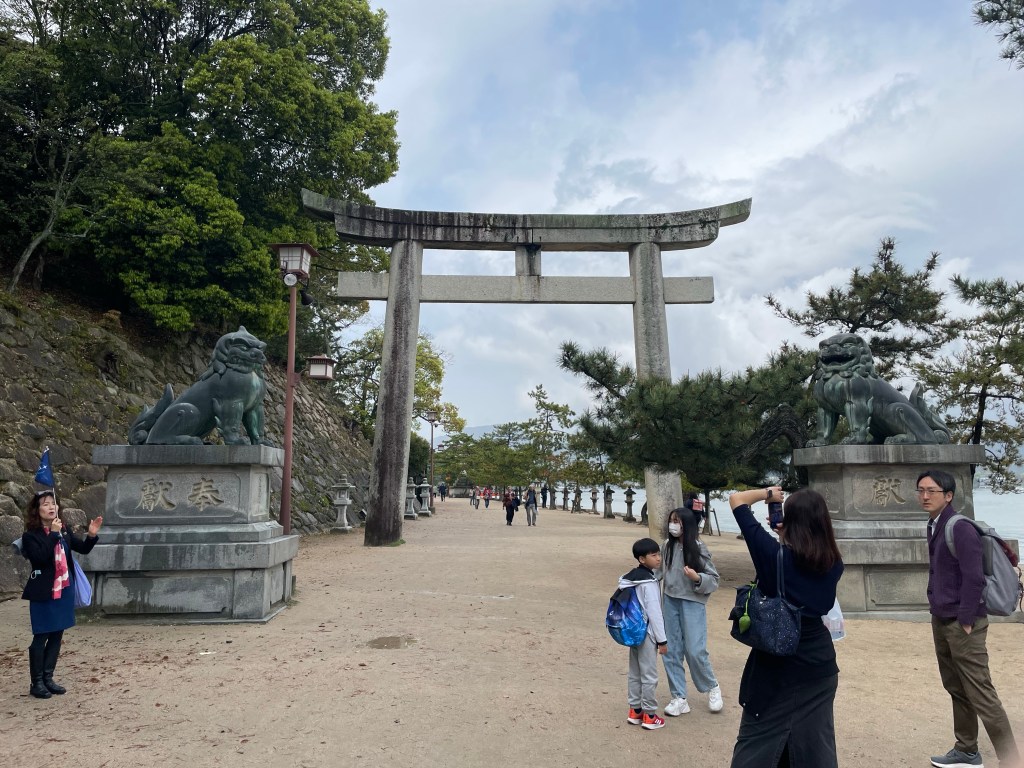
The stone gate, flanked by a pair of guardian dogs. Keiko-san challenges us to identify which is male, and which is female; believe it or not, the one with its mouth open is the male (uttering the first syllable of the Japanese alphabet, ‘a’), and the female’s mouth is closed (expressing ‘n,’ the final syllable). Between the two of them, they encompass the beginning and the end of the alphabet, and of life itself (the baby’s first cry versus one’s final silent exhalation).
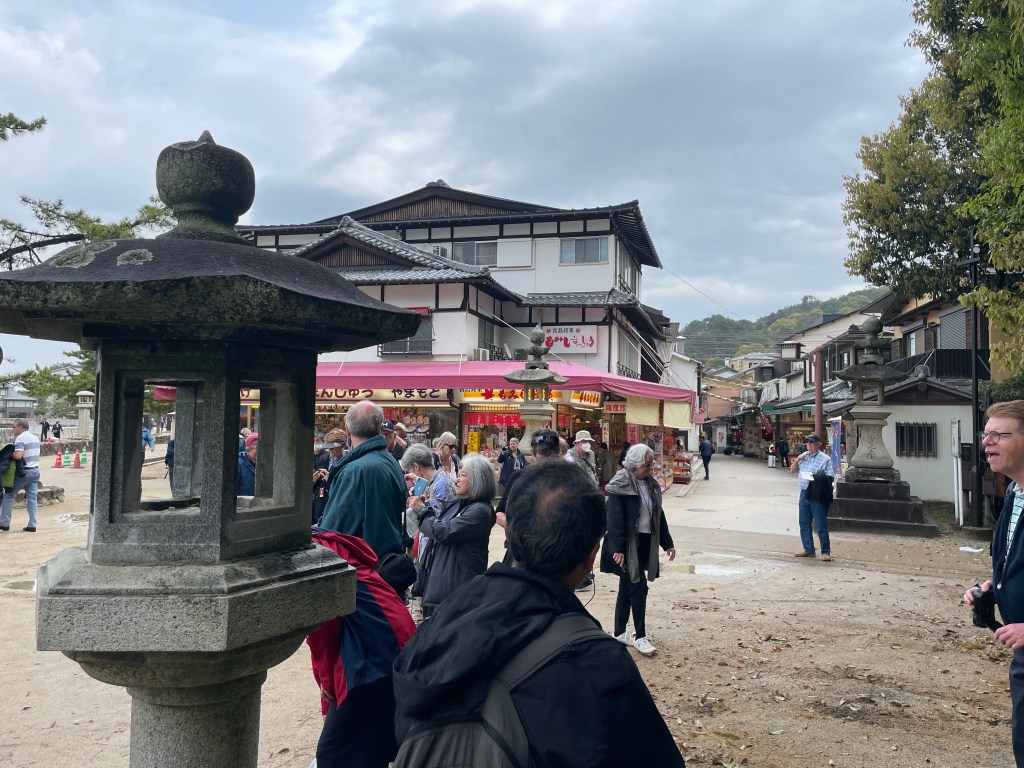
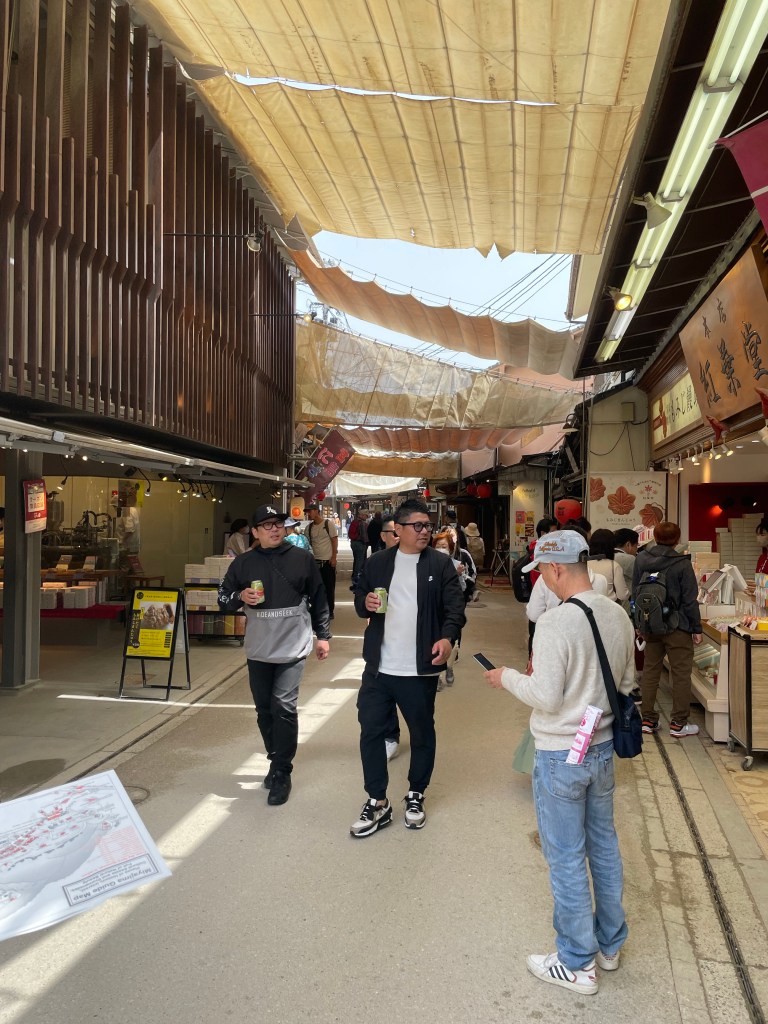
Of course, the other, more commercial side is just as interesting in its own right.
We’re supposed to bow to the spirits as we pass through the torii gate. Daniel refuses to offer homage to the spirits; why pay respects what you don’t believe in?
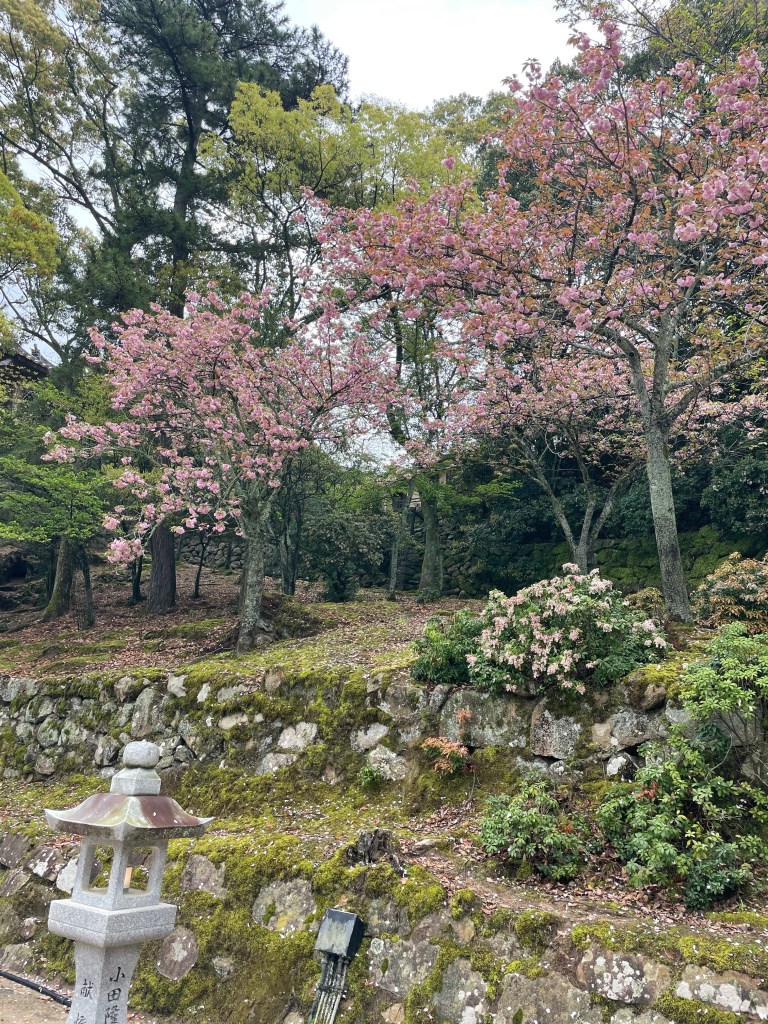
Sakura blossoms along the road.
I’m not generally one for selfies, you know, but the occasional ‘I was here’ shot seems necessary, don’t you agree?
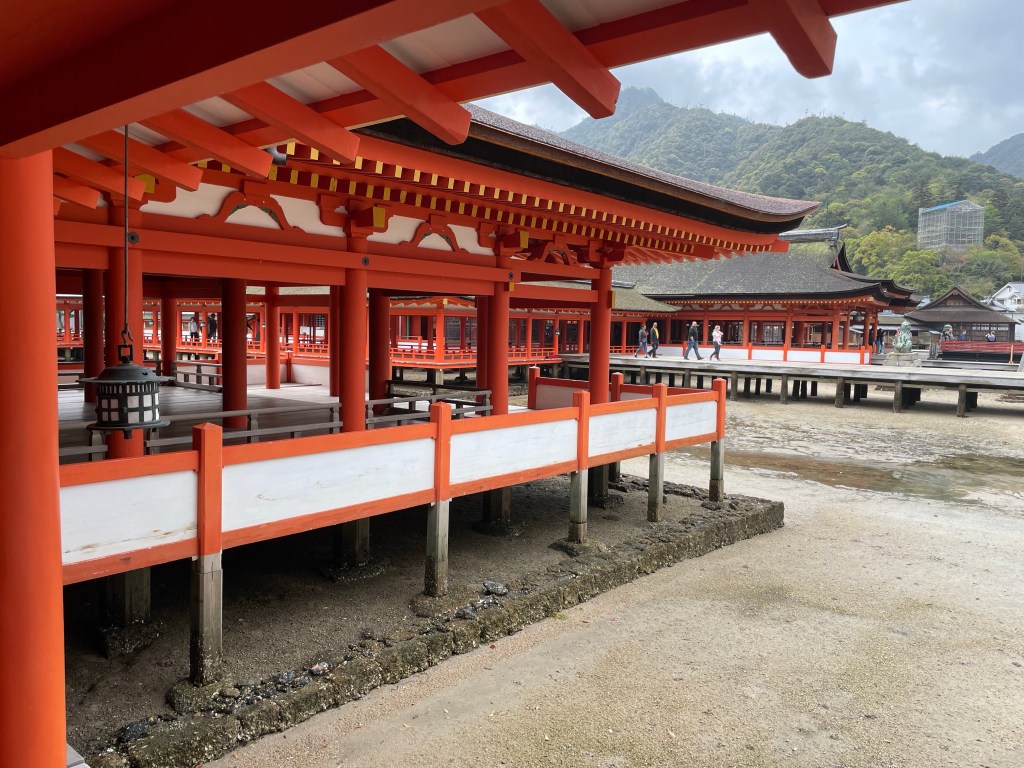
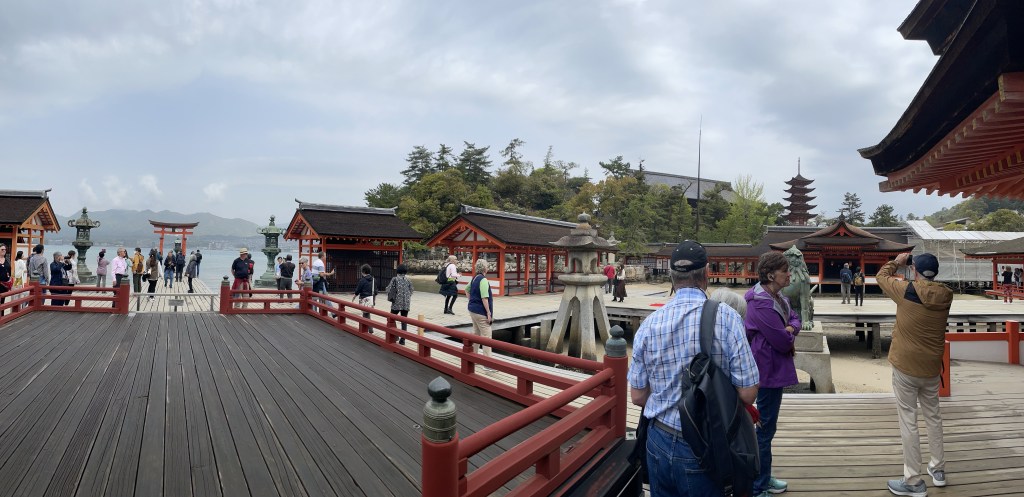
As we enter the Great Hall, Keiko-san explains the significance of the color vermilion. The color red is meant to serve as the color of blood, which scares away the oni or demons. Gold trim is also auspicious for what might seem to be obvious reasons, representing prosperity and the like. And you’ll notice that the shrine is on stilts, keeping it above the tide when it comes in.
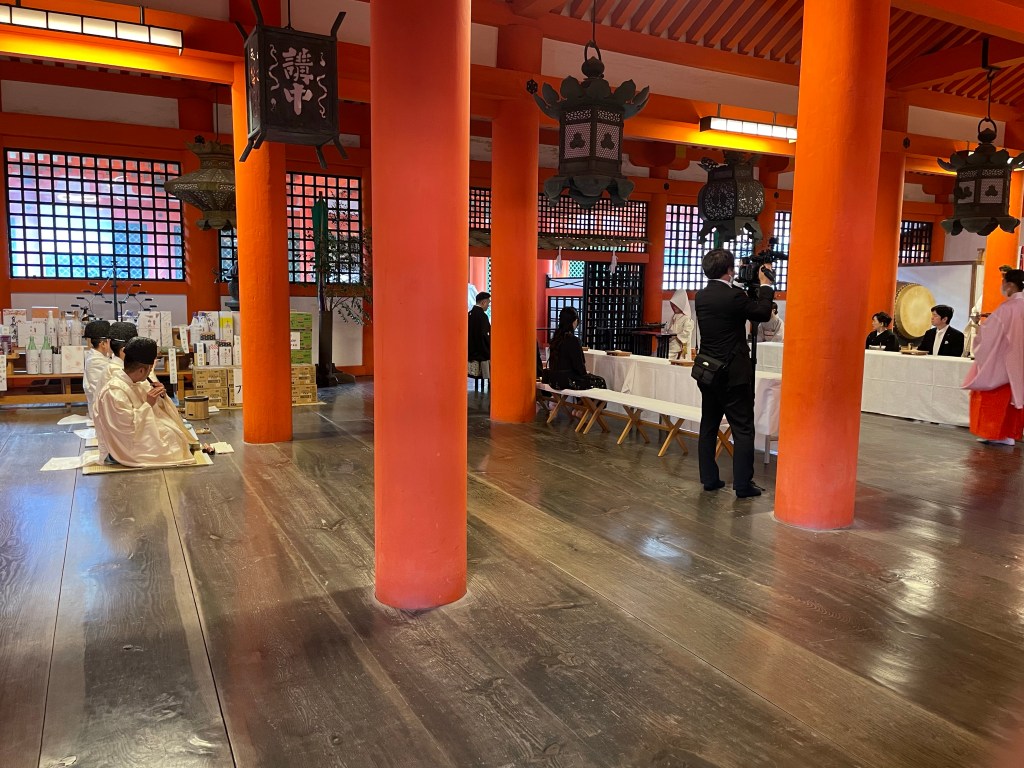
We expect to be able to offer homage to the spirit at the main great hall, but find ourselves encountering an ongoing wedding. We’re allowed to take pictures, but we understandably need to be very quiet about it.
From the Great Torii to the Senjoku Temple; Shinto and Buddhism in a single picture.
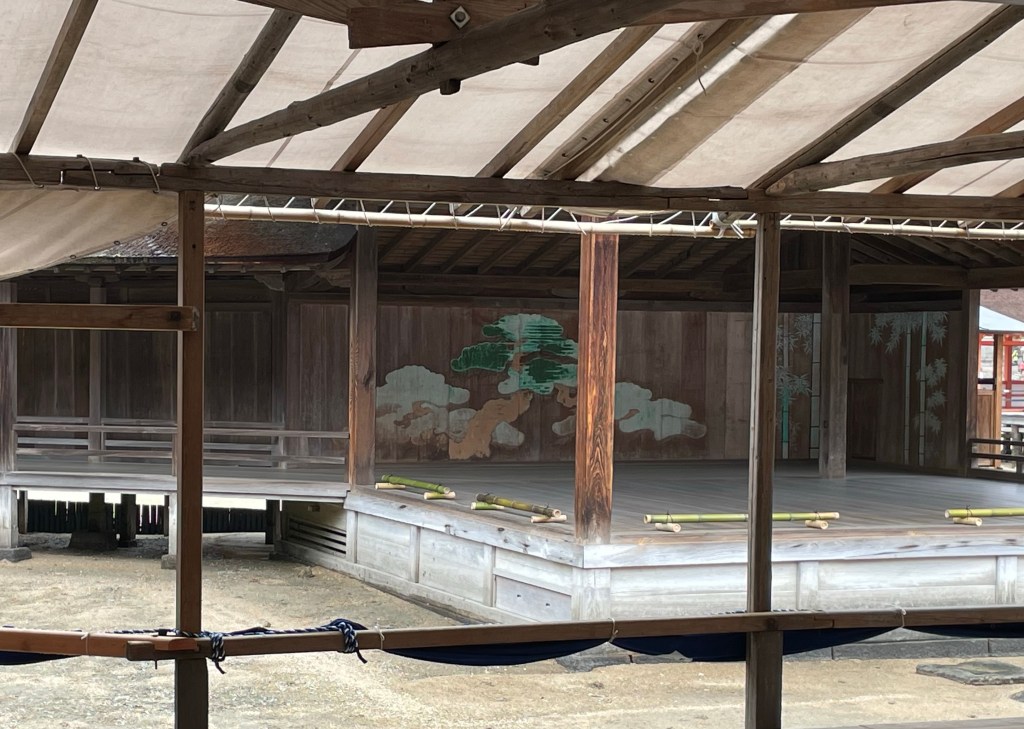
A Noh theatre within the Great Hall complex. It’s still used on several occasions a year.
We exit the hall by the old entrance; the samurai used to visit this temple by boat through the torii gate and follow the channel here to enter the hall.
Keiko-san sets us at liberty for an hour or so, but offers to guide us through some of the other temples along the way. Daniel in particular is not interested, and I’m already getting a little footsore, so we switch off our whisper devices, and begin to make our way back west, toward the pier.
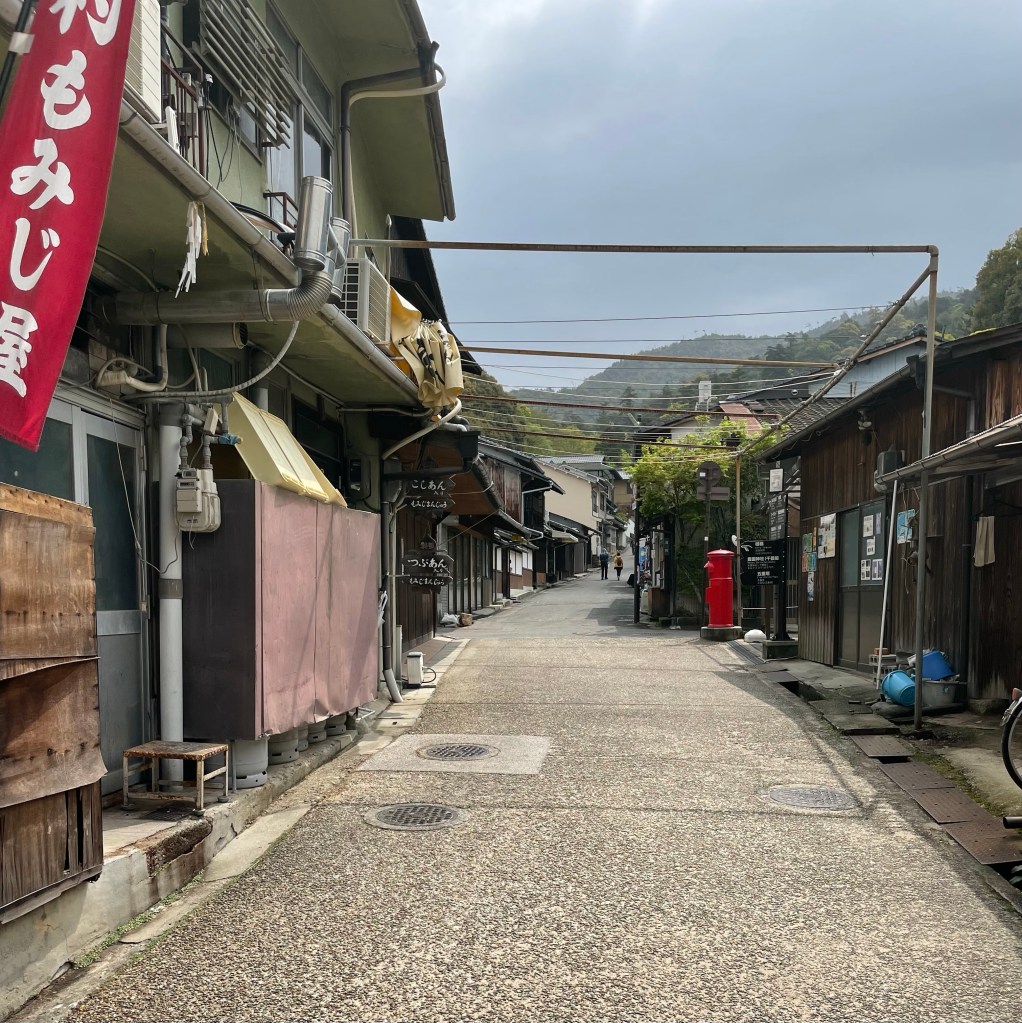
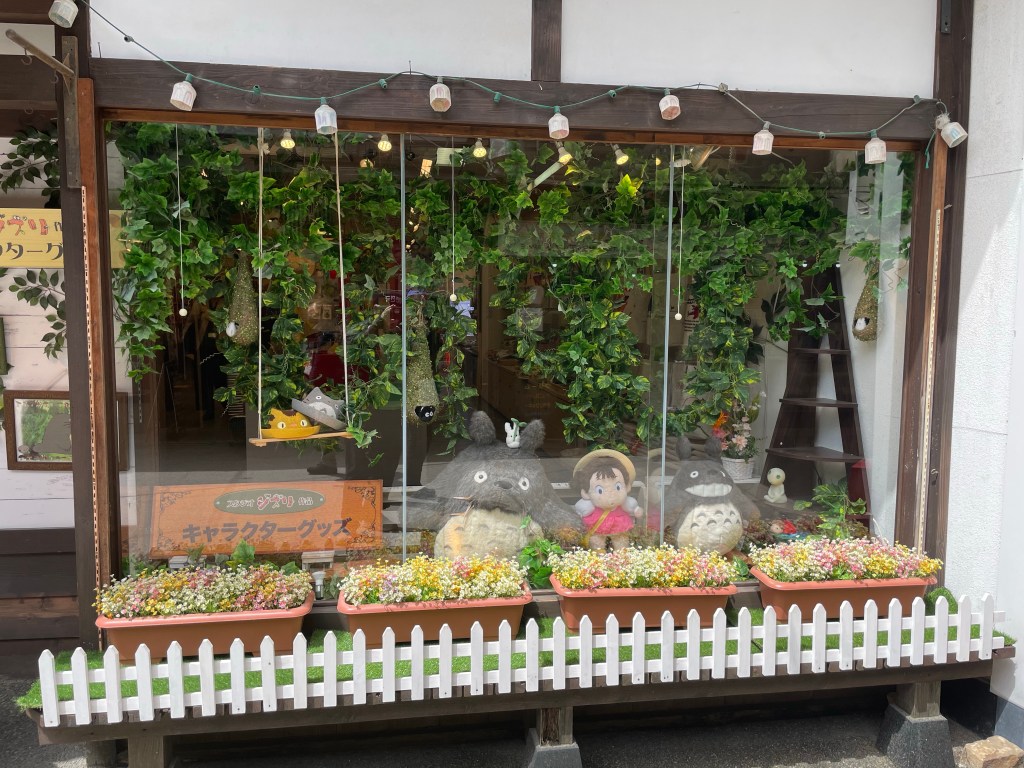
The houses and businesses look very much like they were out of some Ghibli film.
Indeed, some businesses play that Ghibli reference fairly explicitly.
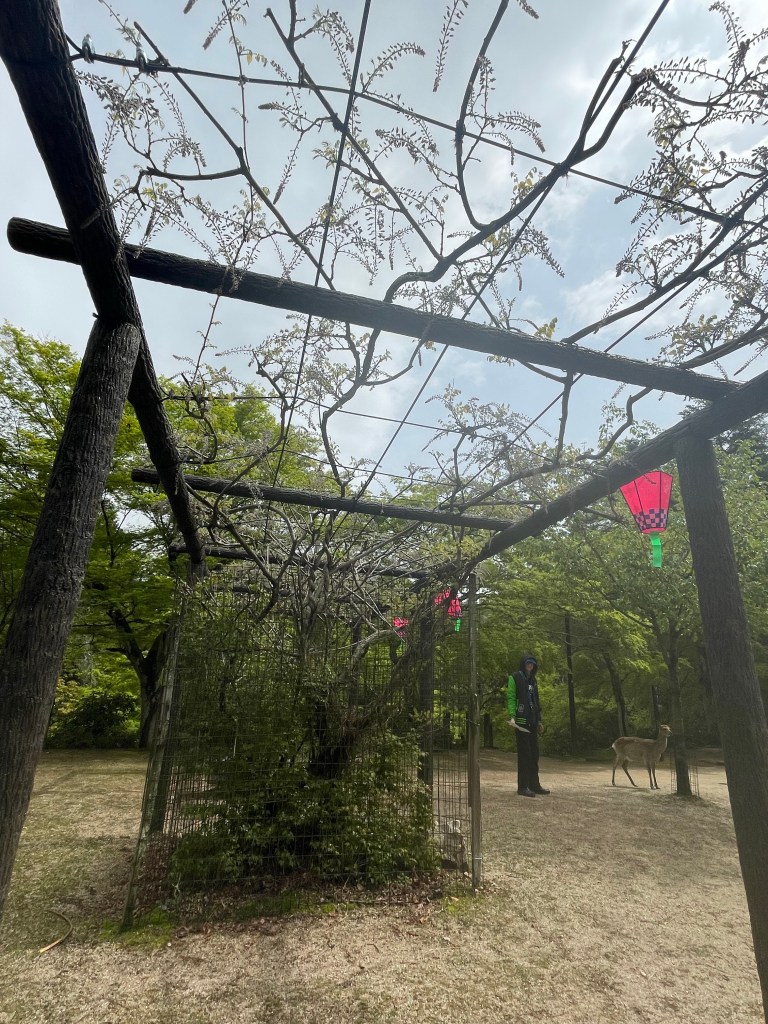
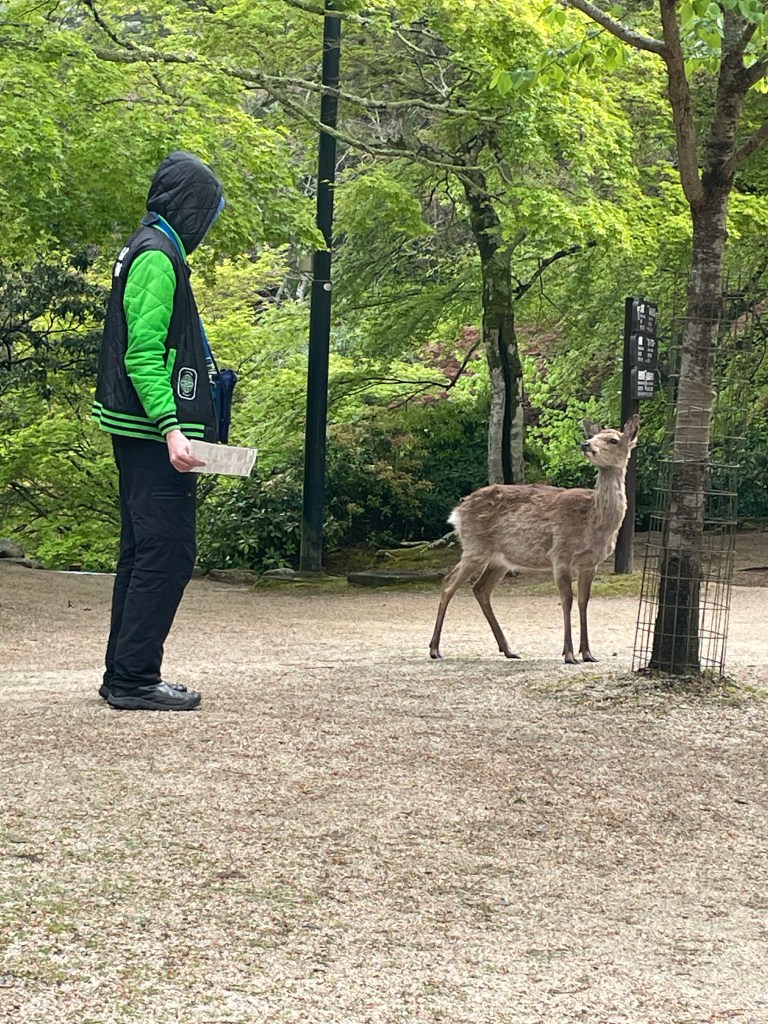
We continue going, uphill, and it starts to look less and less like the waters’ edge. We’re wondering if we’re getting a little lost. But just when we start to wonder that, we come across Momijidani Park. Supposedly, this is the place to find the deer.
In fact, Daniel’s even figured out how to get a deer to notice him.
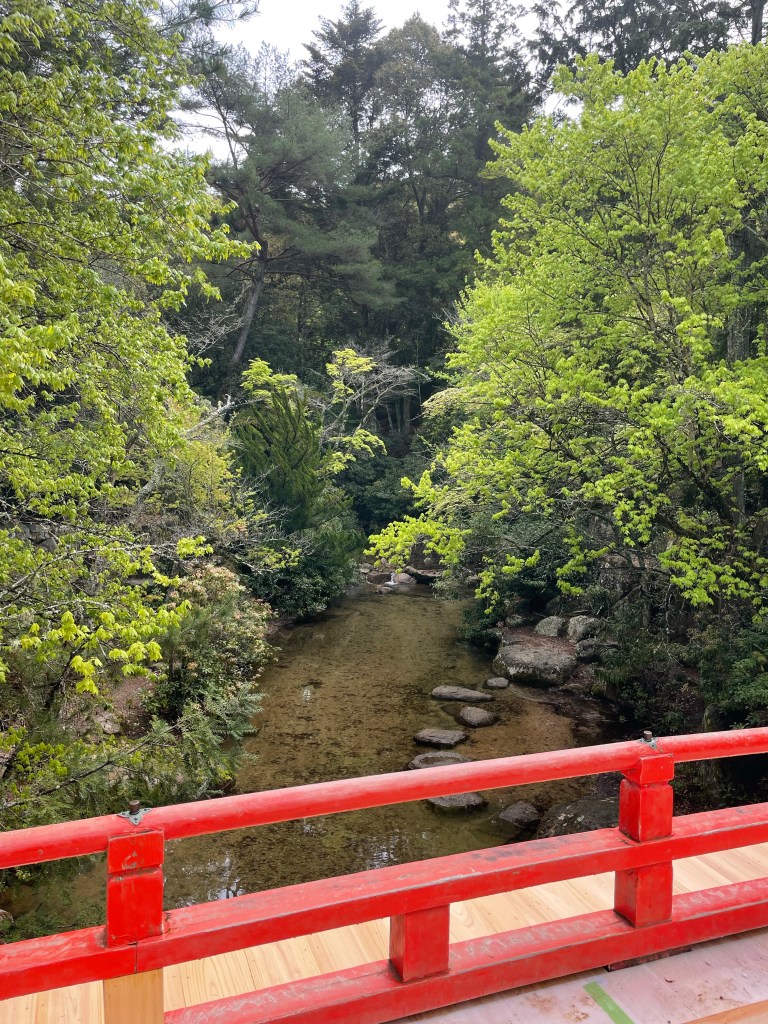
We even find a waterfall, and a newly reconstructed wooden bridge as we make our way out of what we think is the park.
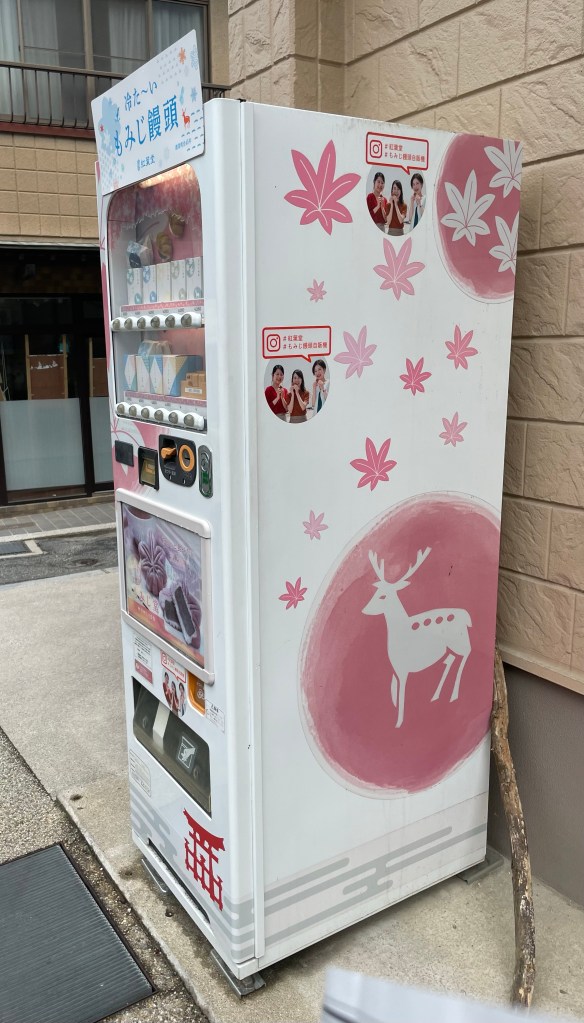
We see the word ‘momiji’ a lot around here. It turns out to mean ‘maple leaf’ in Japanese, and the maple leaf and the deer are common motifs here.
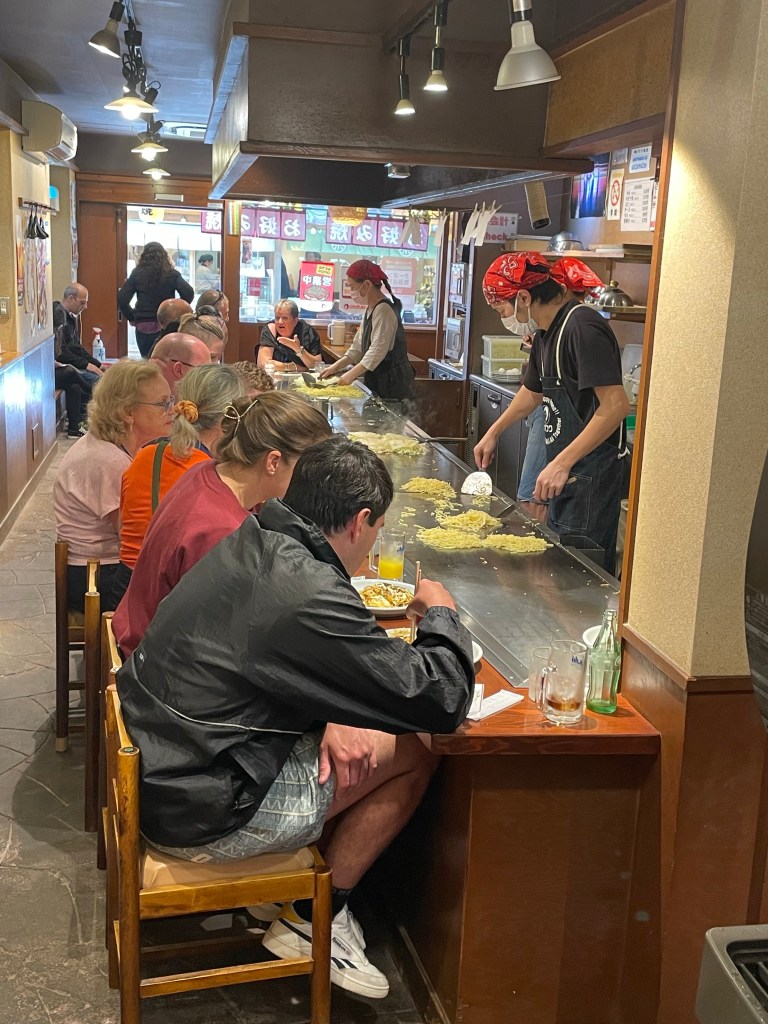
Now, while lunch is provided on this tour, I’m still wanting to try a local version of okonomiyaki. We have to wander for a bit, but we actually find a place.
The only question is whether we can get it before we have to go; it’s not going to be a leisurely meal. Especially if we’re forgotten about; we’re not bellied up to the counter, in front of where they’re preparing them, so it feels like we might go unseen.
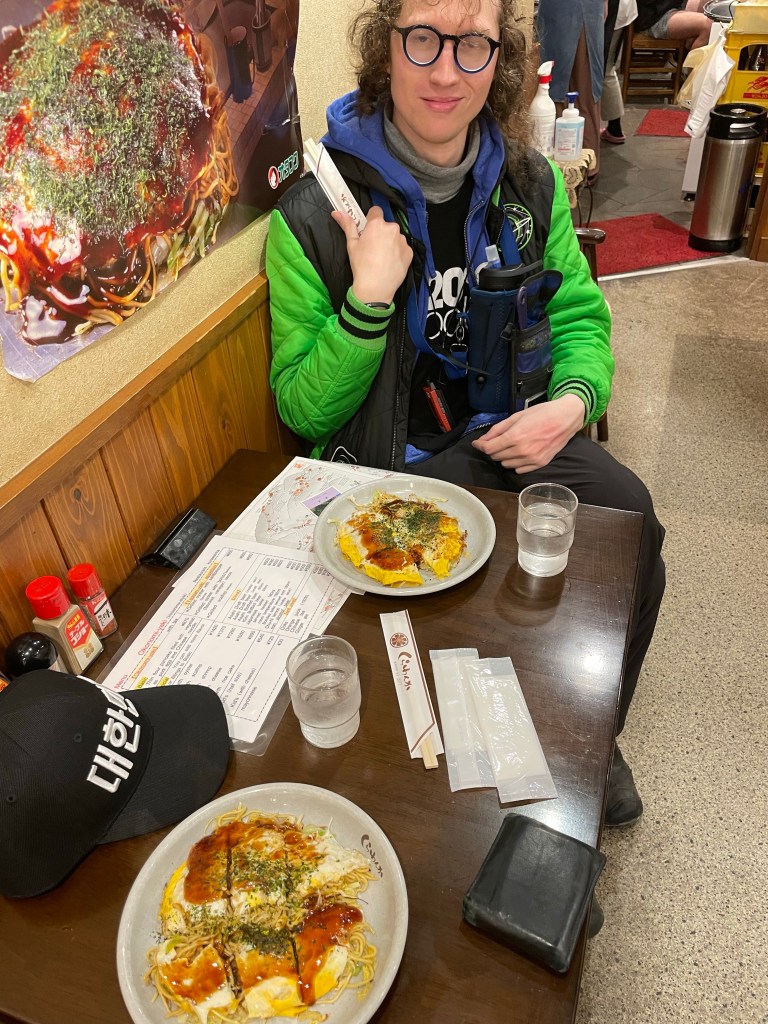
We do make a point of ordering the kid’s size so that we don’t spoil our appetites too much.
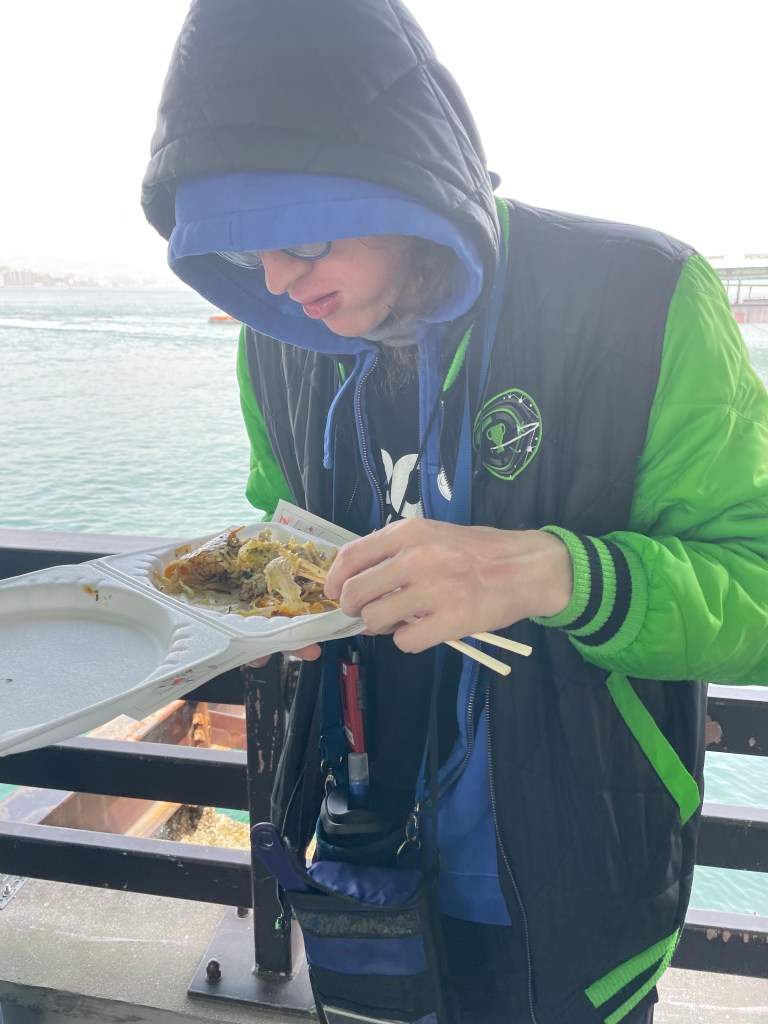
The problem is that they arrive with only ten minutes to spare before we need to be at the pier. Somehow I convince the staff to bring over a box for each of us. We try to shovel the pancakes in, but they basically flip over and fall to pieces in the process; I understand that the Hiroshima style involves keeping the layers separate, but the time crunch and my maladroit handling make all that a bit of a moot point.
Still, they’re delicious; I grab a couple of bites while they’re retrieving my change and while it’s still piping hot. While I’m not a fan of runny egg yolk, it mixes very well with the sauce, the noodles, the cabbage and all the other ingredients. We thank everyone as best we can and, boxes in hand, make our way out, and past the rest of the market stalls, me eating along the way.
Given our chaotic exit, I can’t say it’s done with military precision, but we do arrive at the pier with but a couple minutes to spare. We’re not quite the last ones there, but we’re close enough. Daniel eats his last few bites as we wait at the pier to board the ferry back.
Incidentally, Keiko-san confirms a suspicion I’ve held almost since arriving here in Japan; they simply do not have public rubbish bins here. Folks are just expected to bring their garbage home, and throw it out there. You’d appreciate the ethos, since you took home so much to burn back home, but over here, that’s a bit of a problem, especially since these styrofoam containers can’t be disposed of that way in any event.
However, right off the docks, I find a small container next to a series of vending machines. Most of its contents are empty bottles and cans, but there are a few used napkins and the like, so I squeeze our stuff in. Hopefully, I’ve gotten away with it.
***
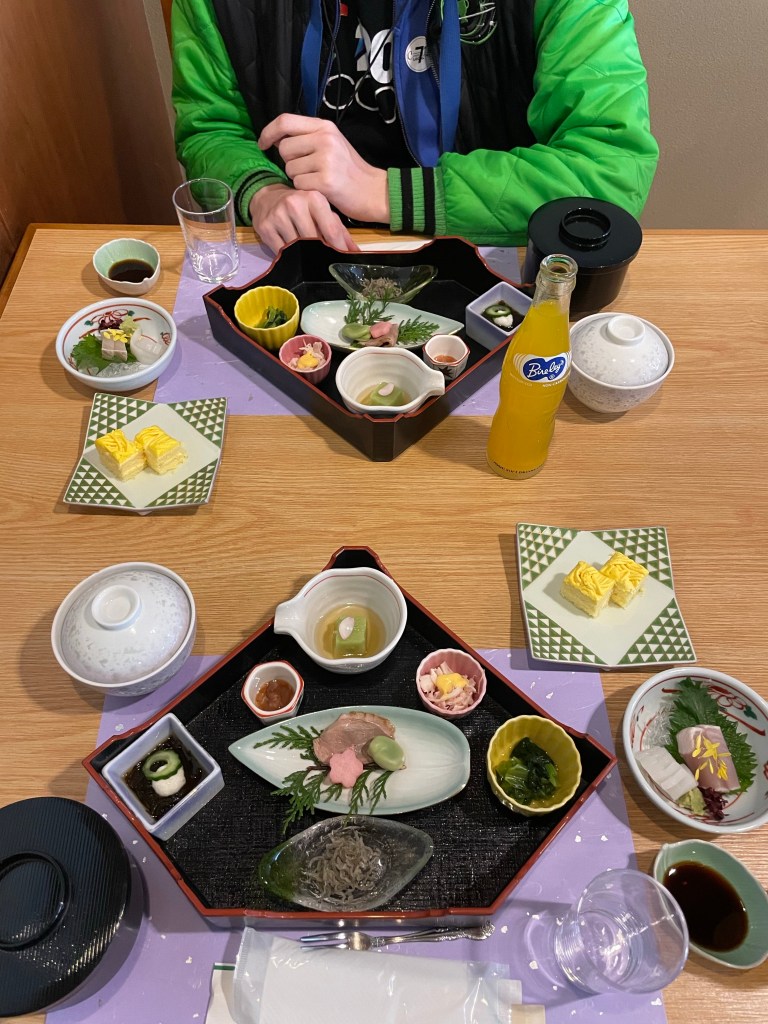
Our next stop is for lunch; and, as artistically arranged as it is, Daniel is having flashbacks to Yamashiro. For his sake, I’m glad we got those okonomiyaki – I almost wish we’d gotten him a full-size one, though. Still, he does eat the chicken, the duck, the rice and the miso, so he does his best.
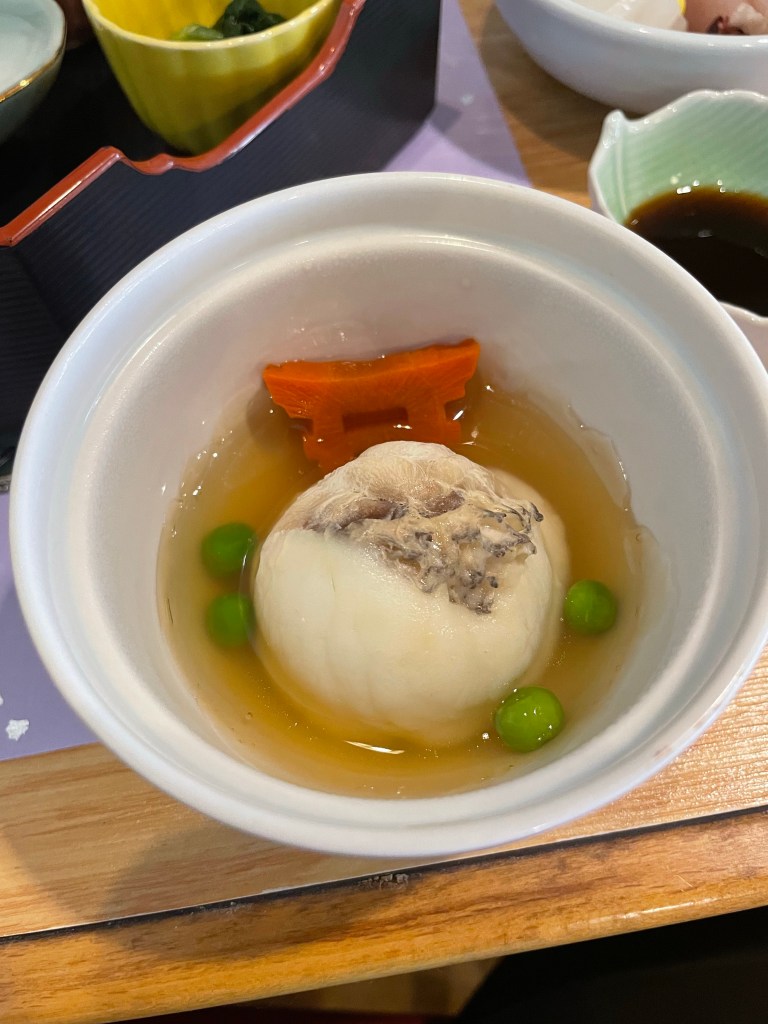
He even tries a bit of this bun, arranged to look like Miyajima. The carrot torii he enjoys, but the bun’s texture (combined with the flavor of sea bream) is a bit much for him. I’ll give him points for tasting it, though.
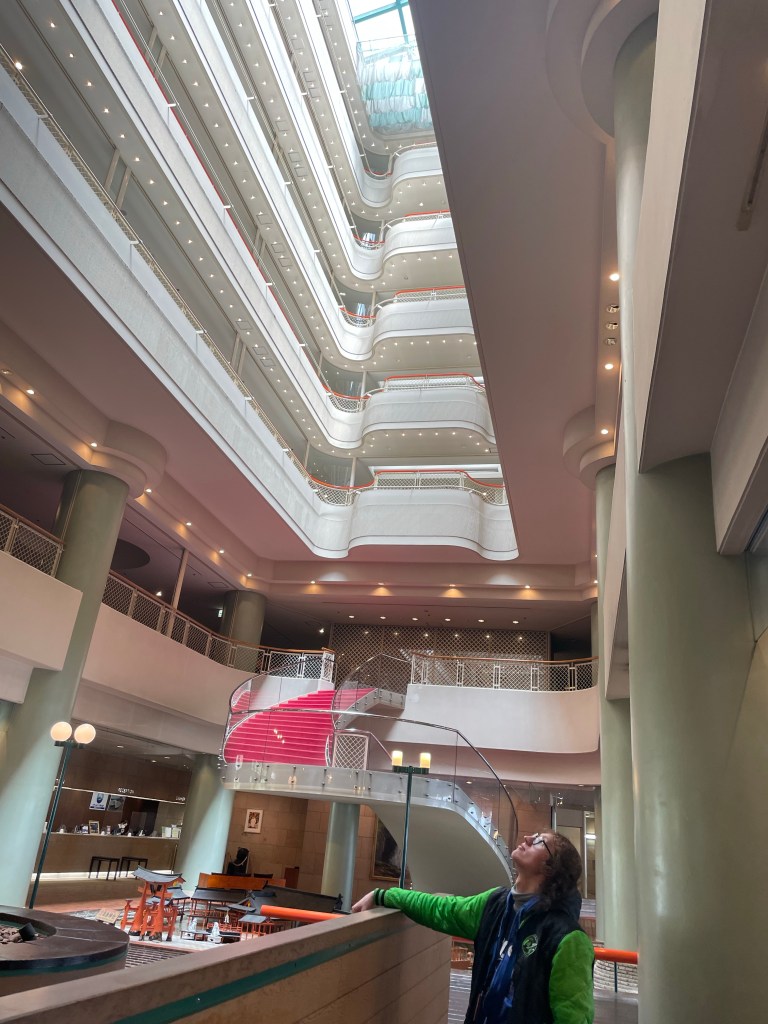
Once done, we head for the lobby to wait for the bus. The vaulted ceiling leaves Daniel missing the Royal Caribbean ships with their soaring centrums.
***
Both Daniel and I nearly (actually? I’m not sure) fall asleep as we make the forty-minute drive the city center… or at least, what used to be the city center.
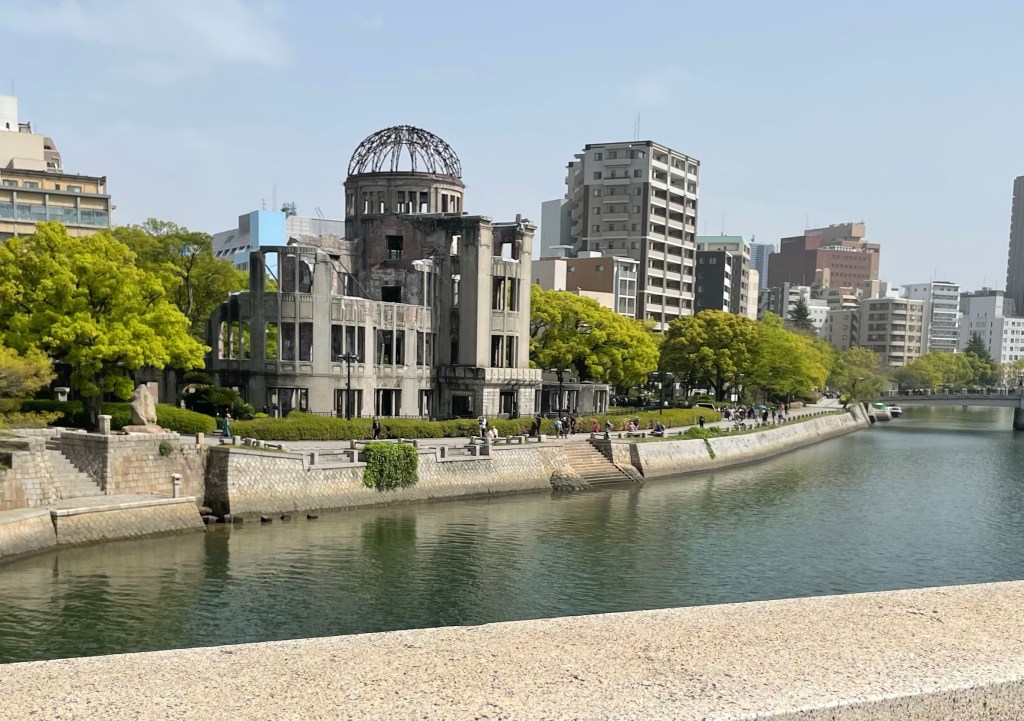
The building at the hypocenter was the prefectural industrial promotion center prior to the war. Having somehow survived the bomb strike (due to its unusual iron framework), it has become a symbol of the destruction that the atom could wreak.
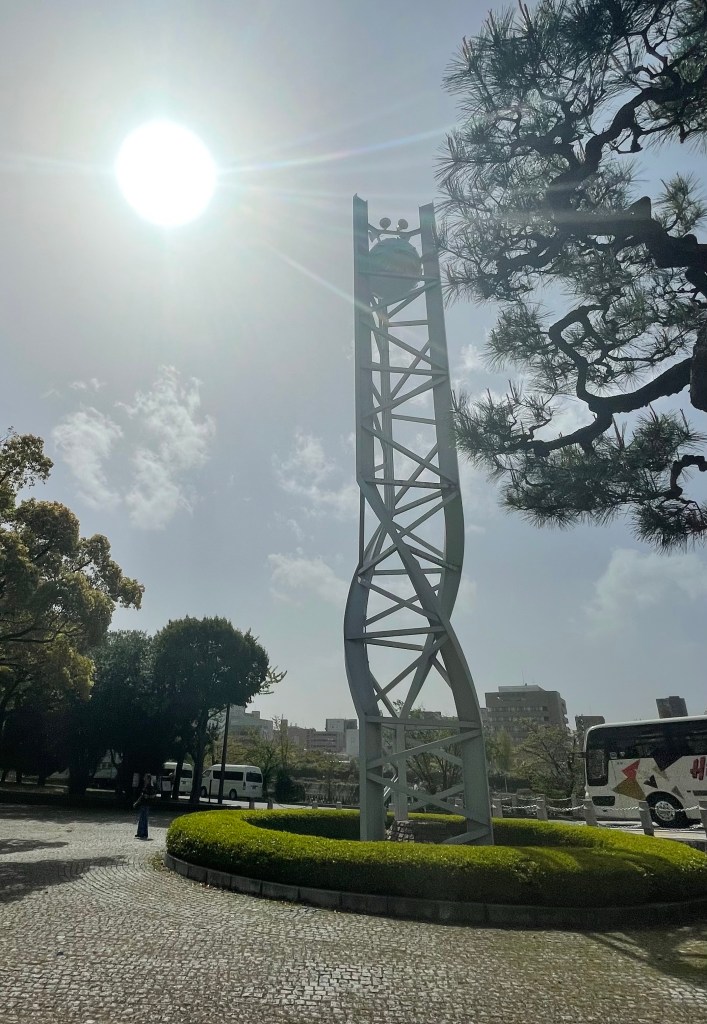
The Atomic Peace Clock, which strikes every morning at 8:15, when the heat of ten thousand suns burst out over the town.
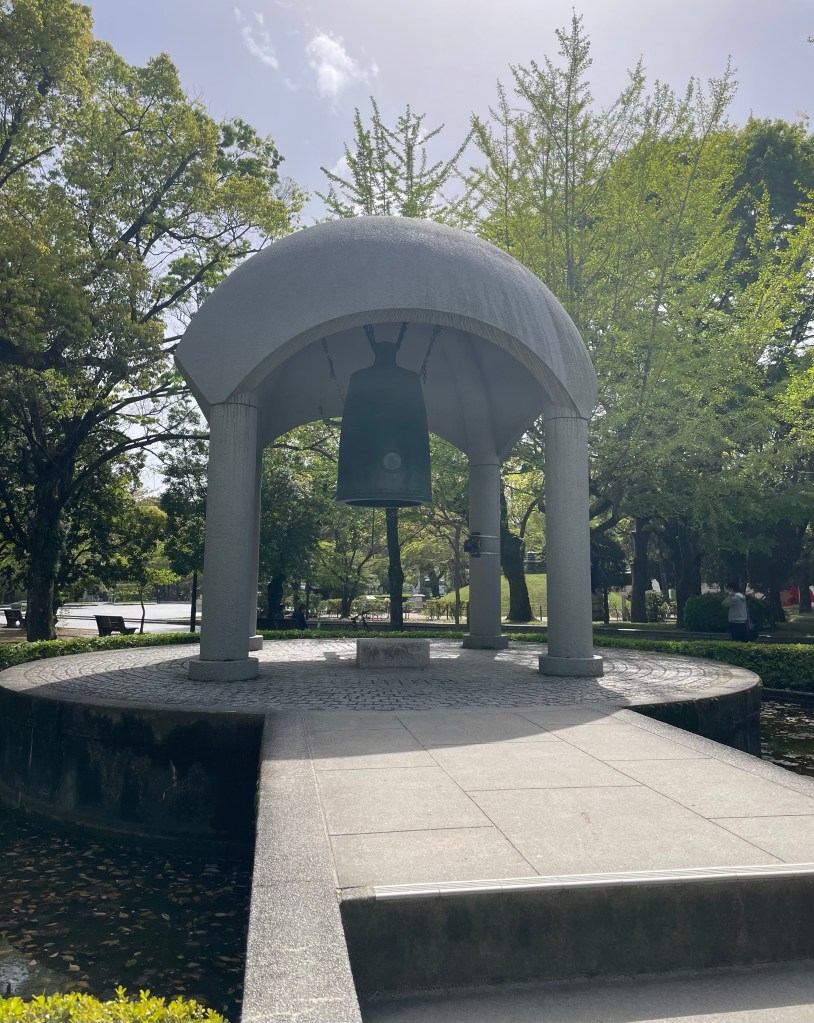
The World Peace Bell, with the outlines of the land masses engraved onto it without borders.
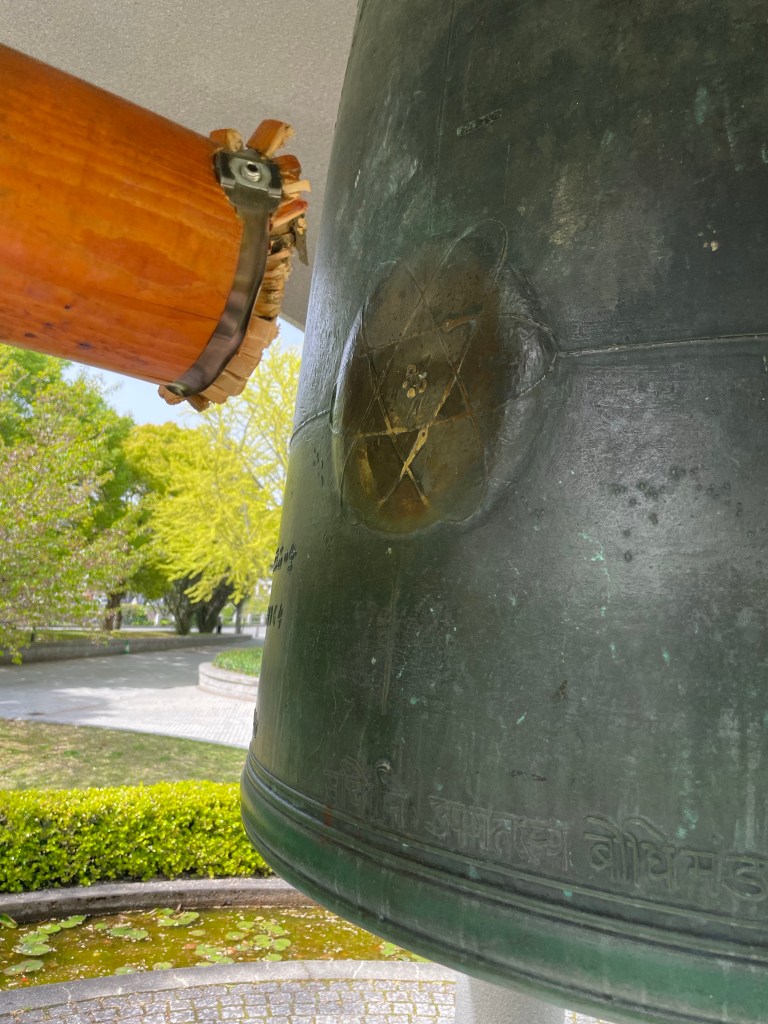
The place where the bell is meant to be struck includes a symbol of an atom, but if you look at it differently, you might see another symbol inside of the atomic orbits. I am not sure if it’s deliberate, but having been to Yad Vashem recently, I can’t help seeing the Mogen David.
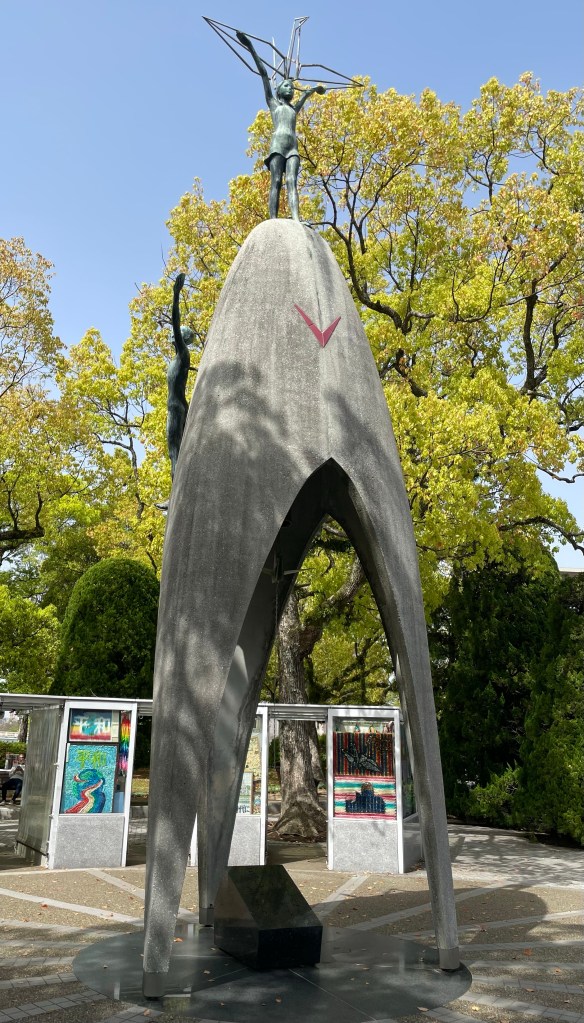
You remember the story of Sadako Sasaki and the thousand paper cranes; in fact, I think you told me the story back in the day. This sculpture is in honor of her and all the children of Hiroshima (and the world), and financed in part by them as well.
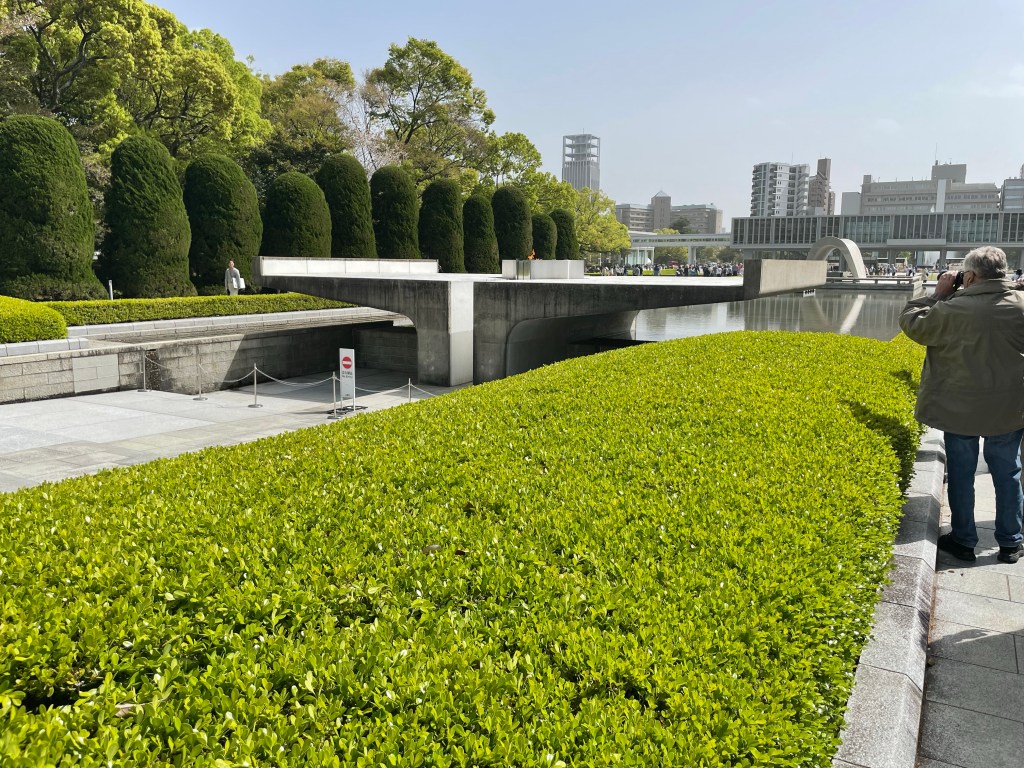
The eternal flame of peace, cradled between two upraised palms.
Another view of the eternal flame, from a stone hanewa (an ancient house of the area) that shelters a coffin (bearing the legend ‘Rest in Peace; we shall not repeat this error’) from the elements. It contains the ashes of those who perished with (and from, as I understand more are added every August 6th) the atomic bomb.
***
Inside the Peace Museum, we’re allowed to take pictures, but not flash photos, and I don’t trust my camera in the dark and gloom of the display. Suffice to say, the photos of people scarred to the point where they look like the plaster casts of Pompeii’s victims, the shadows of those vaporized where they sat waiting for the bank to open, the portraits besides tattered and ruined clothing (the only things left of these people) are powerful images. It’s understandable that once we reach the bookstore below, there is a statement “No More Hiroshimas”
And yet…
One of the things that is argued about the inhumanity of nuclear bombs is its indiscriminate nature; the explosion cares naught about who or what its victim is or may be. I know I mentioned Yad Vashem, but the comparison seems appropriate. Which is more inhumane, dropping a single huge bomb and ‘lett[ing] God sort them out” as a crusader king once put it, or systematically targeting every member of a race for extermination? One is war, with its attendant hell; the other is treated as pest control by those inflicting it.
I’m sure I sound defensive about this, as if I were somehow responsible due to being American. But I want to believe that was never our intent; this was the least of numerous evils. There are so many tragedies behind the statistics, but I want to believe this prevented so many more. We now knew what it could do, and even as we and other nations built bigger and ‘better’ versions over time, we knew we couldn’t be the ones to pull the trigger again – and so did everyone else who had them.
And all strangely thanks to Hiroshima.
On the other hand, the effects upon the city and the nation at large, seems to have been an unswerving desire for peace, even as belligerents right across the Japan Sea continue to arm themselves.
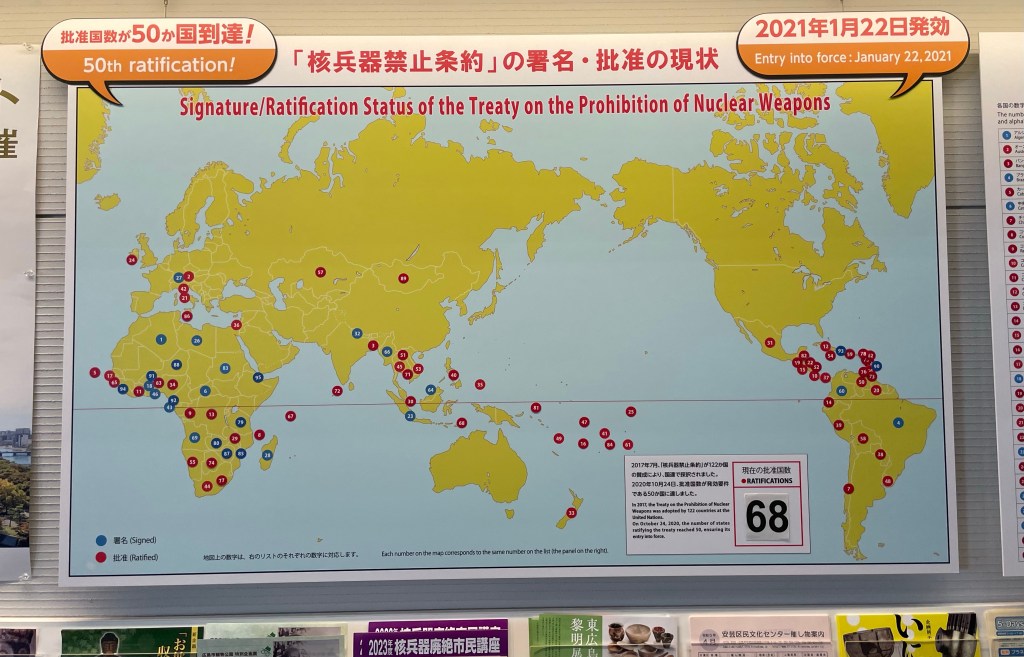
You’ll notice that no one who has nukes has signed onto this treaty – neither the U.S., Russia, China, Britain, France, India, Pakistan or North Korea – rendering it all but worthless. They may celebrate how many signers they have, but if none of them have anything to lose or set aside, it’s completely irrelevant.
We’ve learned lessons from this moment, yes, but some of those lessons may be the wrong ones. If they spur good men to do nothing (i.e., disarm) in the face of evil, it may prove to be worse than useless.
On the other hand, we’ve survived thus far. We’ll see how far it takes us.
For now, though, keep an eye on us, honey, and wish us luck. We’re going to need it.




 Letters to Rachel
One thought on “Rain and Sun”