With every stop we make along the ancient shipping route around the perimeter of Honshu, we get the same announcement from the government of Japan: we’re not allowed to bring meat products ashore, lest we run the risk of bringing potentially infectious items into the country. Setting aside the question of where we would have been to bring such products into port (hint: we’ve been in Japan the whole time since arriving in Tokyo), it amuses me to note that – particularly on a day like Easter – they have no difficulty including fish in that prohibited list. Which makes perfect sense; they are animal products, after all.
After sitting out on the veranda to write you an earlier letter, I find myself wondering whether I need a jacket at all. It’s cool, yes, but I’m wearing a couple of layers and the sun is shining brightly already; it’s only likely to get that much warmer as the day wears on, now that we’ve gotten through that storm.
We’ll see if I wind up regretting that decision in time. For now, it may actually help, as we have to pass a body temperature checking camera as we enter the terminal. Thanks to the current chill in the air, I don’t even register 36°C, let alone the 37.5° that would prevent me from disembarking.
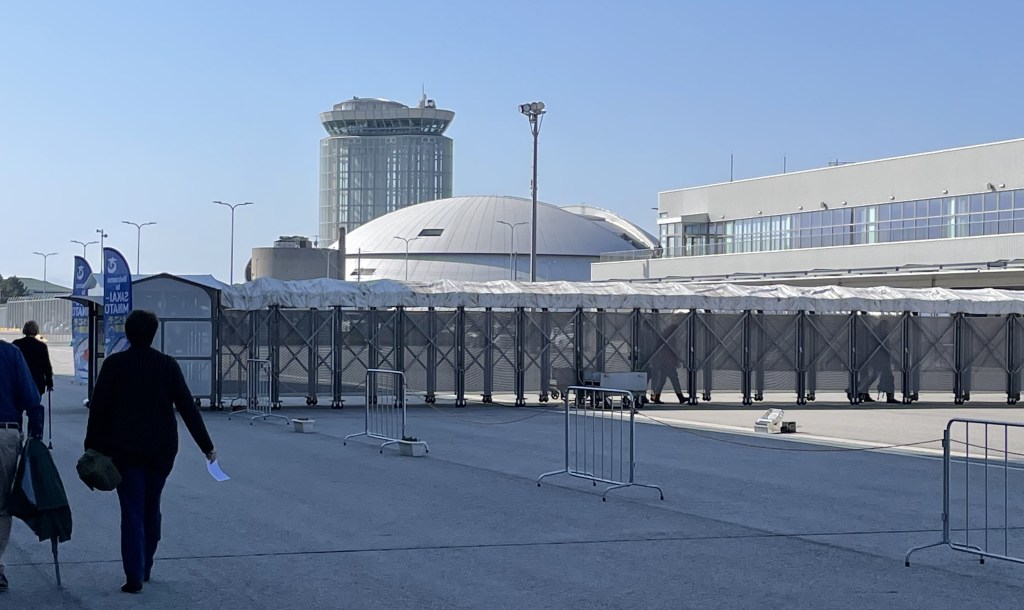
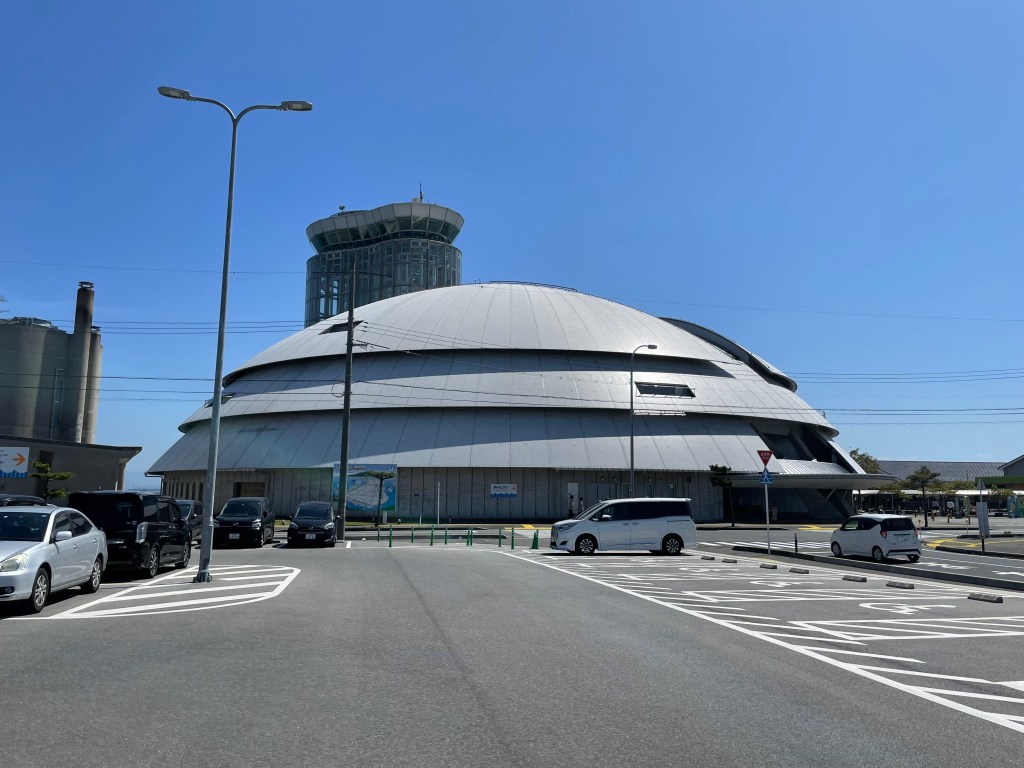
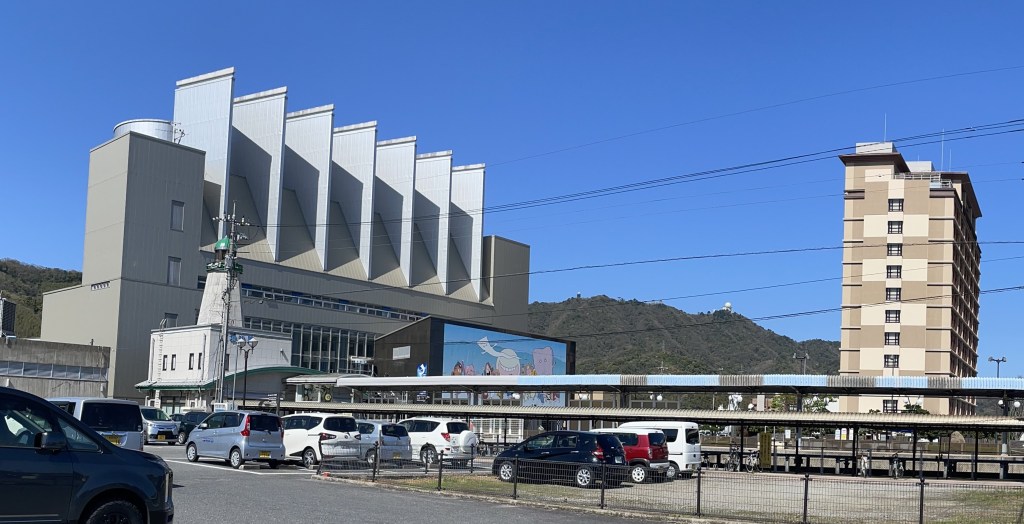
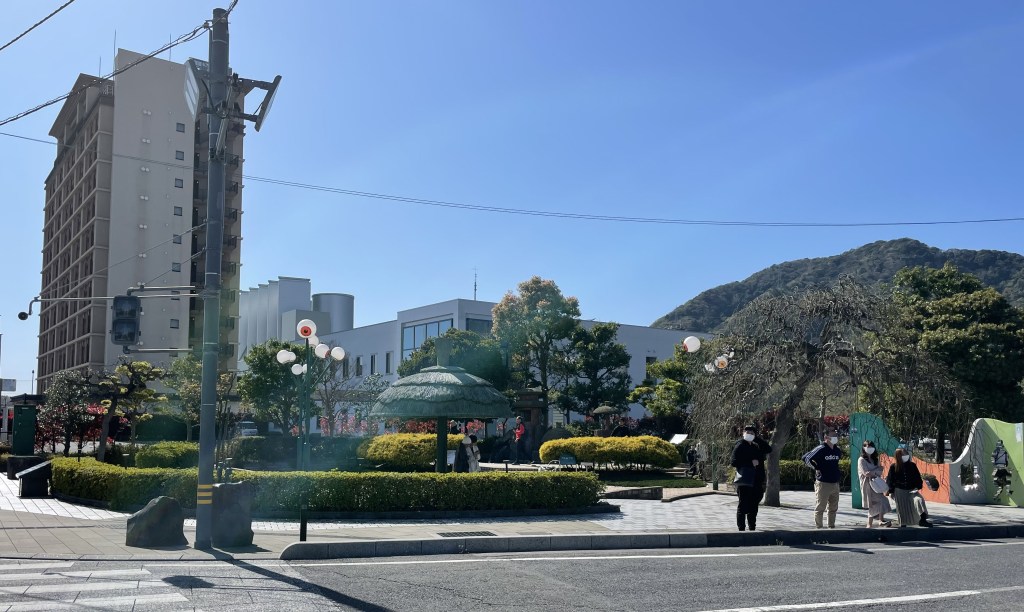
On our way out, I snap a shot of the Yumeminato Tower and the domed building that Daniel and I were puzzling over as the ship made its way into port. It appears to be a shopping mall, if Google Maps is to be believed. Something for reference, if we have time when we return. We’ll probably not want to get back on the board right away, as we’ll have had our passports stamped to exit the country (as our next stop is in Korea), and we won’t be able to get back off if we want to. So these decisions have to be made in advance.
Our tour guide, Miyuki-san, informs us that we will be present for the last day of the spring festival at the castle; we might encounter folks in period costumes, such as samurai and the like. She also warns us that, between the festival and the fact that it’s Sunday, we may have to deal with an increase in traffic from local holidaymakers traveling to these sorts of touristic sites.
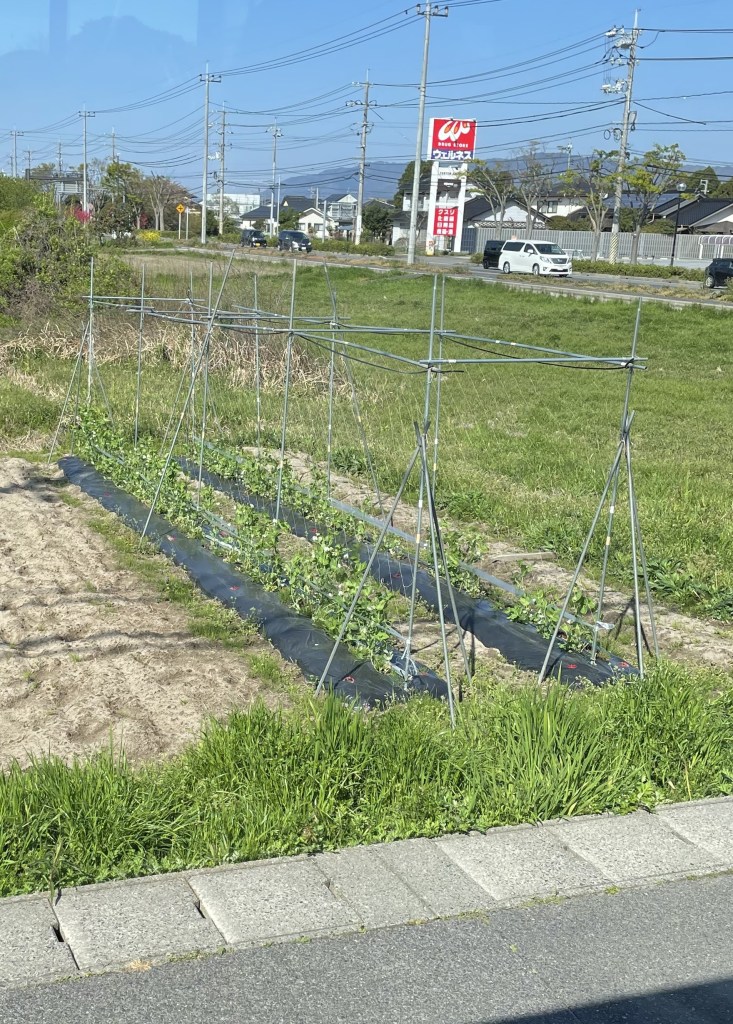
There are several lakes in the Matsue/Sakaiminato area, but they are too brackish and salty for growing rice, like they do in the north. What they do grow are peas (shown here) and buckwheat (for soba) and peonies. In fact, more than 60% of Japan’s peonies are grown in Tottori and Shimane prefectures.
Our first stop is a cruise on the Horikawa River. Miyuki-san informs us that the name translates to ‘moat river,’ as it surrounds Matsue Castle. She mentions that the cherry blossoms have already flowered here, but we will be likely to see plenty of wisteria blossoms on the castle grounds (not that I’d be likely to recognize such).
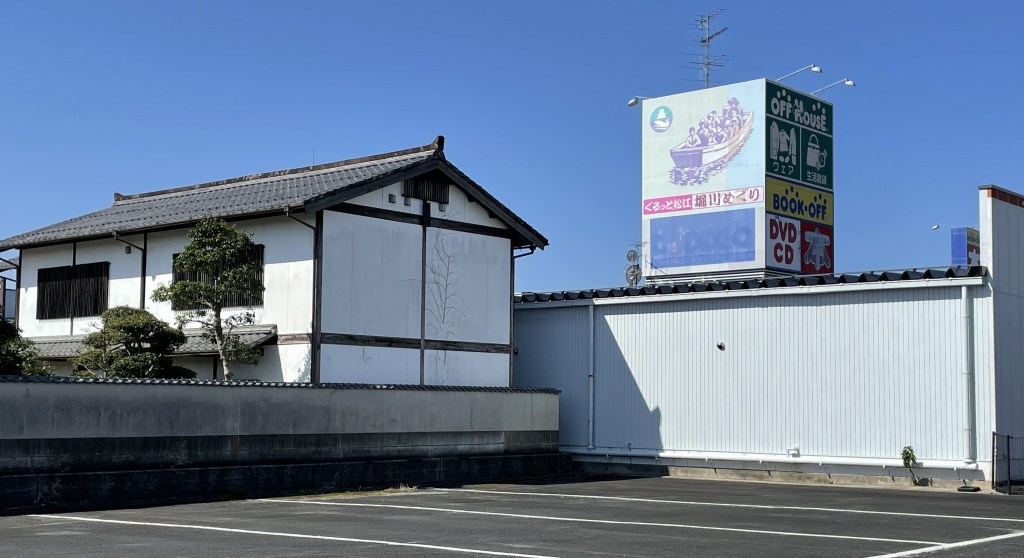
Just by the parking lot, we spot what looks to be a discount bookstore, as far as I can tell. They use the term “X% off” on sale items throughout the country; some things are just universal.
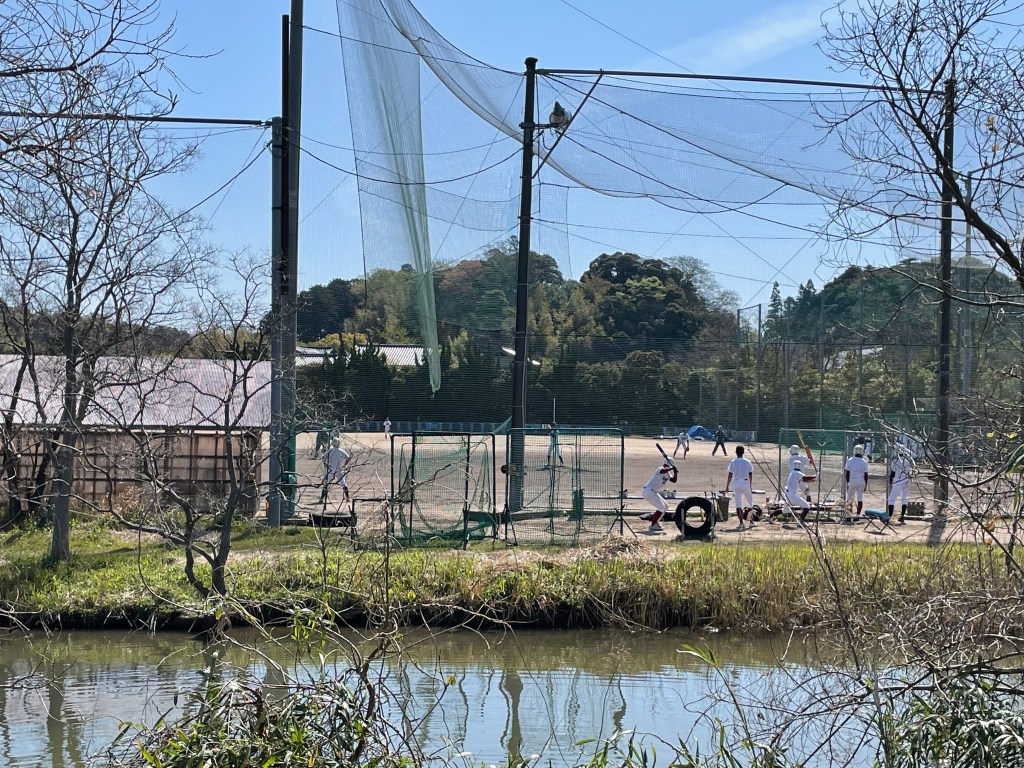
Across the river, we hear some yelling, and discover a group of boys playing baseball. Don’t know if it’s a competition between school teams, or just a league of some kind, but it’s definitely organized.
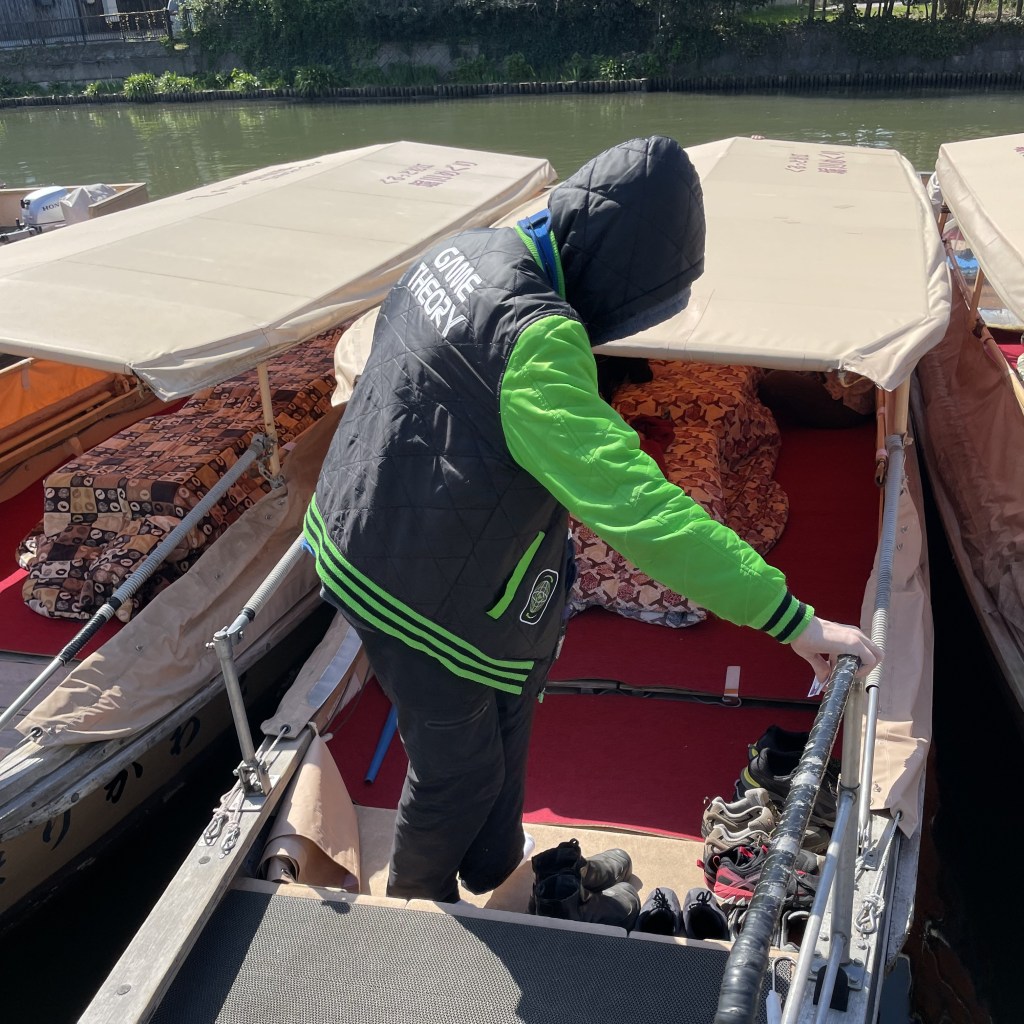
We get on board our boat, and take our shoes off as per Japanese custom.
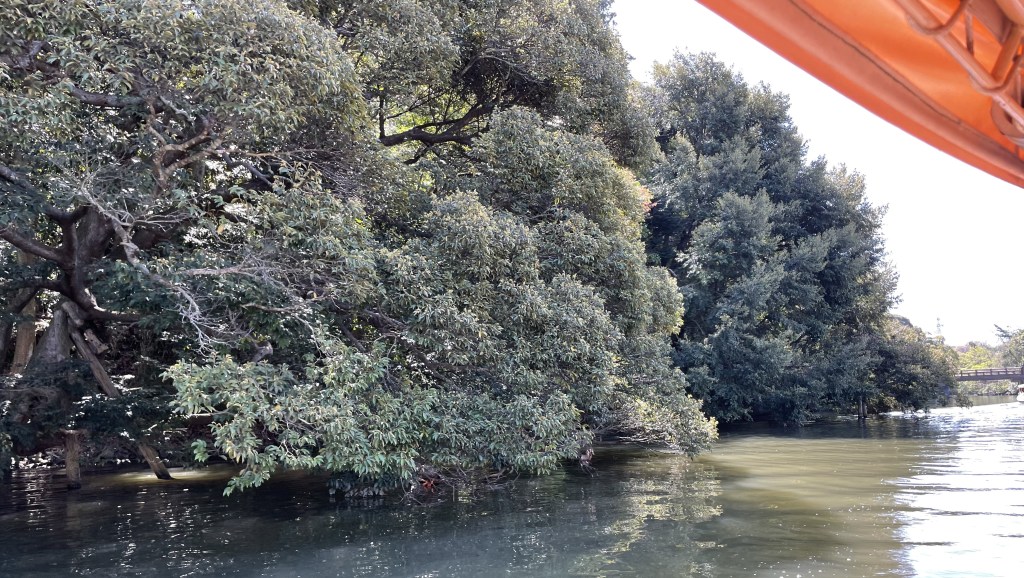
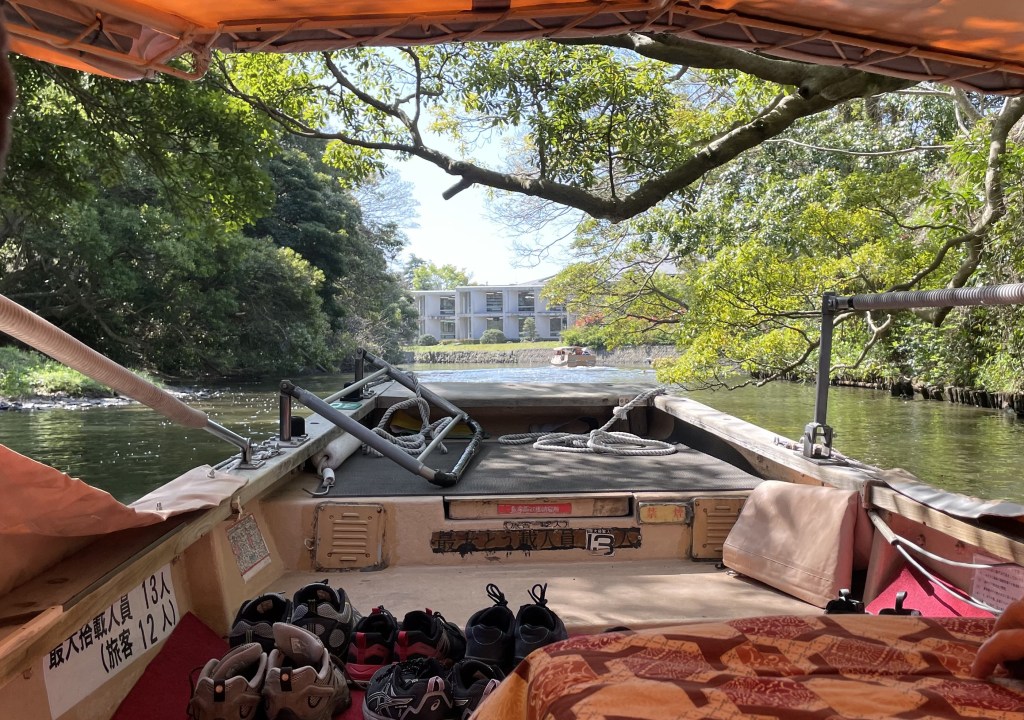
There’s a great deal of plant life around the moat, although it’s difficult to keep the awning out of the pictures. I have it on good authority that it gets that much more difficult when we go under some of the lower bridges; the boatman has made us practice ducking as he lowers it for when the time comes.
The first building we come to appears to be a library…
…and across the adjacent bridge may very be a school; it’s hard to tell, when class isn’t in session.
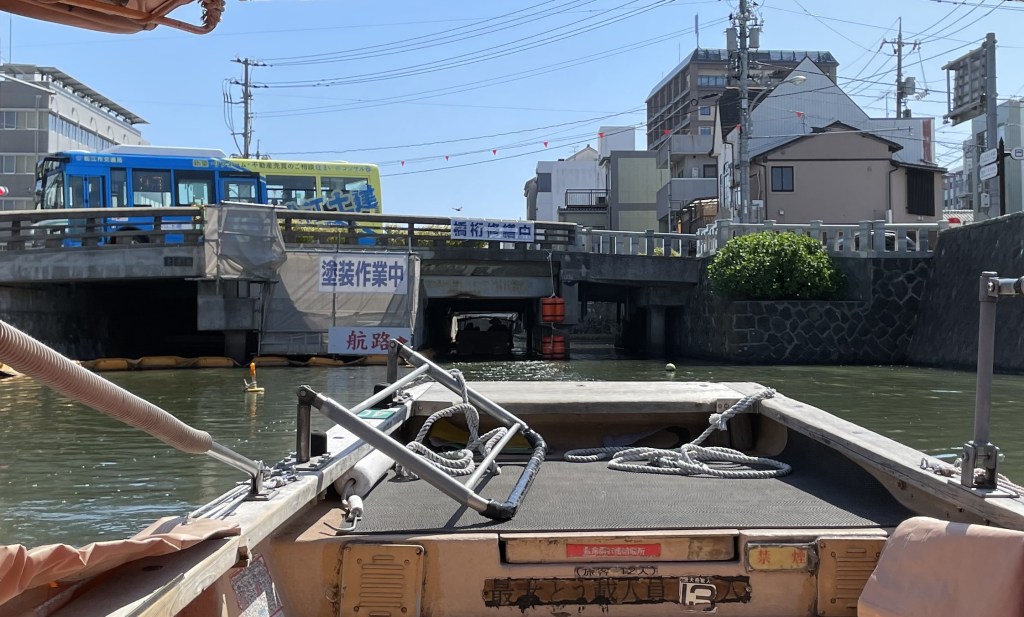
We come to the first low bridge; not only is it low, but it’s narrow as well. We bump it on either side as we make our way through.
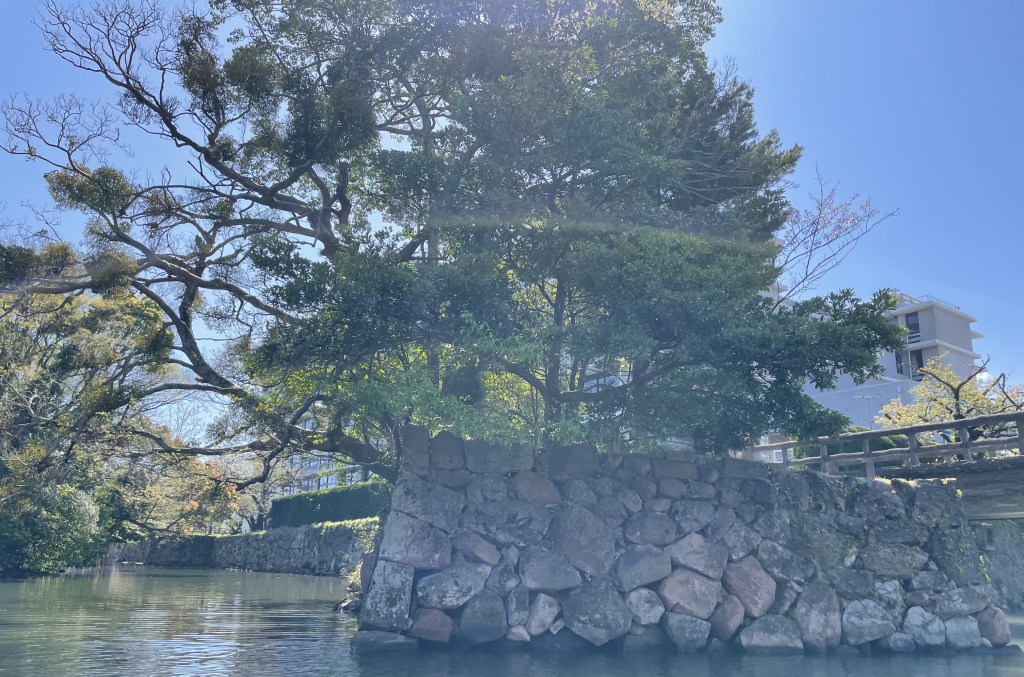
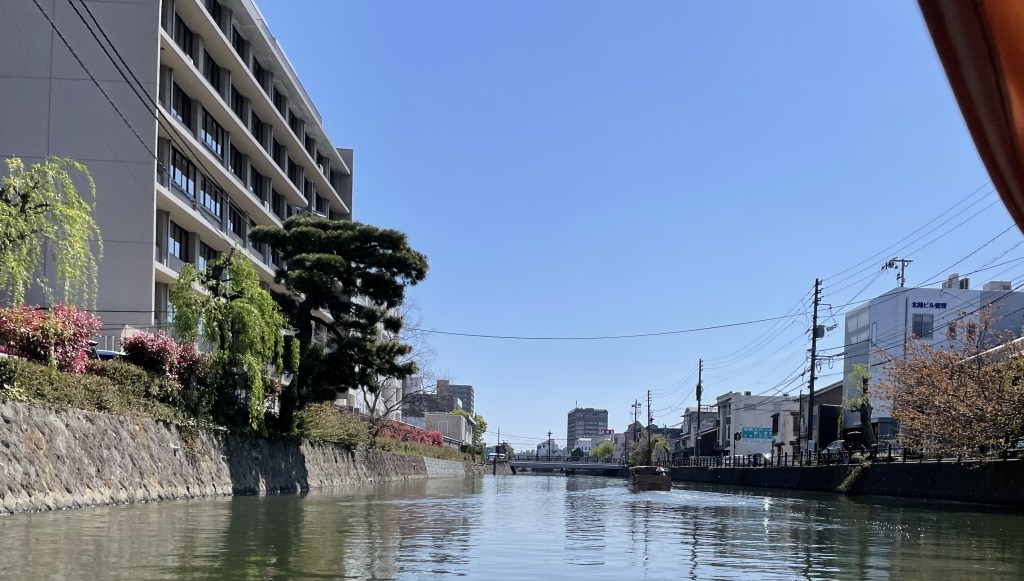
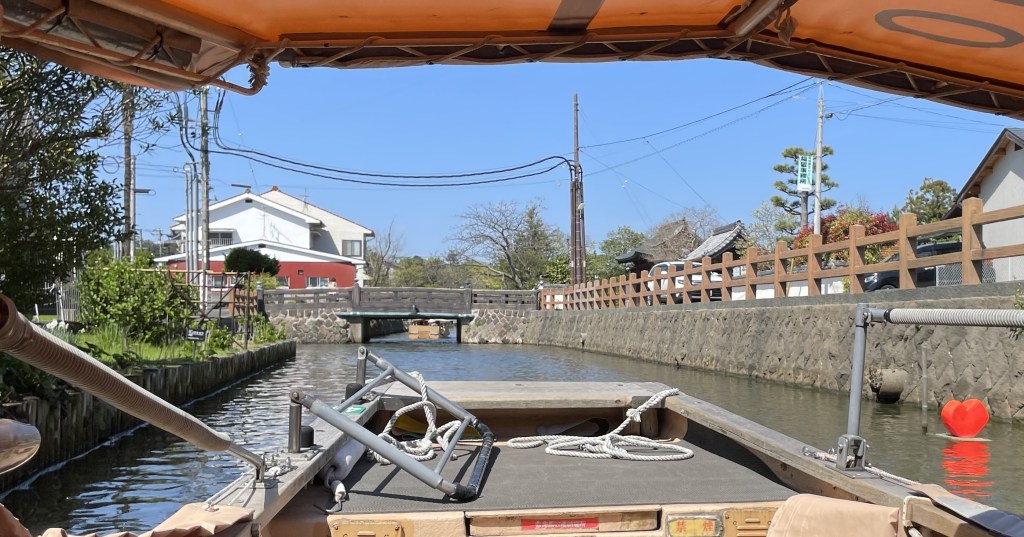
The canal we find ourselves on once emerging from under the bridge is one that separates the town proper on the right from the samurai’s residences.
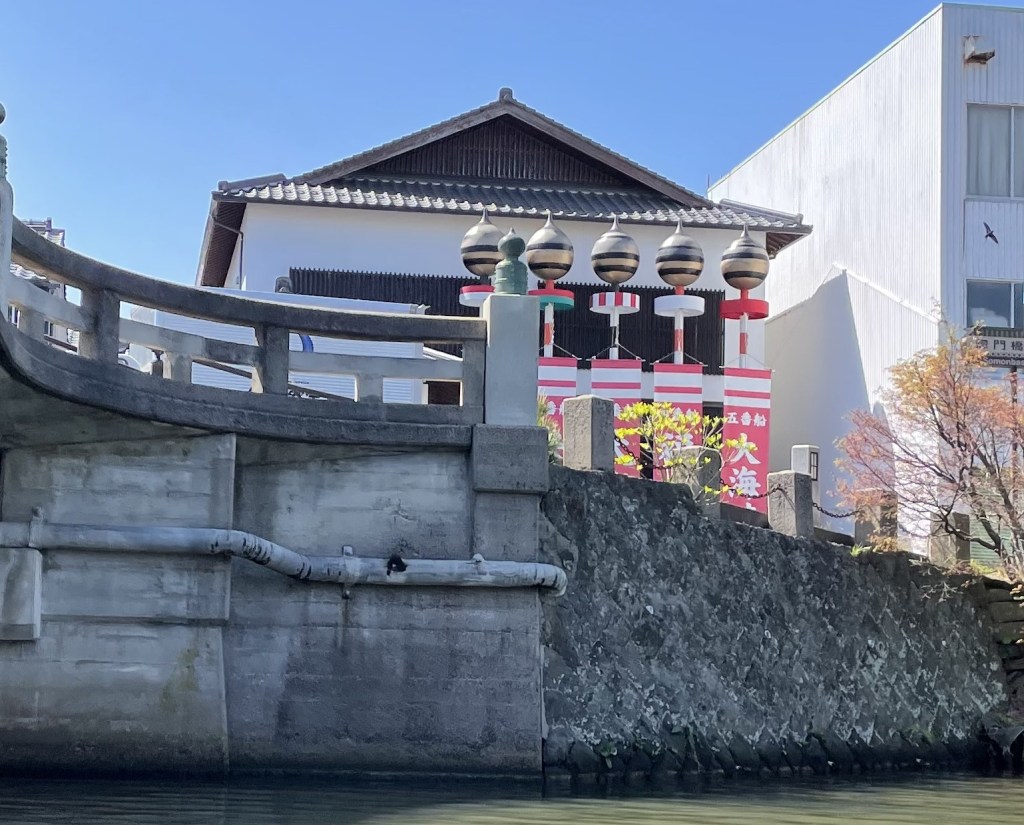
We pass under another bridge, this one made of concrete. The boatman sings a traditional song, and it echoes melodiously off the composite stone.
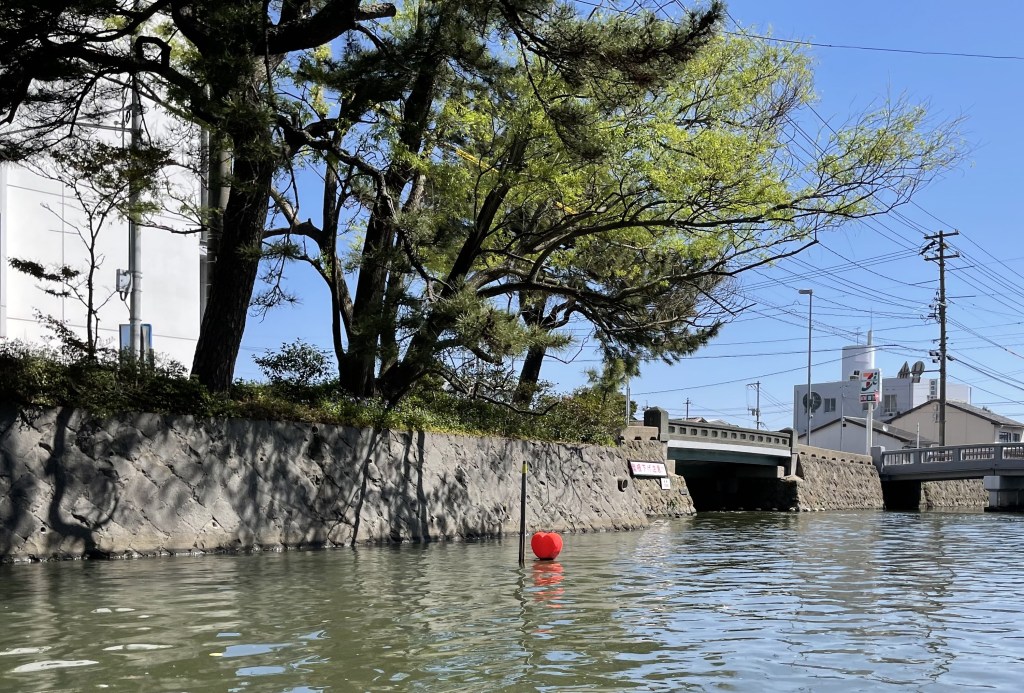
One of a number of heart-shaped buoys outside of the area of town known as Little Kyoto. The story goes that, once upon a time, the local daimyo took a wife for himself from Kyoto, and in an effort to relieve her homesickness for her hometown, he built a section of Matsue city to look like it for her. It’s a sweet little story, and quite the tribute, if you’ve got the money to do it.
Home gardens here really are something else.
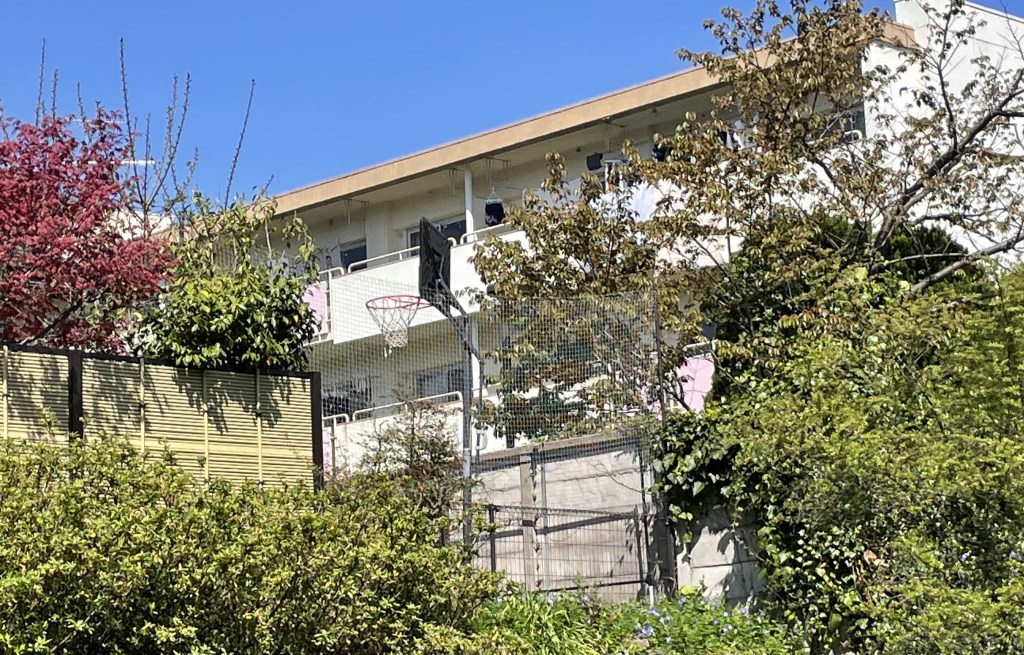
Laundry dying on balconies, behind a basketball hoop.
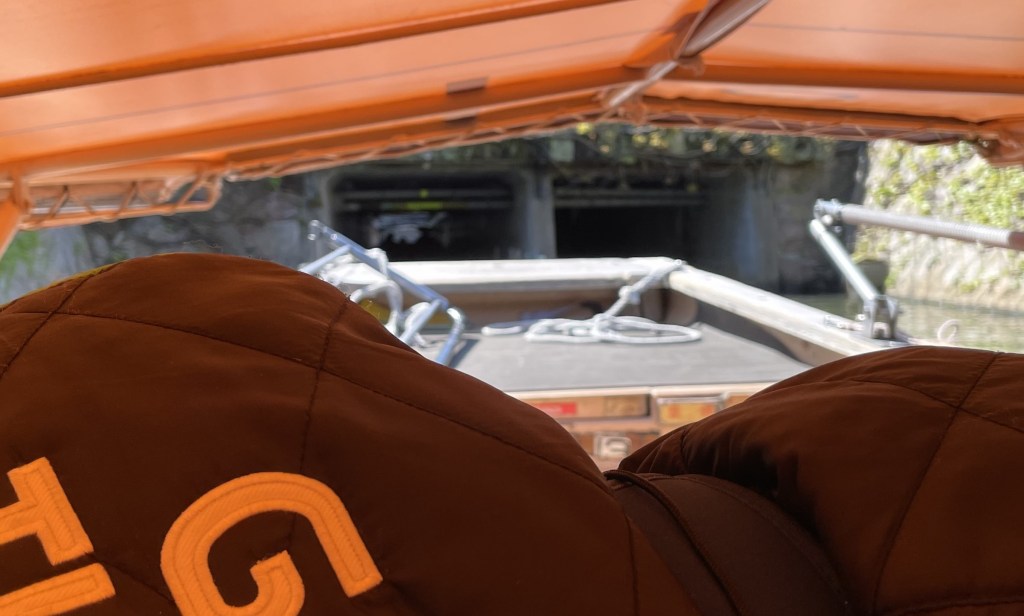
The last and lowest bridge; I’m resting my head on the kotetsu to keep from hitting my head. I can’t help but look back at the boatman, whose head is now well above the awning behind us, but then, even he has to duck.
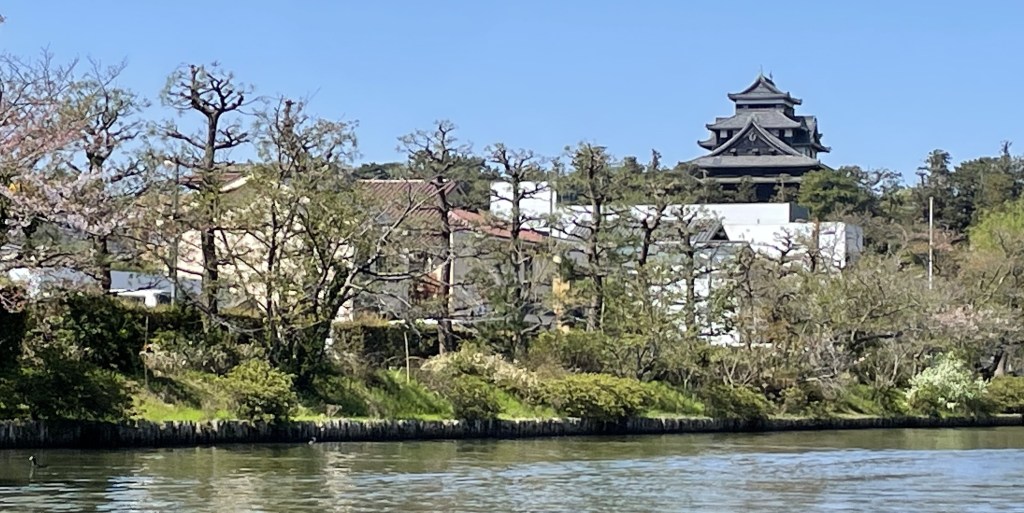
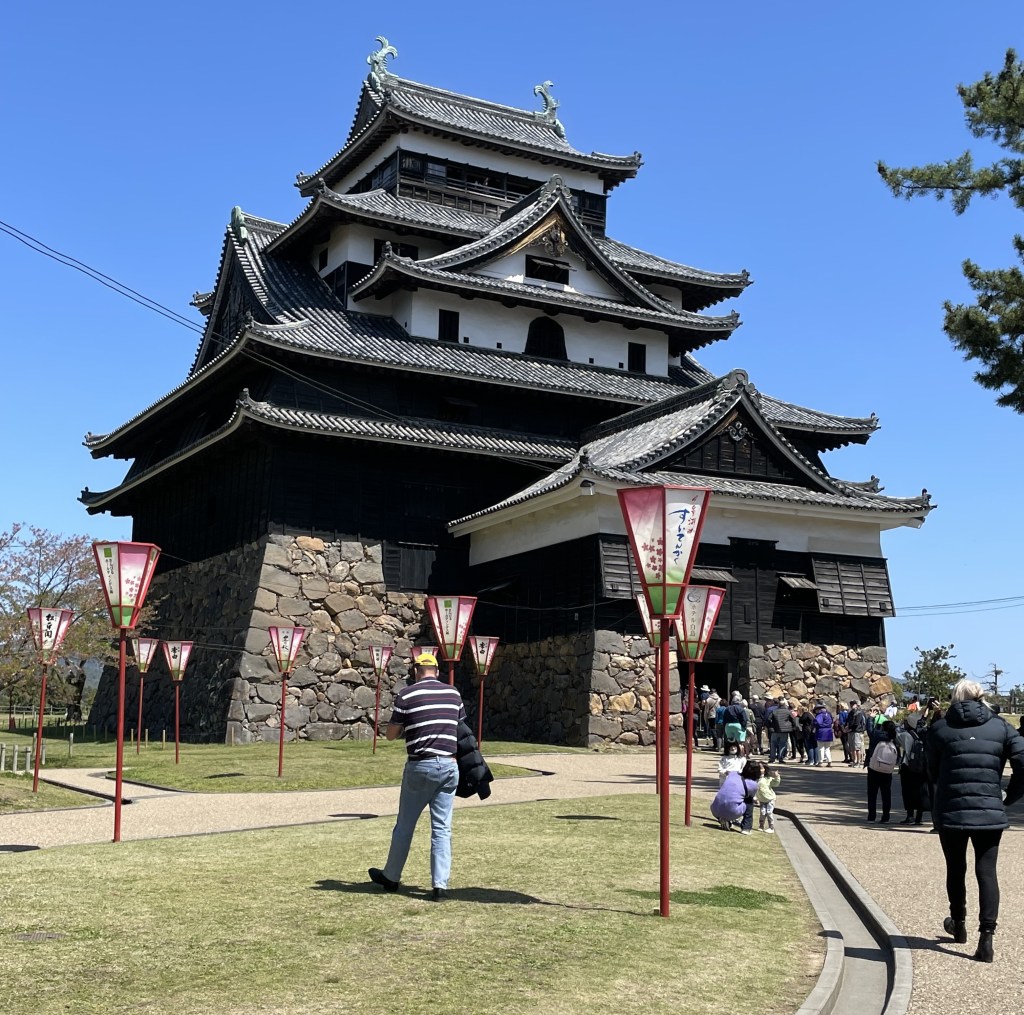
The Black Castle of Matsue; reading about it for research is one thing, but when it comes into view, it really becomes clear as to why it’s called that.
A shrine next to the museum of history.
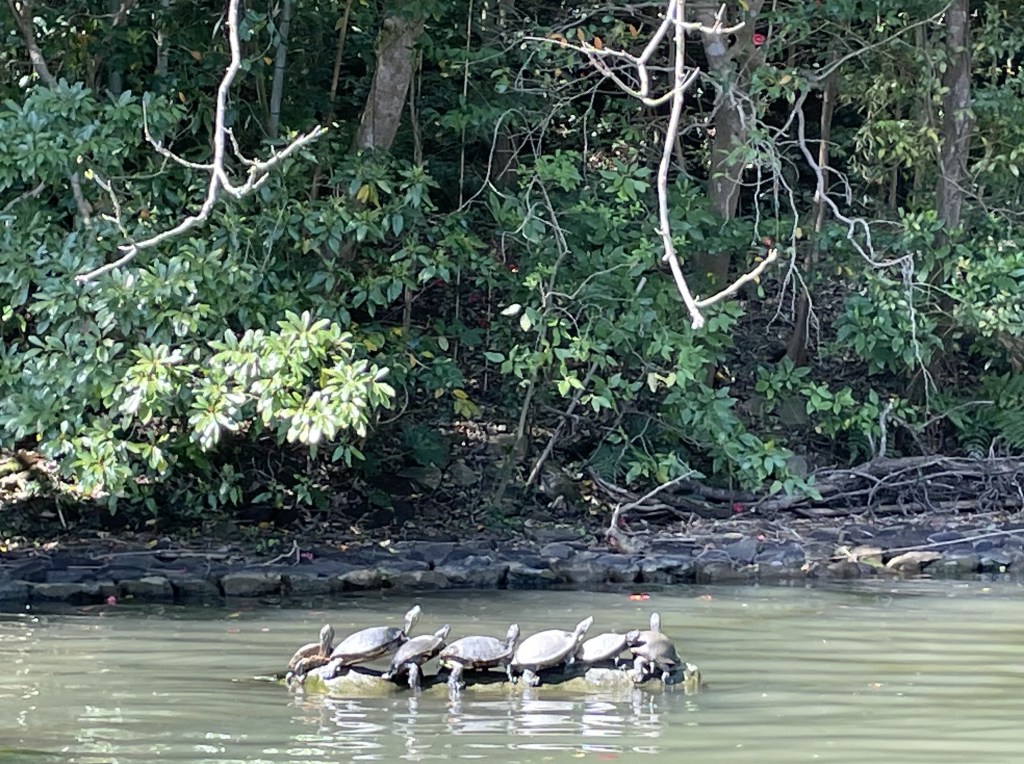
Turtles basking on a rock in the middle of the canal; I think those red blossoms may be the wisteria we were told about, but I really can’t tell.
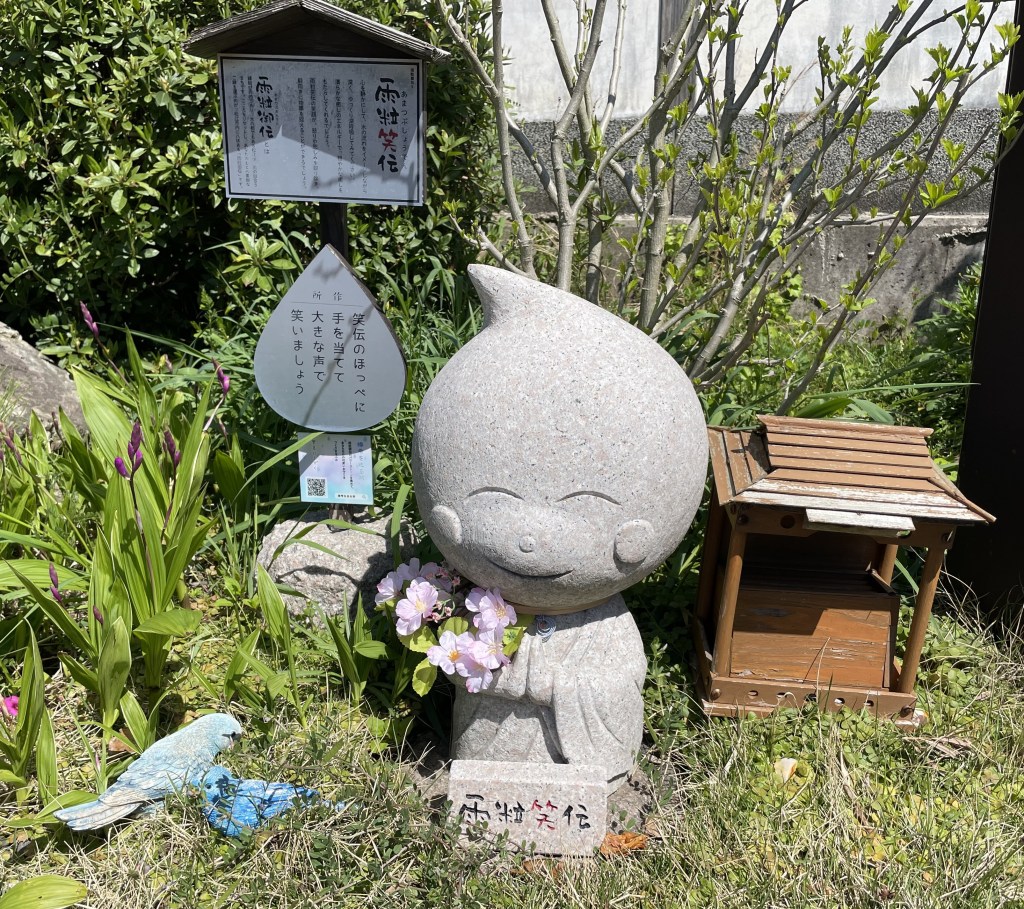
Another cute mascot statue just outside of the disembarkation point.
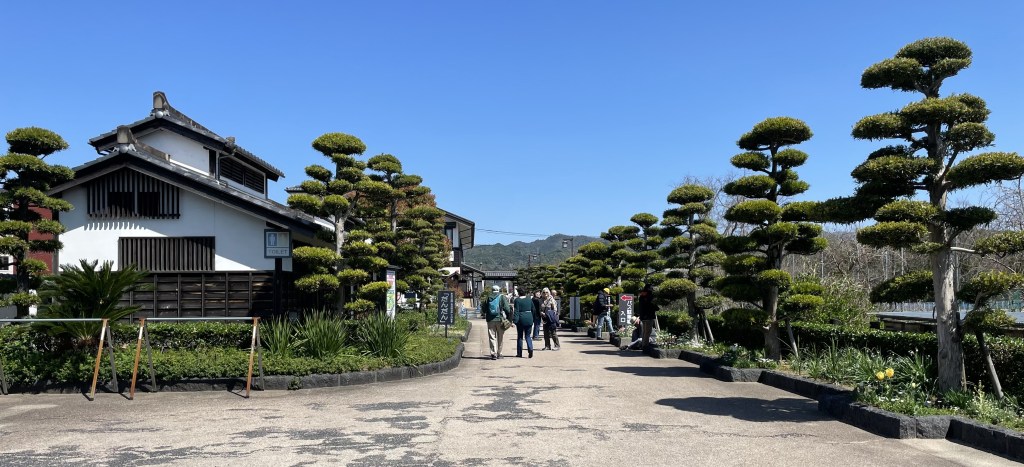
I didn’t see this line of trees on our way in to the riverboat boarding point.
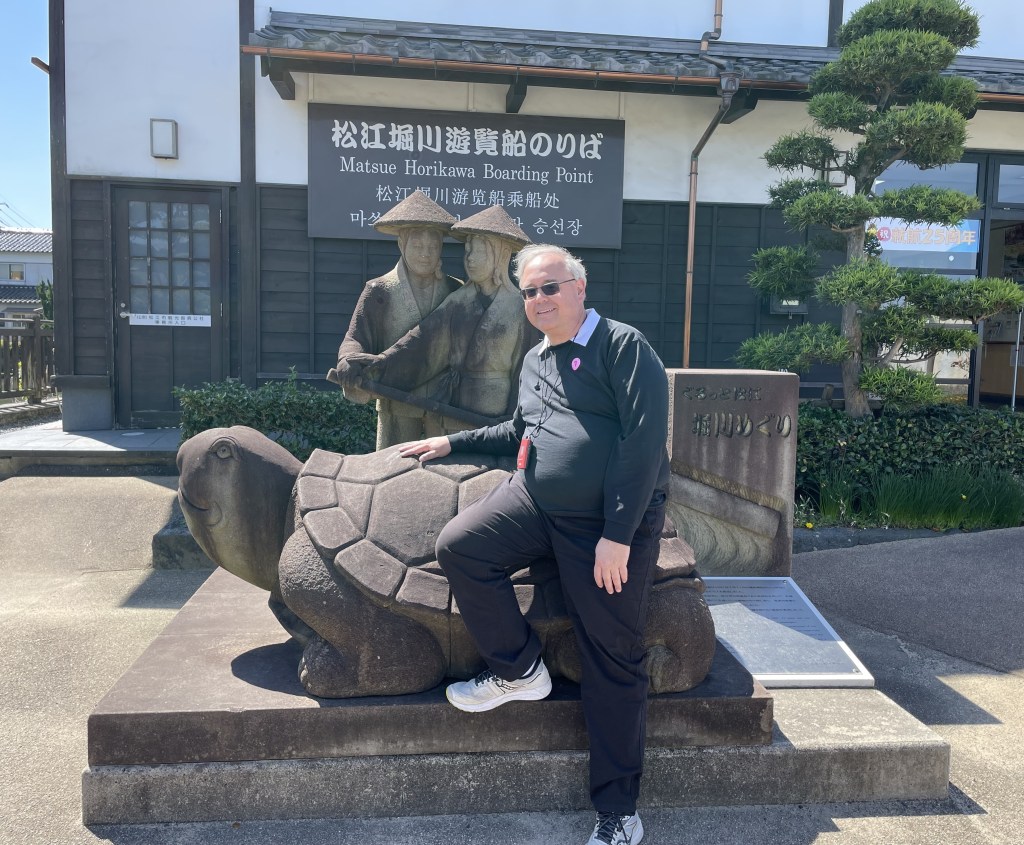
I don’t know what story this is meant to commemorate, but I find myself reminded of Urashima Tarou, Japan’s Rip van Winkle, who rode the back of a giant turtle, and when he returned, a hundred years had passed.
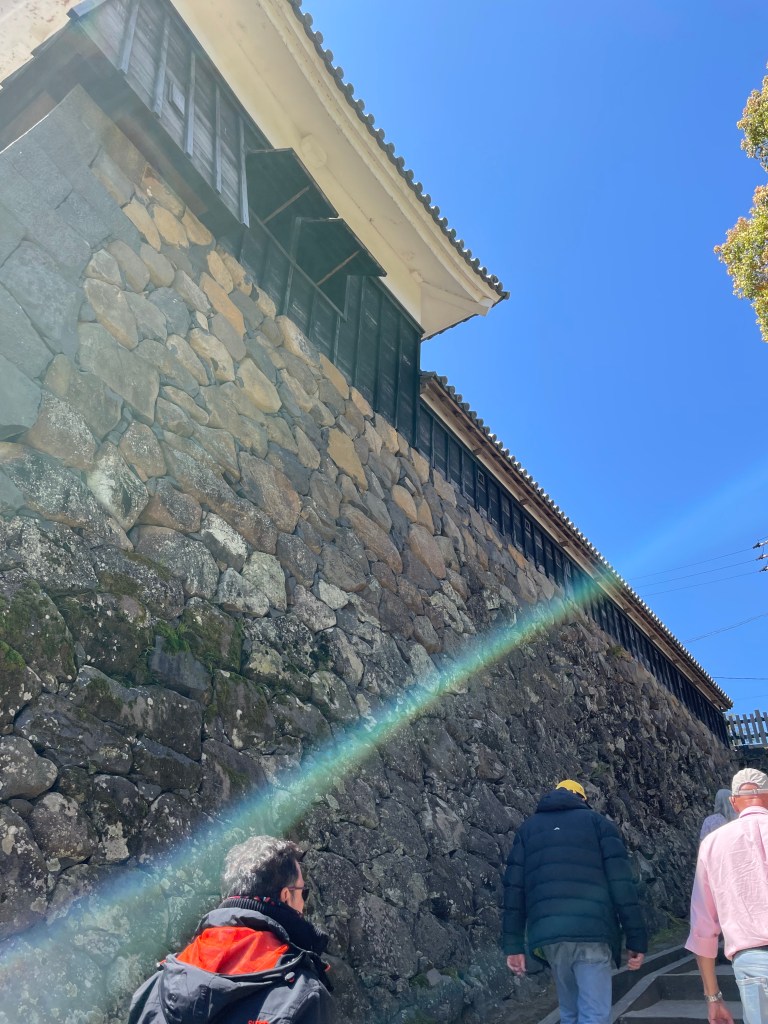
Mayuki-san points out that castles are not meant to be accessed easily (that would be via attackers). Not only are the stairs steep, but you should be able to see slits from which the defenders could shoot arrows or later guns.
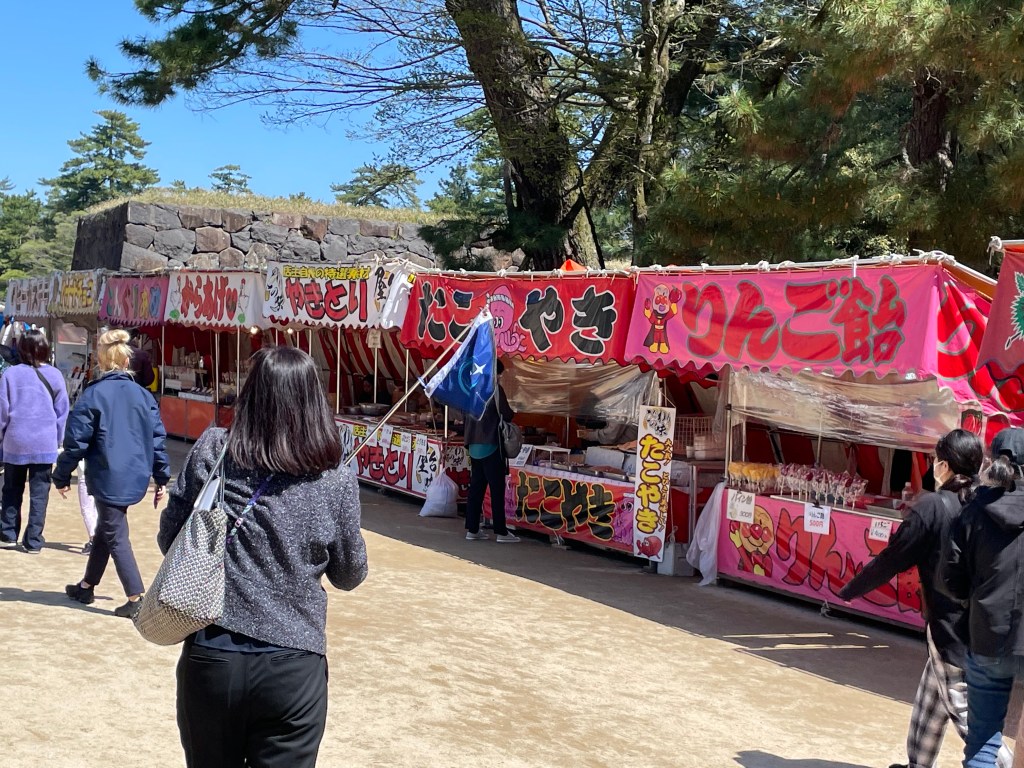
Still, it’s worth the trip, as they’ve got the festival going on, just as promised.
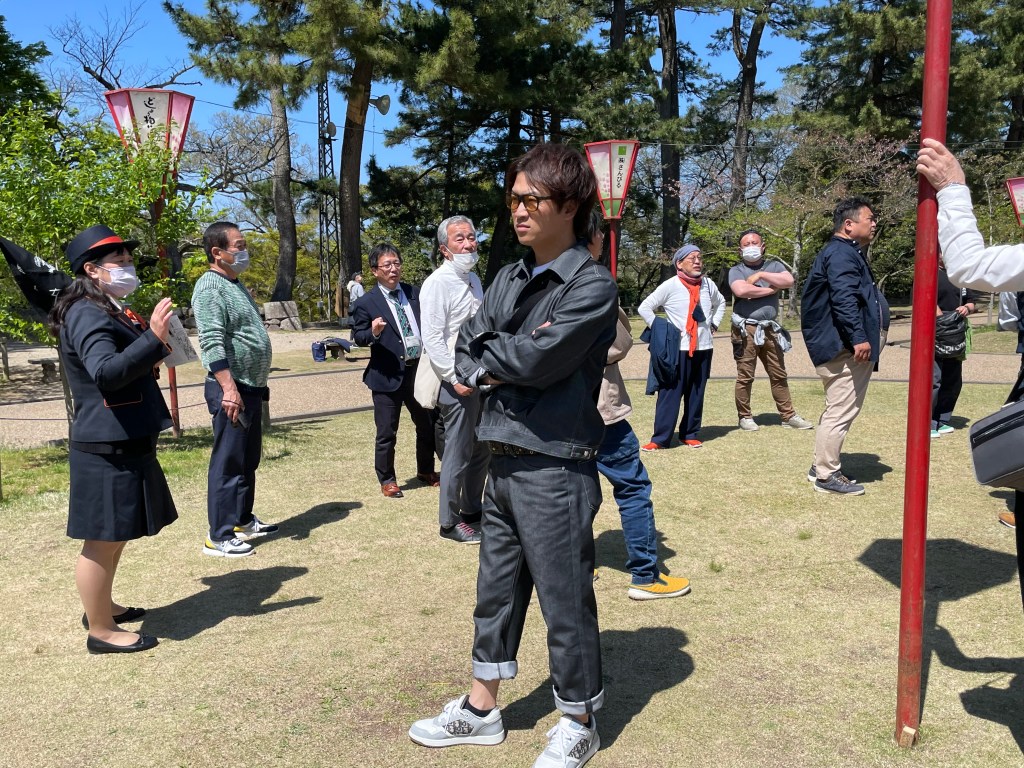
Of course, this also means we aren’t nearly the only ones here; the castle keep area is crowded with other tour groups. I recall uniforms like the one this guide is wearing from my last visit to Japan.
This castle is four stories high (five, if you count the basement) as opposed to the three on the castle in Aomori.
Miyuki-san gives us our tickets, and we thank her in the local dialect: ‘dan dan’. Needless to say, it’s easy for Daniel to remember; he just has to introduce himself twice.
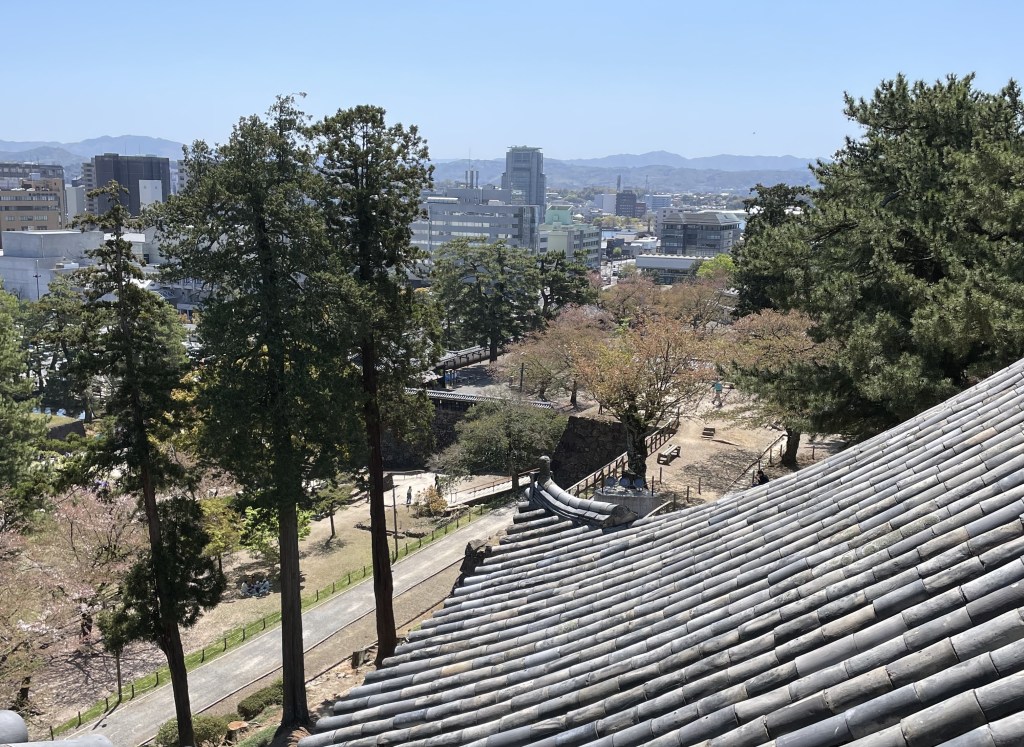
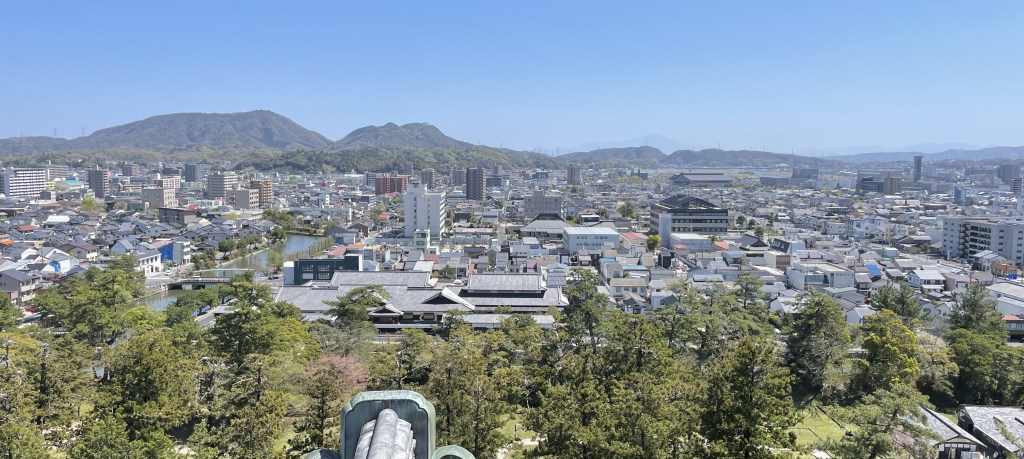
Matsue City as seen from the castle to the south.
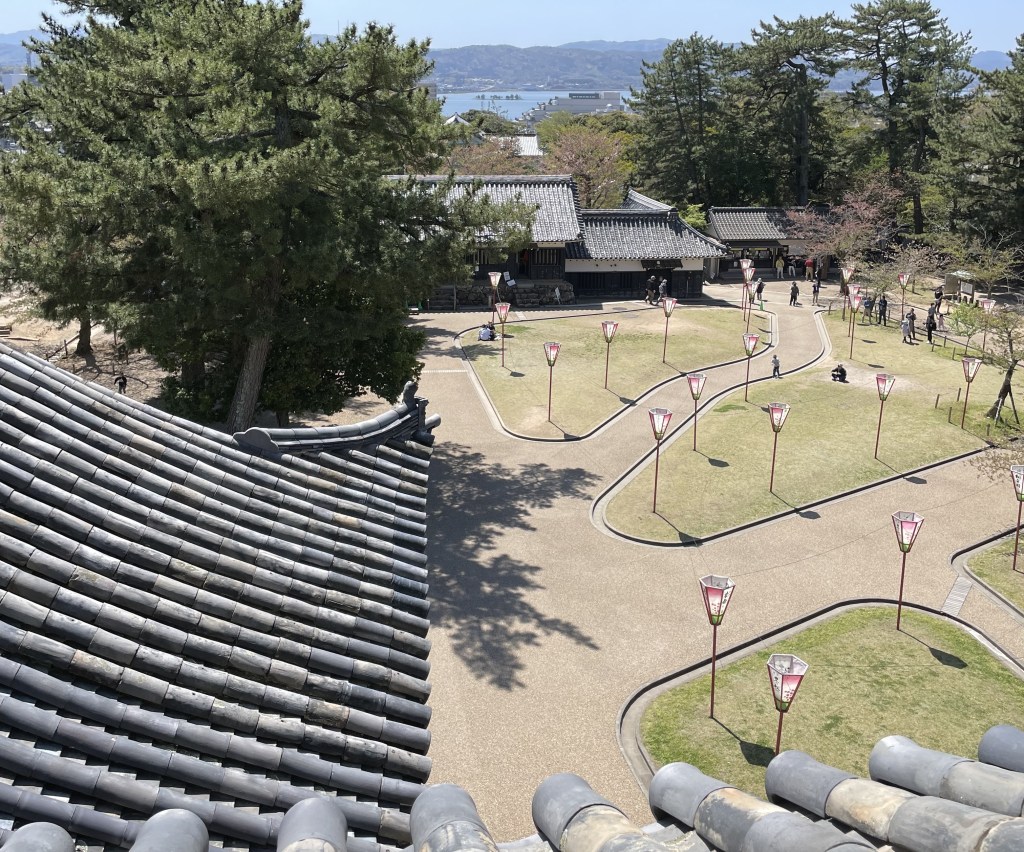
Also toward the south, the keep area, and Lake Shinji in the distance.
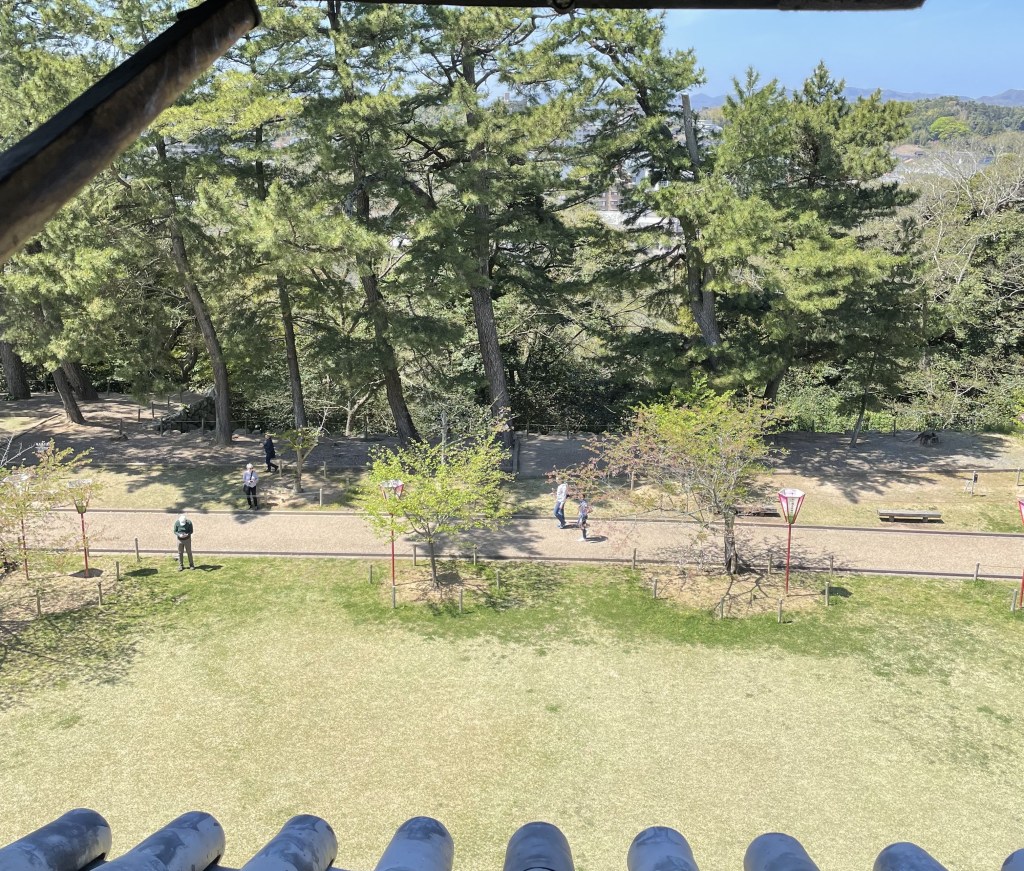
To the west is mostly forest…
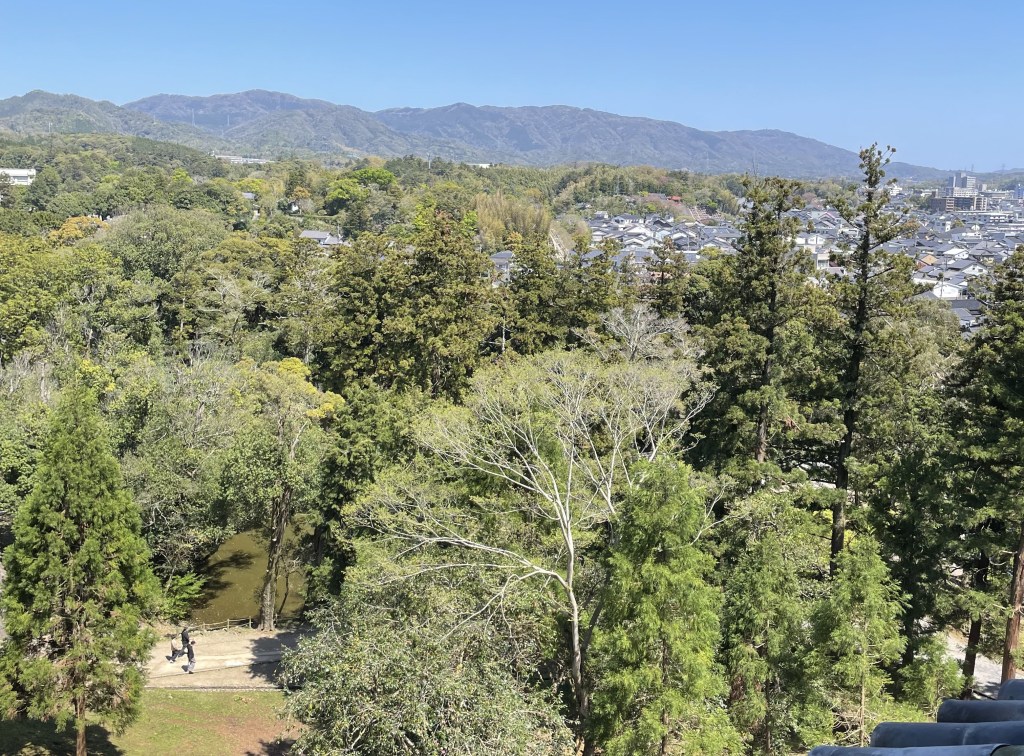
…while to the northeast…
…and east is residential. The holy mountain, Daisan, is barely visible in the right hand distance, some forty kilometers back from whence we came.
The first set of stairs are relatively normal, if a little steep; we think we’re in for an easy time. Then, we spot the next flight; that one is more like the ones we recall from up north. Going up is no problem; but the trip down is once again somewhat nerve wracking. Daniel is able to descend normally, but I find myself having to bring both feet onto each step before proceeding to the next on our way down.
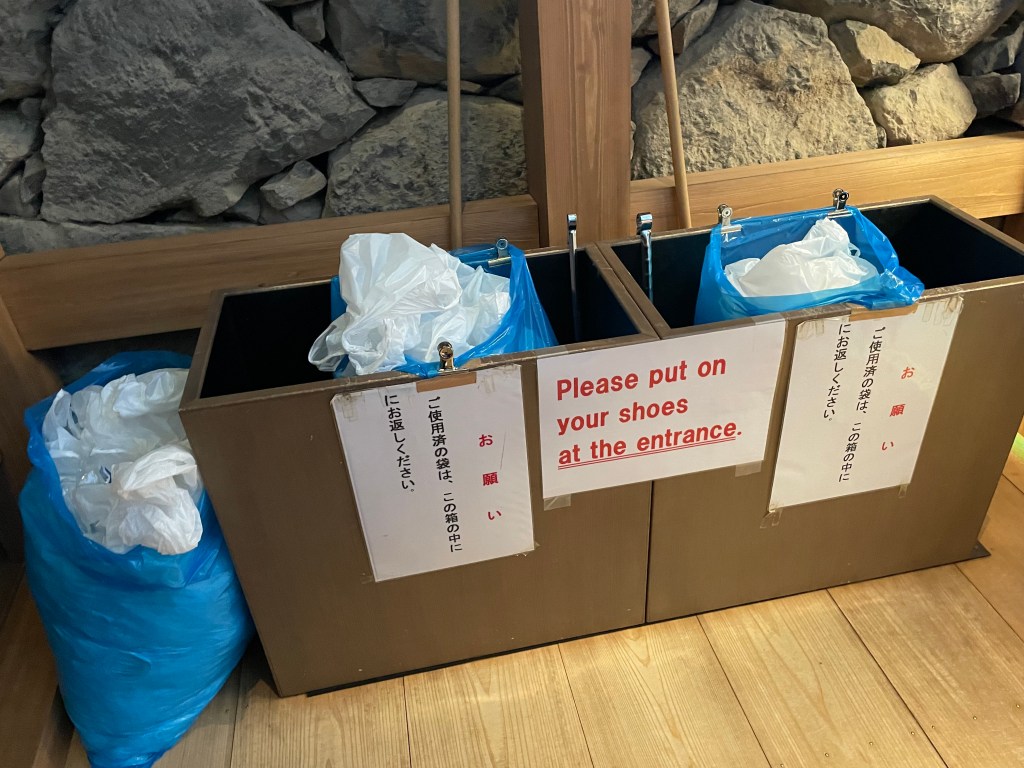
There’s an additional level of difficulty in the fact that we’ve been carrying around our shoes in a plastic carrier bag. Interestingly, once we reach the exit, we’re instructed to recycle our bags.
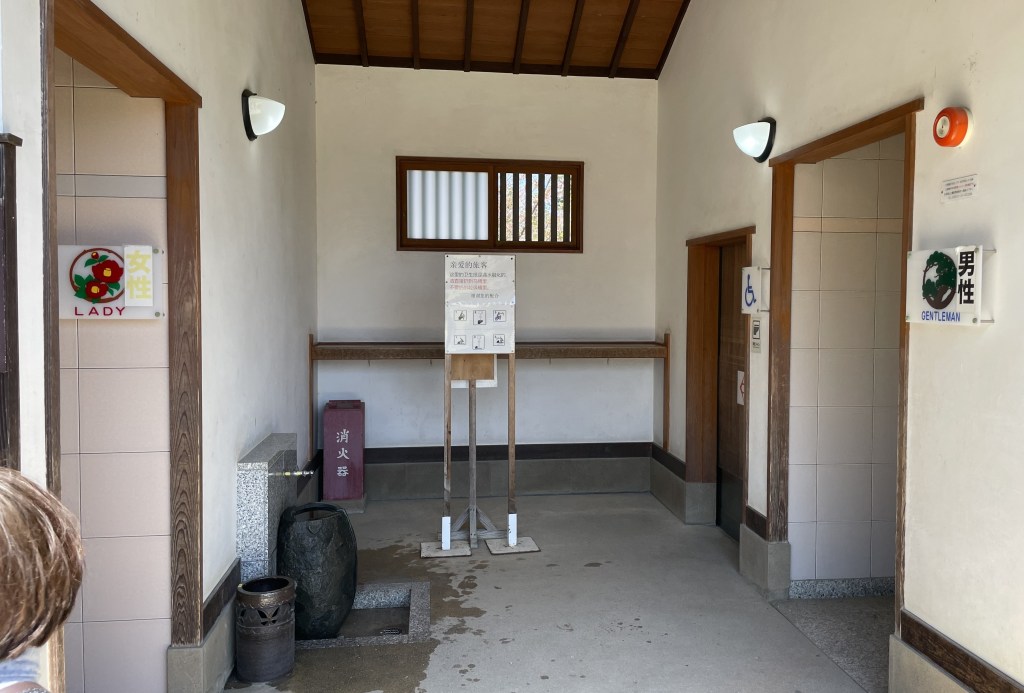
We make our way to the festival area, but not before making another stop (at least, I am; Daniel seems to have infinite capacity to contain himself). I’m not entirely sure if the flowers and the trees are meant to represent anything; I’ll leave you to draw your own conclusions.
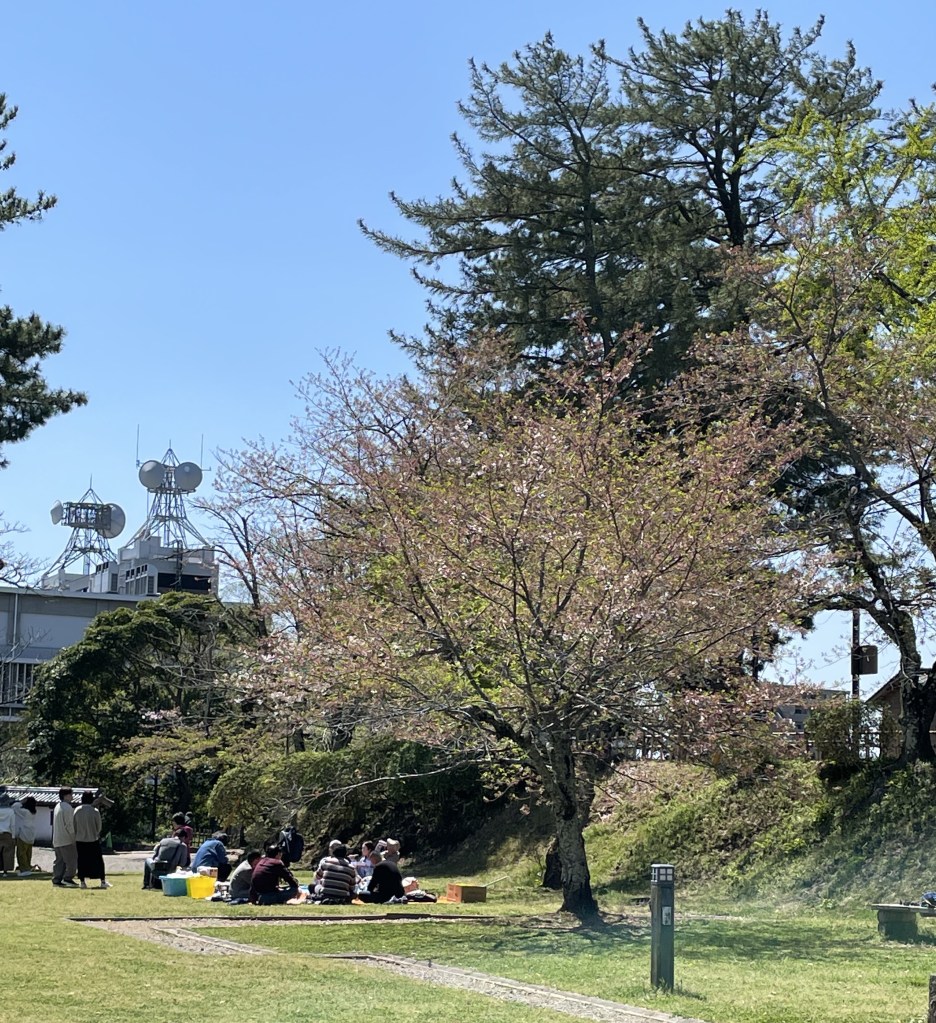
And while the cherry blossom season has come to a close in this part of Japan, there are still blossom-viewing parties being enjoyed this weekend. And why not? Who needs an excuse to have a picnic and a drink or two?
When we get back to the festival area, we both acknowledge to each other that we aren’t that hungry, but want to get something just for the experience. Unfortunately, when I open my billfold, the only bit of Japanese currency I have is a ten thousand yen bill. It’d be like handing a Benjamin over to a street vendor; it just isn’t done, and I know it. I’ll have to get a change for a bunch of thousand yen bills… if I can find such a place.
As it turns out, I can’t; at least, not in the limited amount of time we have before we need to assemble to get on the bus. So, it looks like I’ll have to remain a bit unsatisfied with regard to these festival stalls; at the risk of sounding like ‘sour grapes,’ I’d have had to eat whatever I ordered (I would have settled for yakisoba, but I could have gone for ikuyaki, if Daniel would have put up with it) in a hurry before getting on the bus.
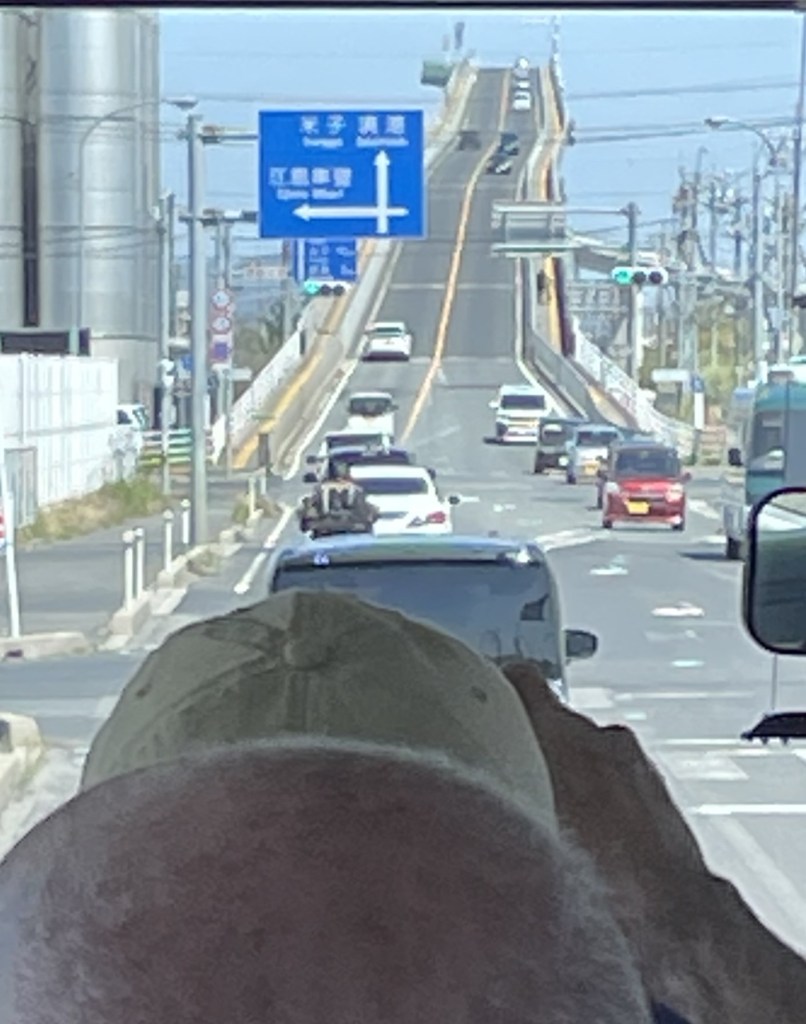
On our way back to Tottori prefecture and our ship, we cross the Eshima Ohashi Bridge. It tops out at about forty or so meters in height, and although it looks steep when we’re headed straight at it, the ascent angle is only about six degrees or so. It’s famous enough to have been used for automobile commercials, and it’s an actual shore excursion in its own right; tourists take pictures of and from this bridge.
***
We arrive back at the terminal, but like I said earlier, we’re not about to go back onboard. If we have to get our passports stamped as if we were exiting the country, we want to take in as much as we can first; especially considering that it’s not even today yet back at home.
So we head for that dome that we’d spotted earlier.
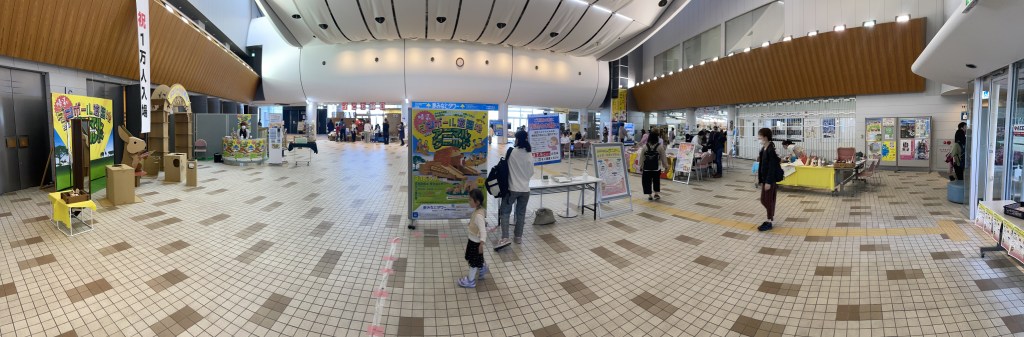
And it turns out, they’re having a little festival of their own; not that I can spend this ¥10K bill there, either (as if there was anything we were interested in buying there in the first place. The town’s mascot, a green duck in a sailor suit with the body of an apple, is available in plushie form, but Daniel has decided that he owns enough plushies)
So we hop on the shuttle into town. We figure we’ll be there for an hour or so, tops. Which is a good thing, as the last one leaves town in two, at four.
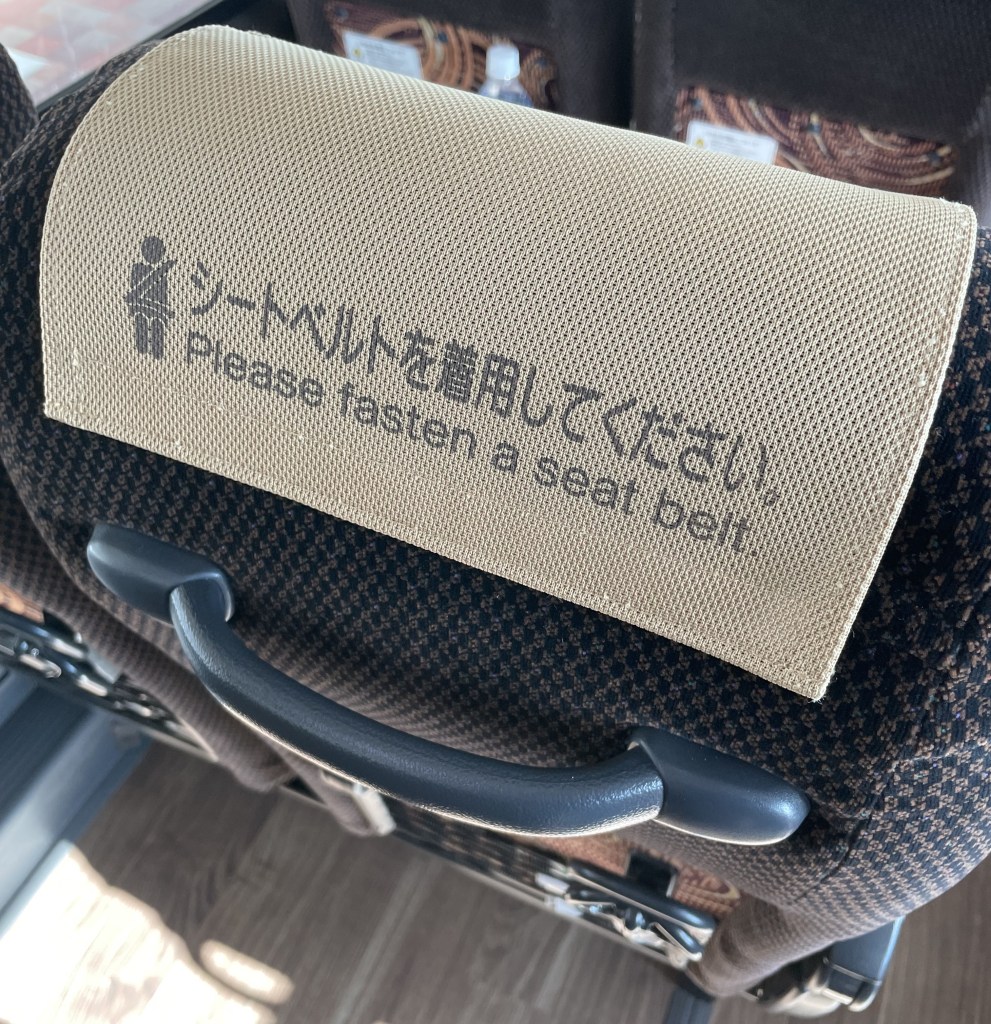
I should take a moment to mention that seatbelts are required while riding the bus in Japan; however, thanks to a translation error, it can be argued that one does not necessarily have to fasten their own seatbelt, just a seatbelt.
It takes maybe ten minutes or so before we find ourselves at a small parking lot next to the train station (which I should mention is nothing like Niigata’s. The line literally dead-ends here, and the station is tiny), next to the city’s community center.
The community center next to the station is practically a museum dedicated to their favorite son, Shigeru Mizuki, and his artwork. Even though GeGeGe no Kitaro is a manga, the fact that Daniel hasn’t heard of it means he’s not particularly interested in it; and anyway, art displays don’t appeal to him in general.
Then again, it might just be his stomach talking. He didn’t have nearly as much breakfast as I did this morning. And while he may not have been particularly interested in anything being offered at the stalls by Matsue Castle, his hunger is starting to catch up with him. Can we find something for him to eat?
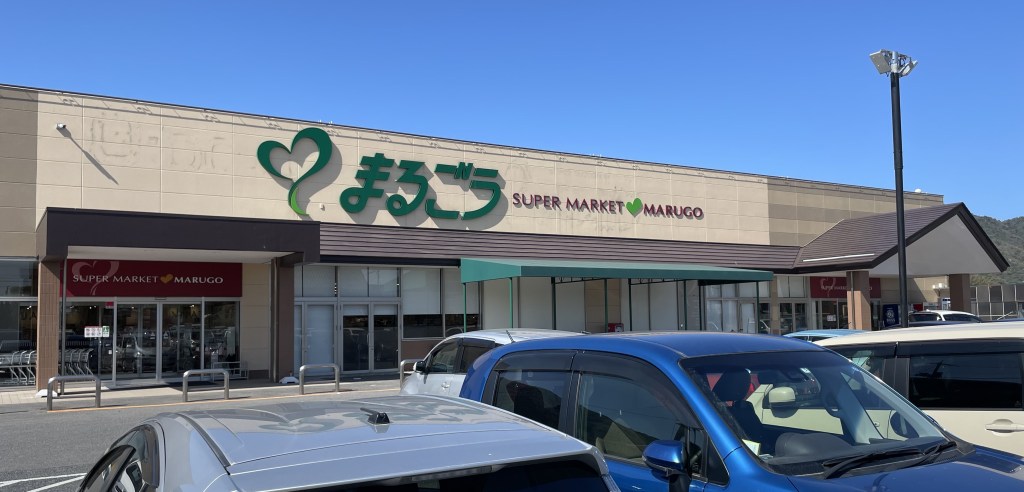
Well… kind of. On the other side of our drop-off point, we find a supermarket. I can’t help observing that the only way I can get him to willingly go shopping with me is to do so in a foreign country.
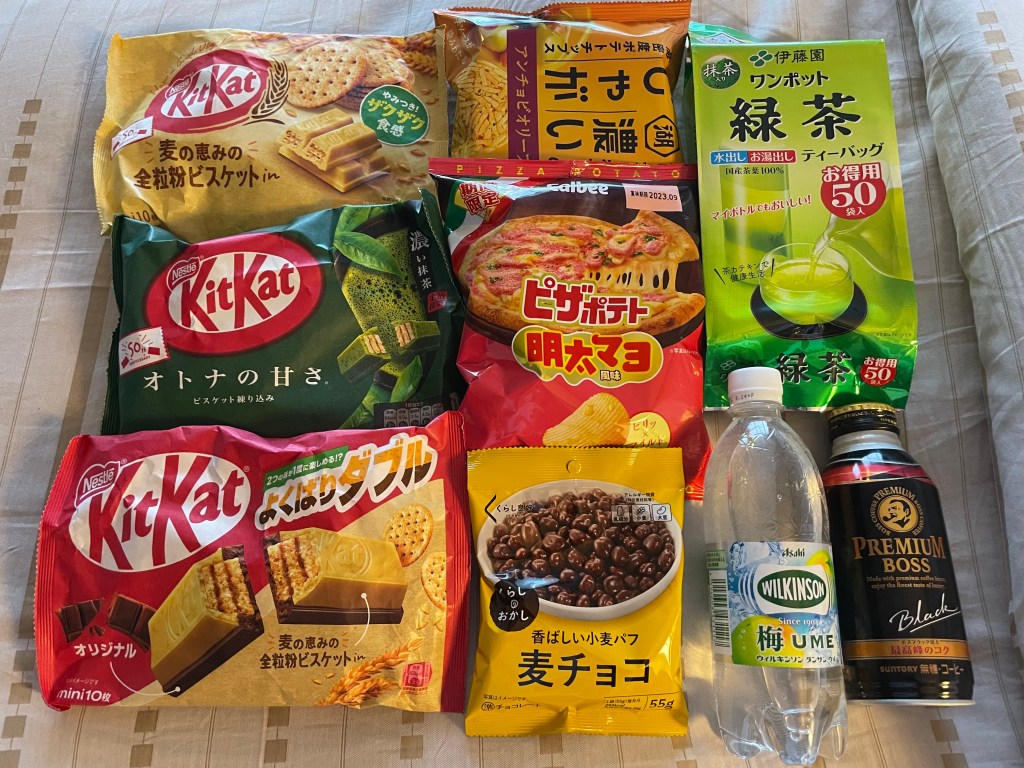
On the other hand, I’m the one picking most of the stuff to bring back to the ship (including some green tea per Kris’ request – the only person to specifically ask for something in particular from our trip). And it’s not like a grocery wouldn’t be accustomed to dealing with large bills. Indeed, when we finally decide to check out, we’re stuck behind a customer with three baskets of purchases. Some things are universal, after all.
Granted, when we get to the snack aisle, there are a few things that pique Daniel’s interest, such as the odd flavors of KitKats…
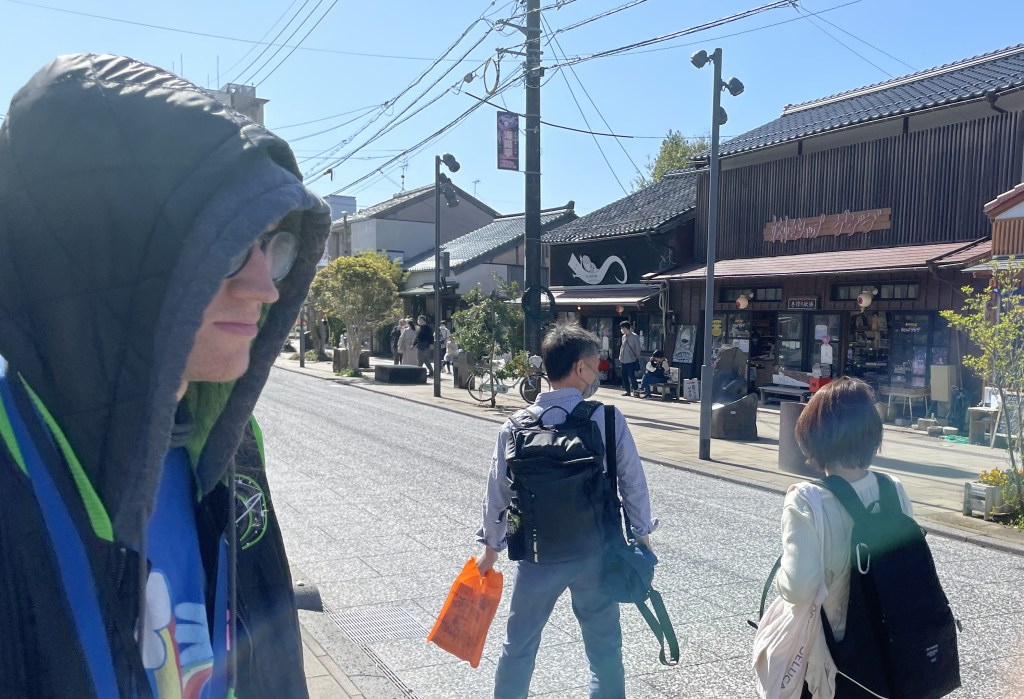
…but really, what he had in mind what a place where we could buy something ready to eat, as opposed to this sort of stuff. So we leave the market, and head down a block before turning left in the direction of the community center. We think we see something in the distance as we left the parking lot, but by the time we get where we think it ought to be, there doesn’t seem to be anything there. We turn left again, heading north; we’re simply making a wide circle around where the city center is supposed to be…
…and then, we find it, sort of. A street full of souvenir shops and the like, all Kitaro-themed.
Even a modest little park featuring various monsters from the Kitarofranchise.
Not really appealing, until we spot a place selling food across the street. We all but jaywalk in order to get there… and discover to our dismay that we don’t know what anything pictured is, or how to ask for it (assuming Daniel wanted it). So it seems we end up less than satisfied on either side of the prefectural border, albeit for very different reasons.
Then again, there’s always plenty to eat on the ship. So we hop on the next shuttle, and now, we’re off to get ourselves some dinner.
Anyway, I’ll keep in touch, honey. Keep an eye on us, and wish us luck; we’re going to need it.


 Letters to Rachel