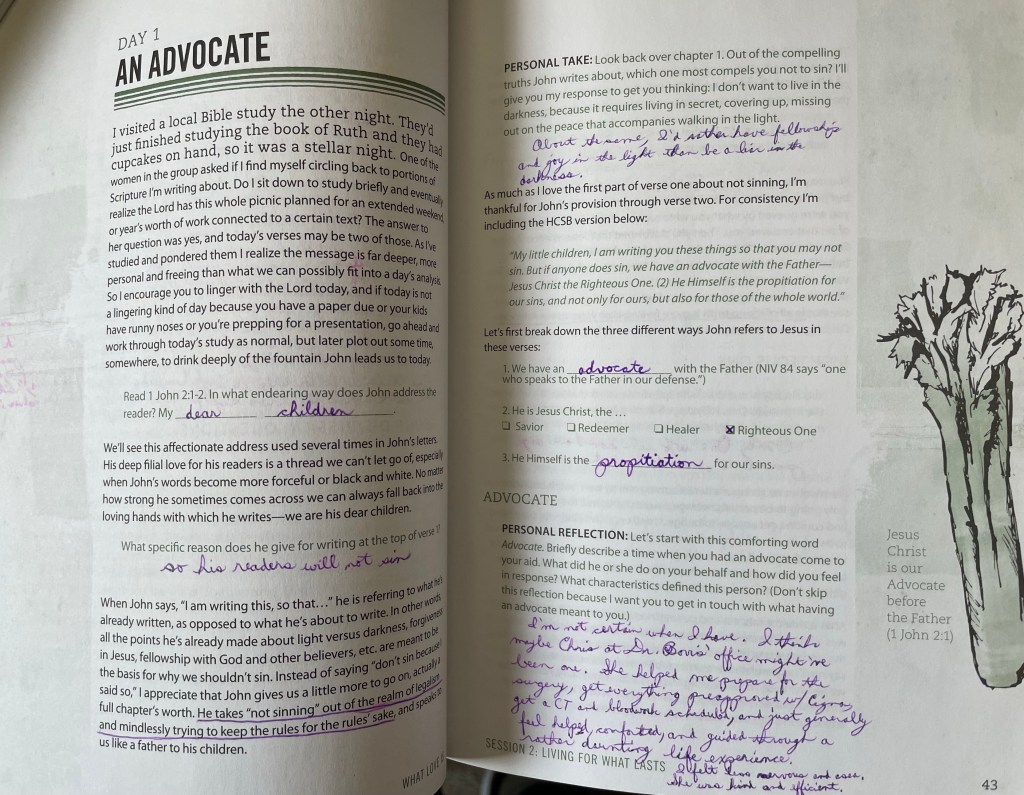

Read 1 John 2:1-2. In what endearing way does John address the reader? My “dear children”.
What specific reason does he give for writing at the top of verse 1?
“So his readers will not sin.”
[John] takes “not sinning” out of the realm of legalism and mindlessly trying to keep the rules for the rules’ sake
Look back over chapter 1. Out of the compelling truths John writes about, which one most compels you not to sin? I’ll give you my response to get you thinking: I don’t want to live in the darkness, because it requires living in secret, covering up, missing out on the peace that accompanies walking in the light.
“About the same; I’d rather have fellowship and joy in the light than be a liar in the darkness.”
Let’s first break down the three different ways John refers to Jesus in these verses:
1. We have an “advocate ” with the Father (NIV 84 says ‘one who speaks to the Father in our defense’)
2. He is Jesus Christ, the “Righteous One”
3. He Himself is the “propitiation” for our sins
Let’s start with this comforting word Advocate. Briefly describe a time when you had an advocate come to your aid. What did he or she do on your behalf and how did you feel in response? What characteristics defined this person? (Don’t skip this reflection because I want you to get in touch with what having an advocate meant to you.)
“I’m not certain when I have. I think maybe Chris at Dr. Bovis’ office might’ve been one. She helped me prepare for the surgery, get everything preapproved with CIGNA, get a CT and bloodwork scheduled, and just generally feel helped, comforted, and guided through a rather daunting life experience. I felt less nervous and at sea. She was kind and efficient.”
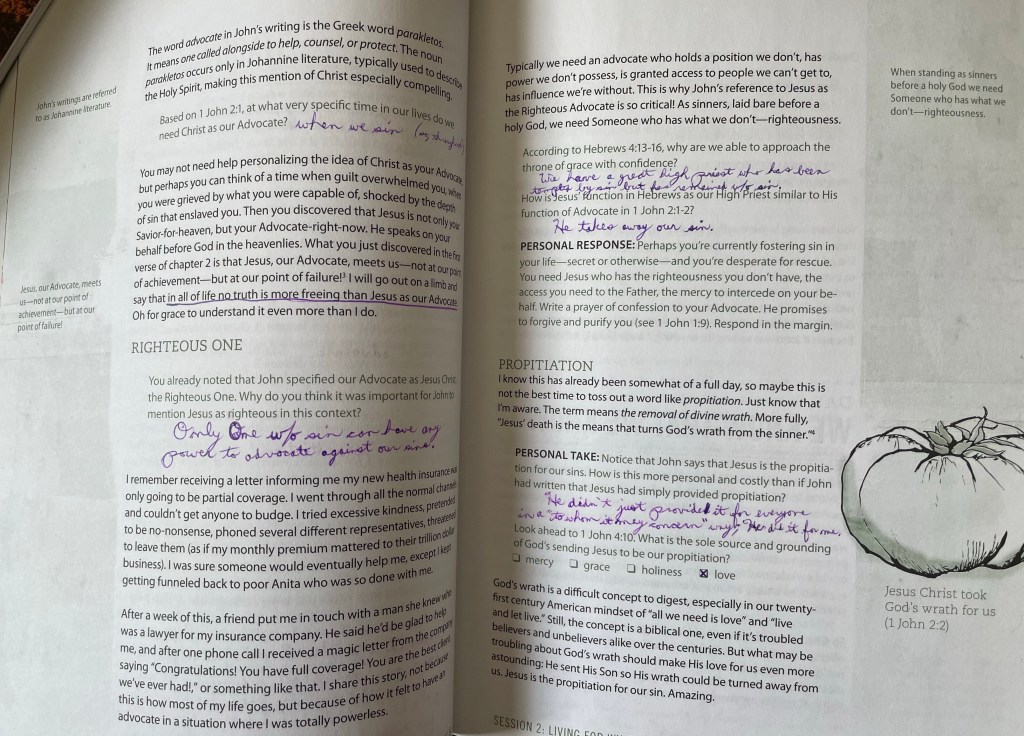
Based on 1 John 2:1, at what very specific time in our lives do we need Christ as our Advocate?
“When we sin (so, throughout)”
You already noted that John specified our advocate as Jesus Christ, the Righteous One. Why do you think it was important for John to mention Jesus as righteous in this context?
“Only One without sin can have any power to advocate against our sin.”
According to Hebrews 4:13-16, why are we able to approach the throne of grace with confidence?
“We have a great high priest who has been tempted by sin, but has remained without sin.”
How is Jesus’ function in Hebrews as our High Priest similar to his function of Advocate in 1 John 2:1-2?
“He takes away our sin.”
Notice that John says that Jesus is the propitiation for our sins. How is this more personal and costly than if John had written that Jesus had simply provided propitiation?
“He didn’t just provide it for everyone in a ‘to whom it may concern’ way; he did it for me.”
“Thank you, God, for sending Your Son to be the propitiation for my sins. Thank You, Jesus, for willingly being sent and for all You still do today. Words are not enough. Thank You. Amen.”
Dearest Rachel –
It does help to relate to certain concepts by having suitable real-life examples to recall. Just like someone with a good relationship with their parents can have a better grasp of what God the Father is like (just as an example), so too does the idea of Jesus as our Advocate make more sense when you’ve experienced advocacy in a real life situation (not that our Christian life isn’t real life, but you know what I mean).
And so, despite a moment of indecision (which you couldn’t take back when an example came to mind, since you insisted on using ink – not that this was a bad thing, as your use of purple ink made it obvious that it was something you wrote, and thus identified anything to Jan as not to be thrown out, so there’s that), you certainly had someone in Chris. Your having to go through brain surgery, while not necessarily a life-or-death case at the time, was still a traumatic experience to deal with; having to deal with the paperwork on your own, without any guidance, would have made things so much worse. The fact that she was accustomed to the procedure allowed her to walk you through it with a minimum of fuss, laying the groundwork for all you still needed to do to prepare for the procedure (and to make sure it was paid for – for all that we’ve paid into health insurance over the years, the amount handled with this procedure and the follow-up gamma knife surgeries have certainly given us our money’s worth).
Of course, I tend to think of a lawyer when I consider the term; and although neither of us has ever been a defendant on trial, I can still picture the scene. Given that the name ‘Satan’ literally means ‘accuser,’ it’s like an unending stream of litigation:
“Your Honor, look what Randy’s done this time! Now, Your laws state that You’re supposed to throw the book at him!”
And Jesus stands up like Phoenix Wright; “Objection, Father! I paid the penalty for that transgression already. I move to dismiss these charges.”
To which the Father nods sagely. “Objection sustained. The court indeed has the record of payment. Motion accepted; case dismissed.” Honestly, you would think that the devil would get tired of playing such a constantly losing game. But I guess, given eternity, he has to occupy himself with something. Meanwhile, some day, the Lord will presumably tire of such a vexatious litigant, and bar him from the court; for myself, I can’t wait to see it happen.
But until then, honey, keep an eye on me, and wish me luck. I’m going to need it.

 Letters to Rachel