Dearest Rachel –
The first time we heard this phrase was the last time we were in Israel. Our guide, Irad, claimed no credit for it; he had, on a recent tour previous, been asked about them from a pair of twenty-something girls, and liked the expression so much as to ask permission to borrow it from them, and used it repeatedly (often in the negative, as “there won’t be any time for shopportunities” at this or that location) throughout the course of the tour.
Ironically, despite calling attention to it like that, I would venture a guess that we had more such occasion to do so on that trip as we have on this one. And that’s fine with the two of us; we don’t need anything from here ourselves, and it’s hard to take into account gifts for others unless we have specific instructions for them. Besides, this is an educational tour, for spiritual edification; the commercial nature is something of an interference to that. Daniel, in particular
And yet…
The Holy Land in its entirety owes much of its survival to commerce. The Moslem inhabitants of the Levant may have little love for the other “people of the book,” but the fact that they were willing to come and spent money as pilgrims made them reconsider the idea of letting them visit in peace. Better they come as pilgrims bringing gold, than as knights bearing swords.
Indeed, Amro, our tour guide here in the Palestinian Authority, mentions that Bethlehem runs entirely on tourism. When Covid hit, and tourism dried up, the city was dealing with a staggering 85% unemployment rate.
Besides, at our first stop, the families that work and make their living here are Christian Palestinians – making them a minority within a minority. One might consider them worthy of support based solely on that.

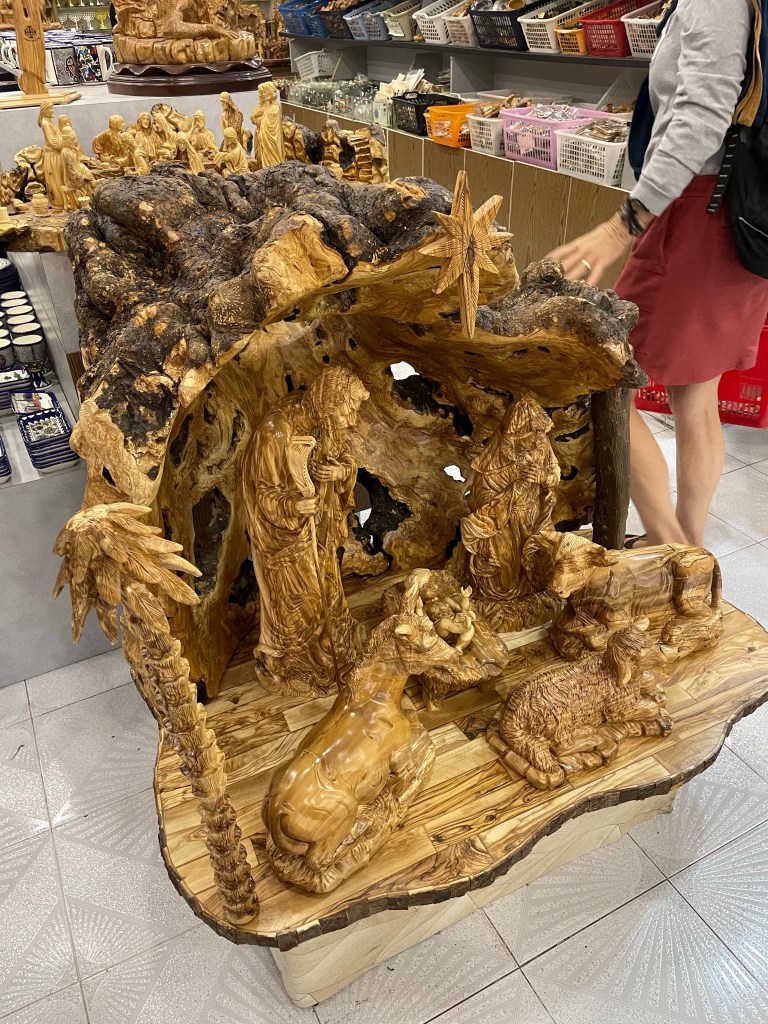
One other bit of olive tree trivia; evidently there are a few, a little ways south of here, that are still producing fruit despite being 5,000 years old. There are even some that are as much as 7,500 years old, but are not producing fruit anymore.
Anyway, Daniel and I have no one to shop for here – not even for the upcoming Christmas holidays – and no need ourselves for any of the paraphernalia offered for sale. Indeed, Daniel is quite disdainful of the icons, rosaries and other tchotchkes that seem to belong to a completely different religion than ours, despite their claims to the contrary. While we may be able to be impressed by the artwork, and certainly can ‘respect the hustle,’ as the saying goes, we feel no desire to participate in any of it.

We leave the shop, and travel on to our next destination – the Shepherds’ Field, outside of Bethlehem.
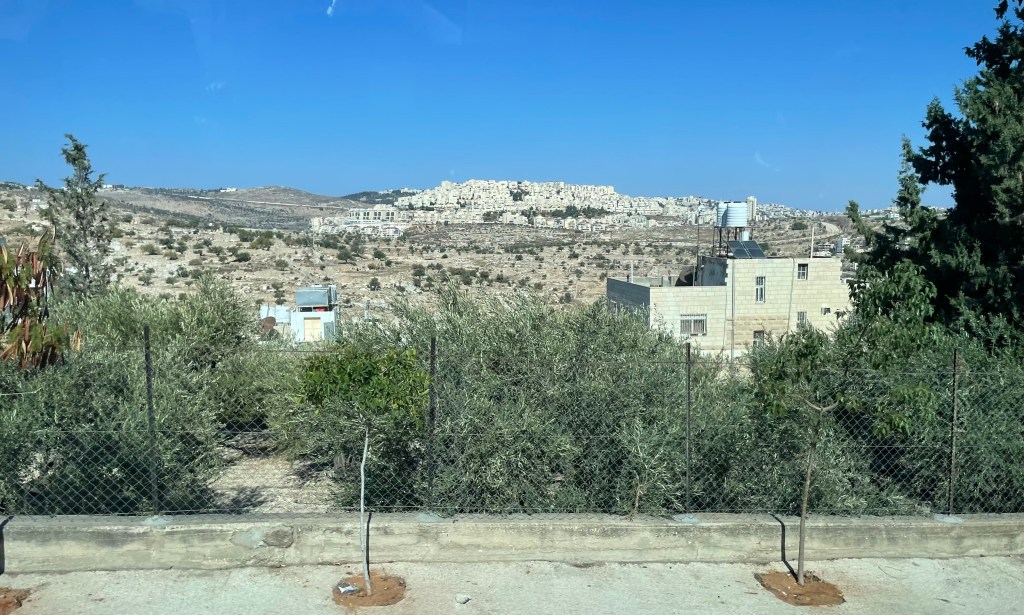
According to Amro, it’s busy in Bethlehem, now the tourists are back. In fact, you can hardly get transportation or a hotel any place anymore. So it seems the more they change, the more things stay the same: there is still no room at the inn.

Junior doesn’t put a lot of stock in that, as the altars were placed thirty or forty years after the fact, and one cave looks much like another, which is undeniably true. Then again, other ‘A’ and ‘B’ sites are based on where Byzantine churches were erected to commemorate a given event in scripture, which were built hundreds of years later, rather than mere decades.

It’s observed that Mary and Joseph might have been kept from an inn (or a family home thus used during this period of census and taxation) because of the shame of being pregnant out of wedlock; it may have been more than simply a simple matter of ‘no vacancy.’ Indeed, it’s almost as if she was being treated badly to humiliate her; the implication being, if you’re going to rut like an animal, go to the stables and give birth like one, too.
Amro adds that publicly giving birth (or at least, having an ‘innkeeper’ assist in the process) would have made her vulnerable to Herod the Great’s order to kill all baby boys in Bethlehem. Doing so in secret would have allowed them to sneak out to Egypt without being noticed upon receiving the angel’s warning, but if the innkeeper had been an informant, well…
Still, that leaves open the question of the timeline, as the magi found the family in a house at that point, rather than in the stable.

Amro asks us “why give the message to the shepherds?” They were likely teenagers, children of slaves. The hills were full of wild animals – leaving the flocks behind could cost them their life, if they lost any of their sheep, and running up the hill into the city might make them a tasty meal for the lions, too. And when they spread the word, would they have been believed? Not likely… and yet, the word was given to them first. And they went – immediately – to check it out. And once they saw what they did, they spread the news, regardless of whether they would be believed or not.
It seems that this very reason is why they were chosen to be the first to bear the news. Even though they were not considered reliable witnesses, it was for that very reason it becomes more realistic. True, if one were to make an announcement of a King to come, it would go to the highest echelons of the ruling and reporting classes for wide dissemination. But real-life events don’t happen that way. God used kids, working the fields on a dark night, far away from the city proper (a city, I might add, that was of relatively little importance – even being David’s home town didn’t give it much cachet, as it was still considered a little podunk town in Micah’s day, long after King David. God used these apparent weaknesses to proclaim the first of His great truths about His Son, just as women (also considered unreliable witnesses) to be the ones to first see the final one, that of His resurrection.
Anyway, I’ve got more to come. Talk to you later, honey.

 Letters to Rachel
One thought on “Shopportunities”