Dearest Rachel –
After visiting Bethlehem and the shepherd’s caves, we head back into Israel proper. While we never needed our passports (because isn’t it still Israel? I mean, there is no separate country of Palestine at the moment), it has all the feel of a border crossing otherwise.


As we arrive at Nebe Samuel, the tomb of the prophet and judge before the kings of Israel were established, we stop to pray for Laura; she’d just gotten word that her mother Barb, has suffered a stroke. Paul leads a group prayer for Barb, acknowledging that “distance means nothing to [God]” a prayer offered from halfway across the world will be just as effective as one right at her bedside
Thankfully, volume also means nothing to Him, either; as Paul begins his prayer, we are interrupted by the call to prayer from a minaret at the top of the mountain that dominates the valley

Actually, this mountain is the site of a city known as Mizpah, with plenty of archaeological finds going back as far as the 10th-11th century BC. However, during the Crusaders’ time, there was a city known as Ramlah, which they took to be Ramah (it isn’t, of course, but it apparently didn’t matter to the Crusaders), and built a fortress here, claiming it sat atop Samuel’s tomb.

I ask Yael about Mizpah, since it’s referenced as far back as Genesis 31, when Jacob attempted to flee from Laban. She recognizes the connection, but hedges her bets, acknowledging that there are several different places with the name Mizpah, so this may not be that Mizpah.

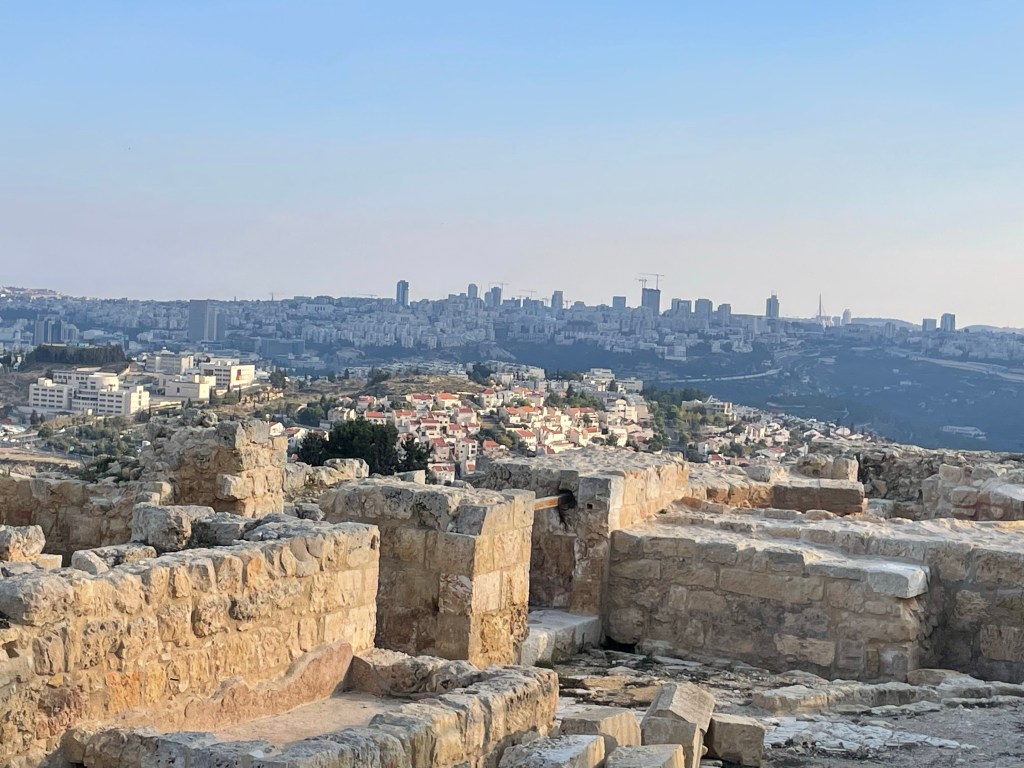
Speaking of the line of sight, yell tries to negotiate a way for us to go up the tower and see that much better from that much further up. However, what with it being Friday, and this being a mosque, there are services going on, and thus, the tower is closed.
In fact, according to get out, the congregants, (or whatever you would call them), are performing something roughly akin to a mikvah. Before prayer, they are washing their feet, their hands, their face and behind their ears. Several people ask why, and while Yael seems to just shrug, I have what I refer to as a “Liar’s Club” answer – one that, without a quick way to check otherwise, seems plausible, but I’m really just bluffing – that they are purifying themselves from where they have been, what they have done, what they have seen (and perhaps said) and what they have heard, respectively.
***
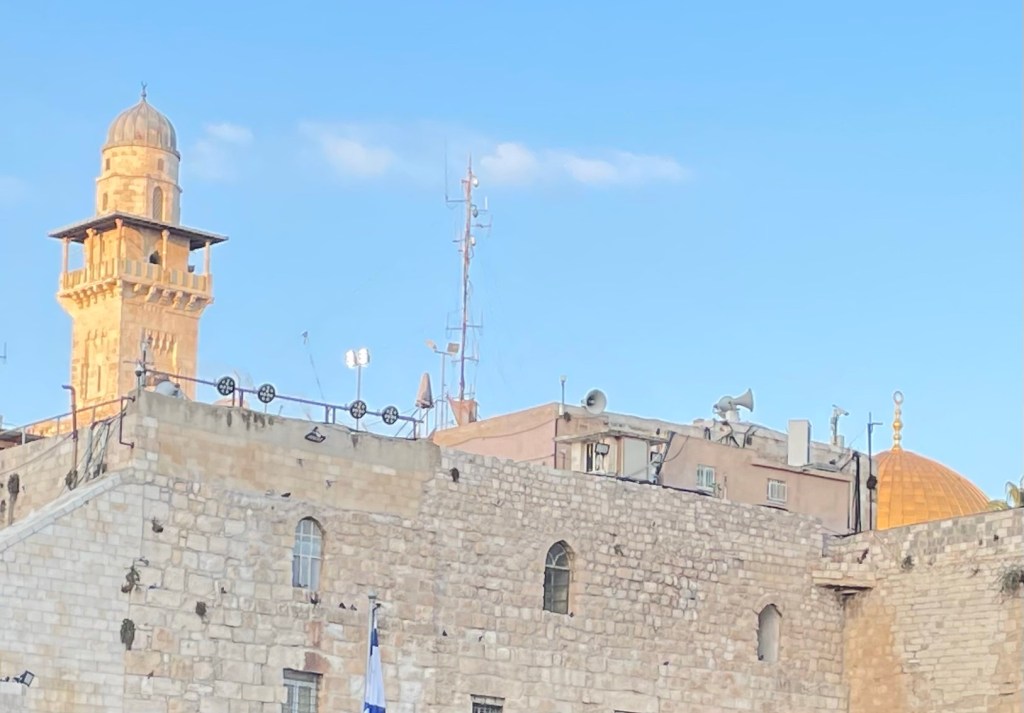
Our final stop before Shabbat begins is a return to the Western Wall. Since by the time we are there, Shabbat will be starting, we will not be allowed to take pictures or taking notes, either of which will be considered ‘work,’ and thus offensive to Jewish sensibilities. Yael will still be with us, doing her job, however.
Along those same lines, there’s some question among us as to whether Yael holding the antenna with the sock (which she’s been using all week to rally us around like a flag) constitutes work, and if it’s forbidden. Then again, as I recall, those celebrating at the Wailing Wall on Shabbat the last time we were here were waving flags, so apparently that’s not a problem.
On that subject, what happens if you’re stuck in traffic when the sun sets on Friday evening? I’m sure that, like cheese and chicken, it’s been a topic of much debate in the synagogues for quite some time; the question is, have they come up with an answer?
And what would Jesus have said about the matter?
It’s so very confusing.
***
Shabbat at the Wall is a study in contrasts. Daniel and I follow Junior, Denim and Jordan into the synagogue by the men’s side of the wall. A number of men, dressed in traditional Hasidic garb, are hauling chairs on dollies (and I’ll ask you to let what they’re doing sink in for a moment) to in front of the Wall. Many of them then sit on these chairs, reading scriptures, and praying, some bowing back and forth repeatedly. Inside the synagogue, with its vaulted stone ceiling, men mill about with scriptures of their own. There is a glass floor that opens onto a portion of stone floor that Junior thinks may date from as far back as the First Temple period (and it’s deep enough that I’m not about to contest his assertion). At least one man stands in a corner, bowing toward the Wall, and kissing it within the synagogue.
Outside, and at a remove from the Wall, a mass of young people are bouncing up and down, chanting and singing. Yael translates one as a children’s song about Shabbat: “Who likes Shabbat? Mom and Dad! Who likes Shabbat? Grandma and Grandpa! So why isn’t every day Shabbat?” Their celebration reminds me of a group cheering a football match victory (and by that, I mean soccer, but you understand that); others see it as something of a mosh pit. Some of our group even jump into the crowd running in circles together.
It seems to me that the latter group understands better what God has done, in returning Israel back from all the adversity it (and more to the point, its people) has suffered. You would think this would be cause for celebration, not mourning. But celebration requires a certain level of abandon, of letting yourself go, like David before the Ark. The first group seems so very concerned about following every letter of every law, even the ones set around laws to keep one from even coming close to breaking the original ones buried deep within the wider proscriptions, that they just can’t bring themselves to do that. To me, they seem an awful lot like his wife Michal (and won’t they just hate being compared to a woman, let alone one regarded so poorly in the scriptures?)
But, hey, what does a goyische like myself know?
Anyway, thanks for keeping an eye on the two of us, honey. We’ll be heading home tomorrow, so wish us luck. We’re going to need it.

 Letters to Rachel
One thought on “Return to Israel”