Dearest Rachel –
Since thus far, we really haven’t had the time for shopping, it would seem that merchants have decided to come to us. I mentioned about Junior plugging tattoos yesterday; today, we had a guy aboard the bus, shilling personalized necklaces and rings. I’m not gonna lie, I was briefly tempted to get something with your name in Hebrew on it. But as I thought about it, I realized I’d not be likely to wear it in real life. Sometimes, you just have to be brutally practical, and not just buy something that you think will be a keepsake, but will just wind up in some drawer somewhere. I’ve bought enough stuff out of grief already this past year or so; I have to draw the line somewhere.
As the bus wends its way up the zigzagging roads leading to the top of the Mount of Olives, a standard sized car attempts to squeeze between us and another bus heading in the opposite direction. It’s a wonder there wasn’t a crash; as it was, there is a lot of honking before everybody manages to get on their way. The crazy driving (augmented by our earlier experience with the shuttle driver from the City of David) leave Daniel and I imagining a new installation to the GTA series. Can’t you just picture it? Grand Theft Auto 7: Holy City.
Junior offers a prayer for us as we begin the day, encouraging us to find a place of quiet and calm amid the chaos of Jerusalem, all the while acknowledging that this is going to be quite challenging – especially as we’re assaulted by beggars and vendors as we disembark.

Junior asks if we have been feeling any broken-heartedness about others, or if we have been too calloused or selfish to notice. I know all too well that I’ve been a bit too wrapped up with myself and my own struggles since you left, so this is something I need to work on. Ironically, I wasn’t very good at noticing others even beforehand – you were much more sensitive to others’ need than I – so losing you made me that much more susceptible to selfishness, even without considering my grief.
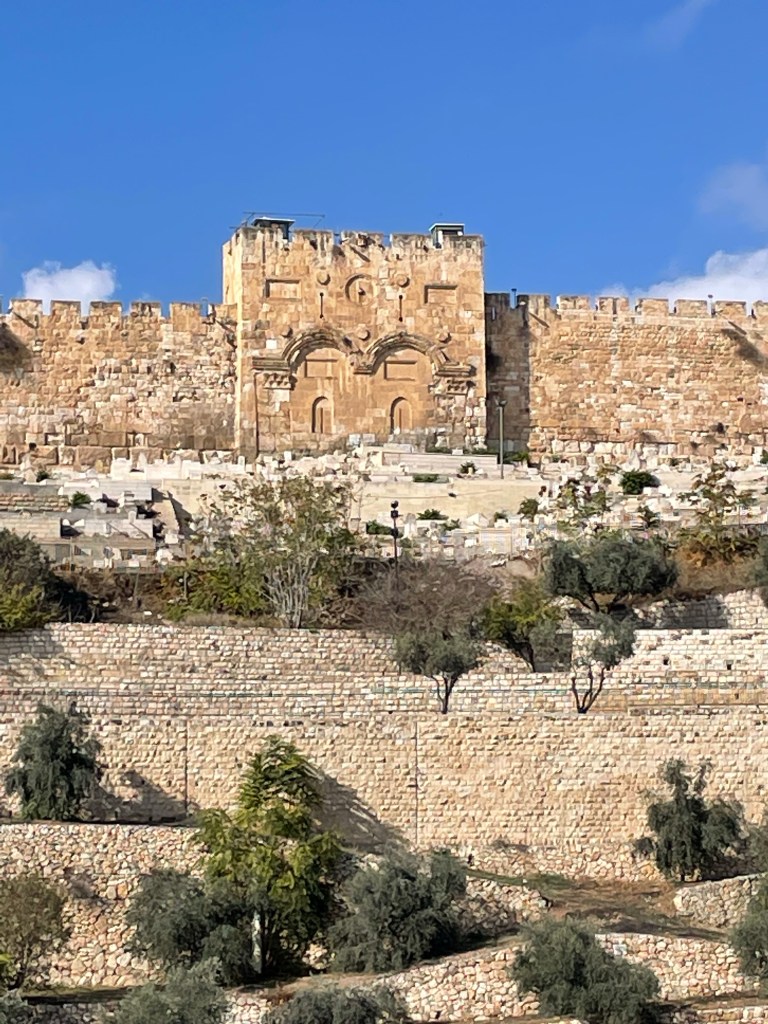
Chad claims to have seen a graffito reading “Jesus was here.” Well, i suppose it’s not wrong. Pity I didn’t get a picture of that… until I ask him if he got a picture, to which he admits he made it all up. Way to spoil it for me, Chad…
We don’t have time to walk down the mountain (which you’ll remember Dad being so proud of being able to do, and grateful for our help in getting him and Mom down safely last time we were all here); in fact, we hadn’t planned on going to the top of the mountain at all, but this was a bonus. Then again, Yael observes that, in this traffic, we might just get to Gethsemane faster on foot.


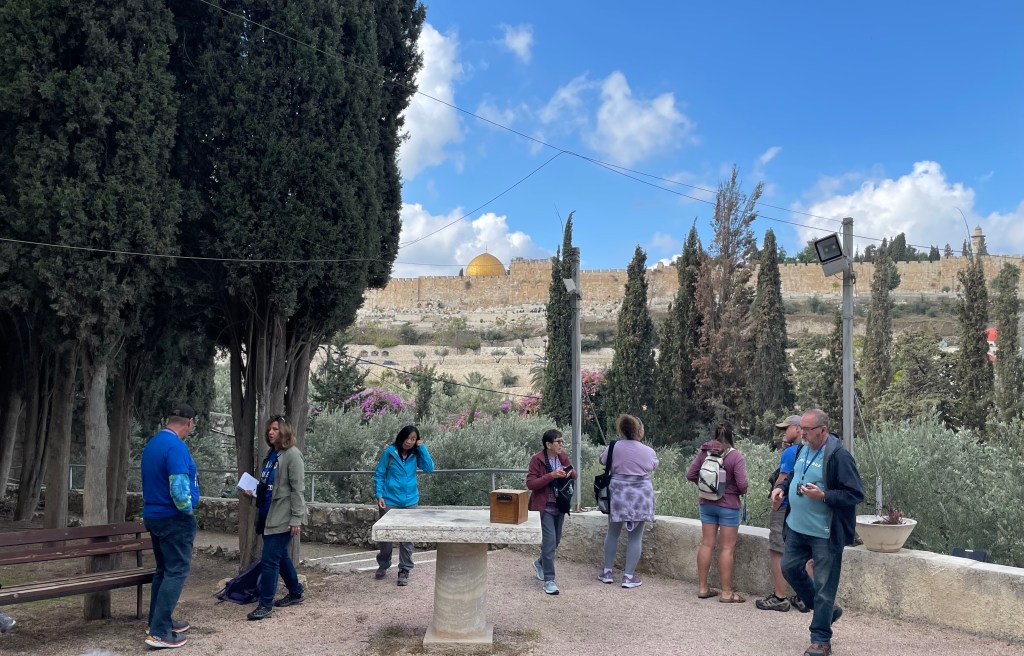
It would probably have been warmer and more muggy here that night, being in late March or early April. The humidity might have made it feel that much more oppressive, in fact, both weighing on Jesus, and lulling the disciples to sleep (a heavy supper and the four glasses of wine with the Seder couldn’t have done them any favors, either). Of course, they (unlike Him) would have had no idea what was to come, and how soon it would be upon them. The thought that they would all be scattered within hours would have seemed almost impossible to them.
Just as the fall happened in a garden, now long lost to all of us (and probably literally washed away with the flood), so too did the first steps toward our redemption take place in a garden; this garden. It was a moment for Him to cry out to His Father before the chaos enveloped Him – and ultimately, the whole world. But it was a chaos leading to our entree into heaven, for which I have to be so grateful for, as I know you’re there, and I’ll catch up with you eventually.
To think that He was arrested – bound up with ropes – and marched into the city at spear point is hard to believe. Imagine, humans tying up God Himself, as if they were in control of Him. Especially since, when He responded as to whether He was Who they were looking for (“I am,” which, being the Name of God, would have had some punch behind it), they were sent reeling backwards; and forcing Him to go in a direction of their choosing.
But were they really? Or was it His choice all along as well? He stated at the time that He had the power to call legions of angels – and those listening would know just how many were in so great a company – to rescue Him. But He didn’t. He didn’t resist, He didn’t fight – He even told Peter to stand down, and healed the servant he had struck. These don’t seem like the acts of one who is not in control, even in the midst of this chaos.
We are, as a group, accosted by a merchant whose stall we stand in front of as we wait for the bus. Yael apologizes for this, as it’s a common feature (or would it be a bug?) of any holy site in and around the old city. It is an irritation for the chaos to impinge upon the contemplative like that, but it’s a necessary aspect of life; people have to make a living.
We drive past dug-up areas on our way to the garden tomb. “Is that construction or archeology?” asks Daniel. Probably both; if you dig for relics, and find nothing, you’ll probably want to use the area to build something. Whereas, if you’re planning to build something, and hit relics, well… then you’re stuck with a dig site, like at Magdala. You just never know what you’ll find, here in Israel, and Jerusalem in particular.
Our guide here to the Garden Tomb, Philip, happens to have a brother named David, who actually attends (periodically) our own Des Plaines campus. Apparently, Junior was already aware of the possibility we might meet him here.
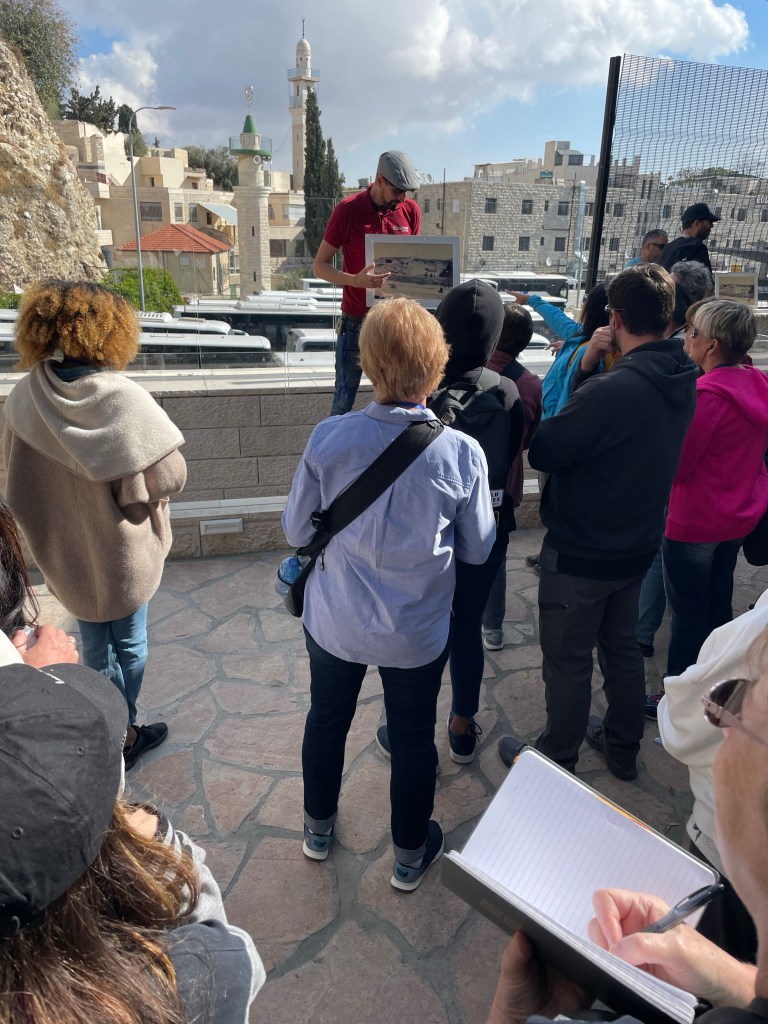
He emphasizes that, in the final analysis, it matters little about exactly where. Whether it was fifty yards away or five hundred is really hardly relevant. The fact is, it happened somewhere reasonably nearby, and since this place looks very much like the place would have looked back then, one can get a feel for the look of it.
Philip points out that the Scriptures don’t say it happened on the hill; in fact, had it done so, passersby wouldn’t be staring the convicted in the face as they went by, which humiliation was part of the point of such punishments. It may just have been more likely to have happened in the ravine itself, where there is now nothing more than a bus station.
The thing about the garden tomb, and for that matter with the hill that purports to be called Golgotha, is that there is no way to prove which site is the real one, by definition. You can’t tell where He was buried, because there are no remains. Indeed, that’s the whole point.
That being said, John’s description states that the tomb was in a garden (which we might think of as an orchard or a small plantation, as opposed to the ornamental garden we tend to think of), and the garden was very near to the site of the crucifixion itself. This place does have a wine press from those days, which would suggest this area would fit John’s description.
Additionally, He was buried in a new tomb, not a long-used family tomb. There’s a different impact between getting there on Sunday morning to find one less body as opposed to getting there and finding nothing inside.
Speaking of finding nothing inside… I’m mildly stunned to see that the door and the sign are no longer within the tomb. Philip mentions that it was removed recently, but that the verse is still somewhere within the campus.
Philip also points out that the limestone that was quarried here proved too soft for use in building, but it was an excellent place to carve out a cave for use as a tomb. Junior builds on this point to note that these stones were thus rejected by the builders, but upon them, the cornerstone of our faith was based.
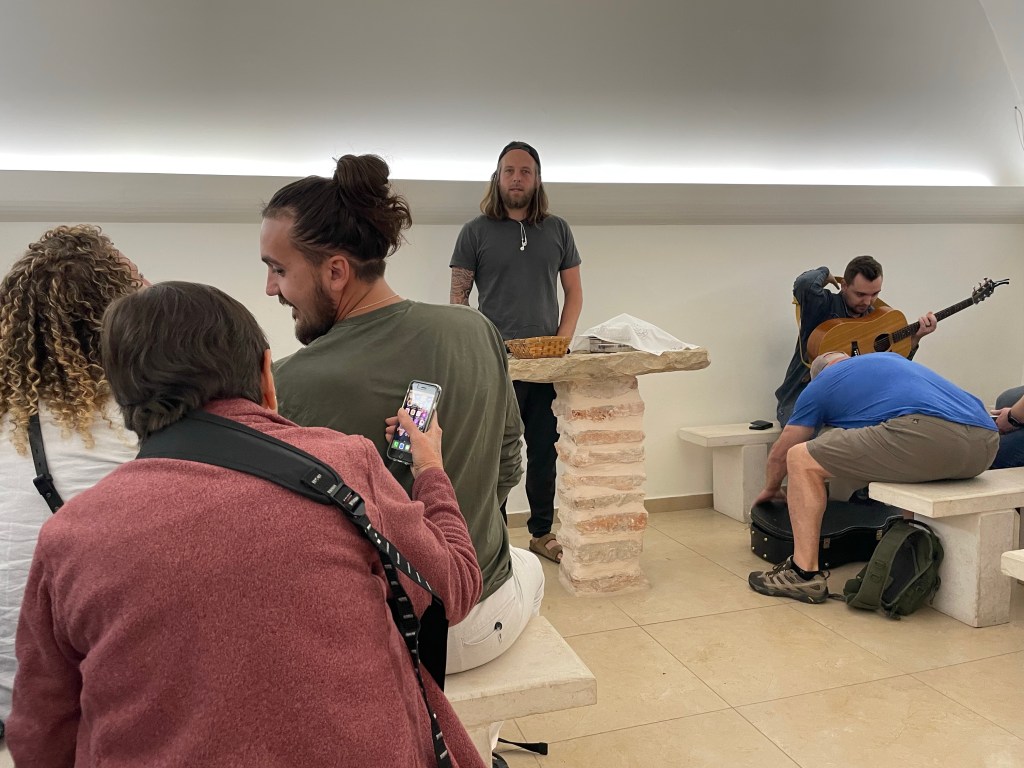
Among those moments, one person mentions how much might have happened throughout this country in those three years of His ministry that we don’t know about. I understand that completely; in barely half that time, I’ve written more words to you than are in the entire Bible, and I guarantee that what’s happened to me has been infinitely less important
For me? It actually occurs to me that, despite my (somewhat disappointed, for a first time) surprise, it doesn’t really matter that the sign isn’t here, just as it doesn’t matter if He was buried here. What matters is what it says: that He rose, and that, once day, so will we.

Until that day when we see each other – and Him – again, keep an eye on me. I’ll fill you in on more of what’s happening soon enough.

 Letters to Rachel
One thought on “Calm Amid the Chaos”