Dearest Rachel –
It’s 8 a.m., and we’re underway – to some applause, as we actually pulled out at 7:59. Considering that I felt like I was being order to be ready to go by 7:45 (and I know, I shouldn’t take it personally if I’m not the one guilty of being late) I don’t quite see what the cheering is all about, since we didn’t leave by the appointed time. I should let it go, but I feel like I ought to admit to my own impressions as well; whether I have a right to feel this way, I’ll leave to you to decide.
***
Daniel has been talking with Yael about the kosher requirements; specifically, about dairy at breakfast, and meat at dinner, and never combining the two together. Turns out, I was right about the why; there’s that one verse, and one verse alone, that instructs the children of Israel not to boil a calf in its mother’s milk. Why anyone would want to do that in the first place, I couldn’t begin to guess. My study Bible suggests it might be some ancient pagan ritual, or augury – which, if so, I can understand why the Lord would issue an injunction against it. And I suppose that the Talmud and other commentaries simply built an added wall (or two, or three) around that instruction that led to the rule about no milk and meat ever – just in case the milk came from the beef cow’s mother. It’s definitely one of those ‘rules around rules around rules’ that Jesus must’ve just deplored about the Pharisees.
In fact, it rather begs the question about things like poultry, since everyone knows, you can’t milk a chicken. So there’s no danger of this ‘mother-and-child reunion’ if you were to slap a piece of cheese on a chicken breast. The only situation that might be considered questionable would be if you were to assemble a dish that combines chicken and eggs together. And even that sounds so far away from the original command as to be ludicrous.
According to Daniel, Yael suggests that this question might well have been the topic of heated debate in the synagogues, both now and way back when. Granted – and I understand this – the hotels and restaurants here have simply decided to err on the farthest side of caution. It may irritate us cheeseburger-eaters, but they know we’ll deal with it; the ultra-orthodox would just take their business elsewhere (and likely tell their friends to never go there, either), and hotels and restaurants can ill afford such silent boycotts.
***
For all our attempts to pack away as much as we can, and bring what we think we need, I’m caught by surprise by our first stop. I’m preparing for a trip south, to the Dead Sea and the like, where it’s hot and dry, and as such, I’m unprepared for the chill and rain as we arrive at Bet-She’an. We’ve actually gone west, rather than south, albeit not far, regardless.

At least we haven’t gone north – not like there’s much more north to Israel than where we’ve already been. Also, the rain isn’t too bad. It’s just enough that I feel it on the top of my cap as it drips from the leaves as we pass underneath.

Yael talks about how the bathhouse was primarily for men, although there were certain, ah, working girls, who would operate out of here for the men’s entertainment and enjoyment.
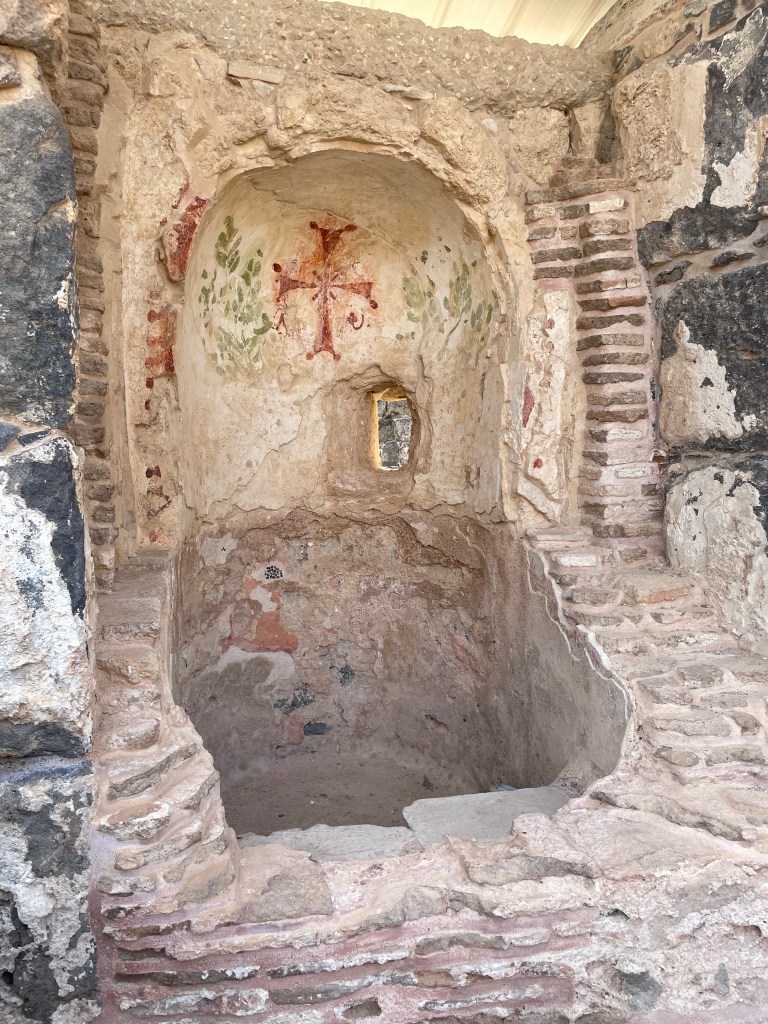
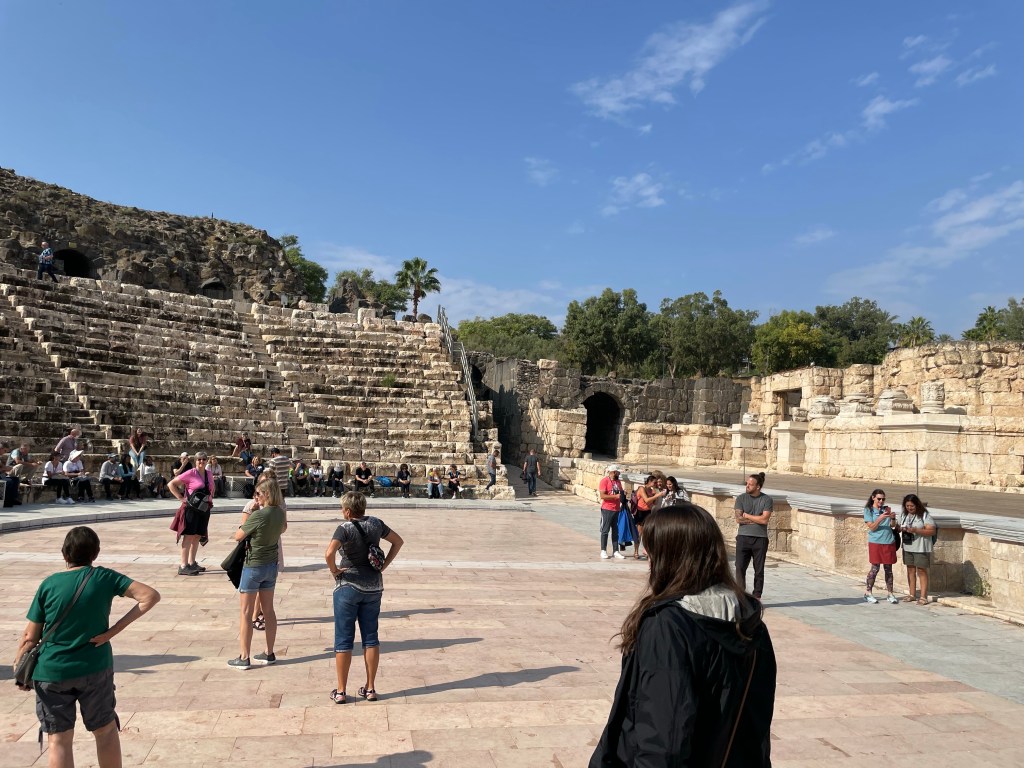

Bet She’an was the Philistine city (at the time) where the bodies of Saul and his sons had been taken as trophies after the battle on the mountains of Gilboa. Paul observes about the challenge the Jabesh Gilead commandos had, sneaking to the city at night without light (let alone something like night-vision goggles), and lugging literal dead weight away from there without being detected.
***
In Jesus’ time, this was a Greek city, one of the ten cities referred to as the Decapolis, and thus not nearly as significant to His story. As such Daniel isn’t terribly broken up by the fact that we don’t have the time to go all the way up the main hill of the city – to him, this is just one more historical site, like those we walk through on cruise shore excursions – but the two of us do wander out of the theater, around the main portion of the city, and along the length of the high street.

***
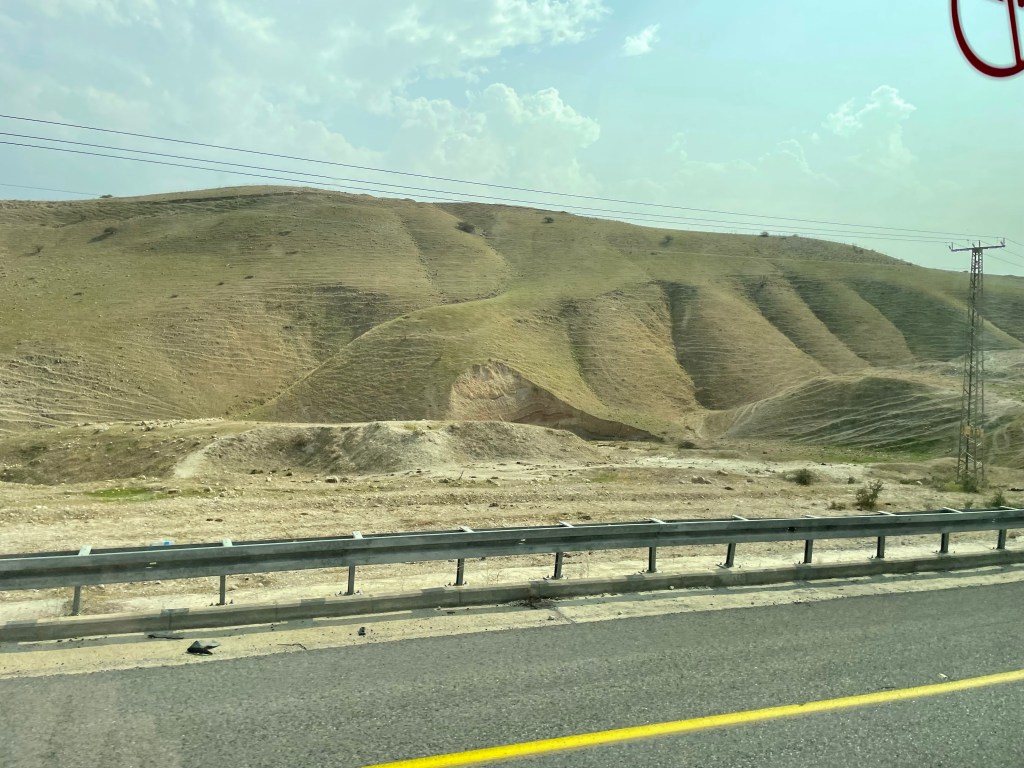
After Bet-She’an, things finally go south – albeit, only literally. I’m stirred from a nap back aboard the bus to discover we’re doing a virtual drive-by of tel-Jericho. However, the archeological site is on the opposite side of the bus, and by the time I’m up with my camera, it’s long past. Daniel is just as happy we’re not bothering with the place, as he reckons it to be cursed; he’s referencing the man who rebuilt the city at the cost of his eldest and youngest sons. Of course, that was so long ago, and the fact that he dealt with the curse already would have taken it away.
He actually seems a little dismayed when we stop here in the town for lunch – although, curiously, he’s fascinated to discover that the water we’re drinking comes from the Elisha Spring aquifer – the ancient water source that makes Jericho an appealing enough location to build a city, even if it does cost a couple of sons to do so.
It occurs to me that the Bible doesn’t spell out how the man’s sons died in the process of building Jericho. Did he literally sacrifice them as a ritual to bring the newly-rebuilt City good fortune? Or were they just involved in unfortunate construction-related accidents? Imagine the number of men who died building Hoover Dam or the Golden Gate Bridge – would either of those be considered to be cursed?
Continuing through the West Bank; the question arises about which places are safe, and which should be avoided. Paul recalls being told by a local (who knew he worked as a police officer in Chicago) “It’s like your hometown; if you live here, you just know” where to go, and more importantly, where not to.
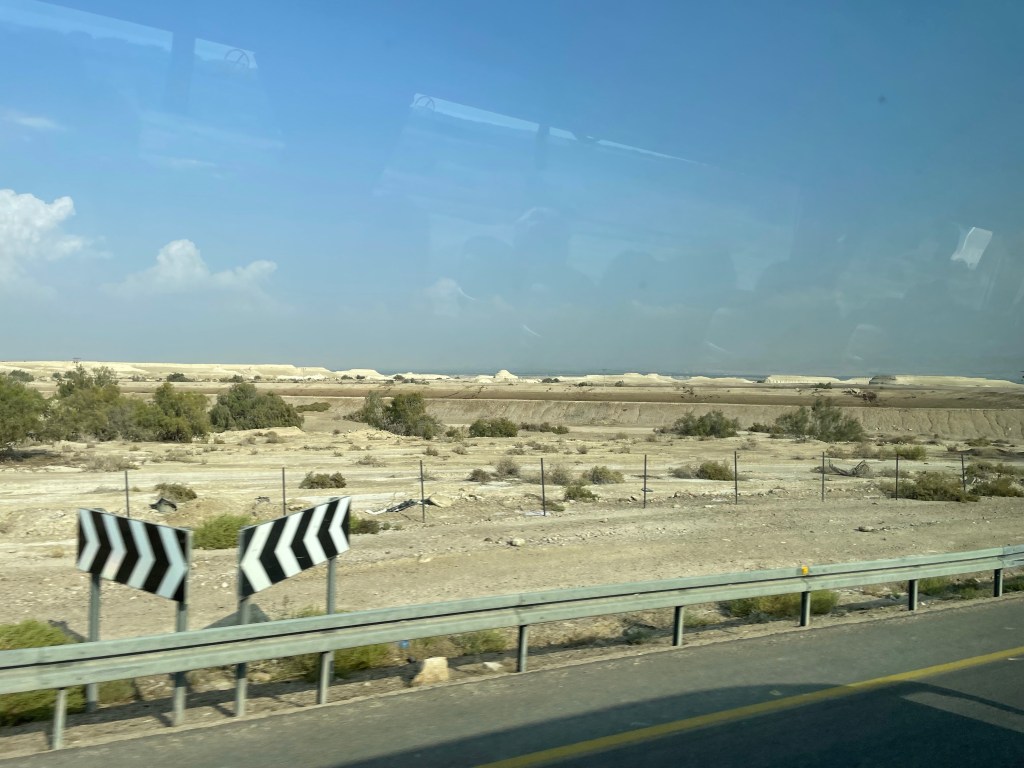
Speaking of where not to go… we find ourselves driving through the desert in which Jesus fasted for forty days and nights – one day for every year the children of Israel spent wandering in their own wilderness.
***
As we make our way to En Gedi, things start to go south on a more figurative level. It just so happens to be closed when we get there, despite being open as of this morning. Ironically, it’s due to that light rainfall we dealt with at Bet-She’an this morning; the rain turns the light dust of the desert into a virtual ceramic surface (as the dust particles expand with the water), and the rest of the water courses down to the lowest point; which happens to be En Gedi. Basically, we would be running the risk of being caught in a flash flood; rather than taking the chance, the park authorities have closed down the park for the time being.
So, it looks like we have to adjust our schedule yet again. Good thing I’m not keeping track of where we’re supposed to be going; I’d be pulling what little hair I have out if I was too focused on our schedule as written out.
***

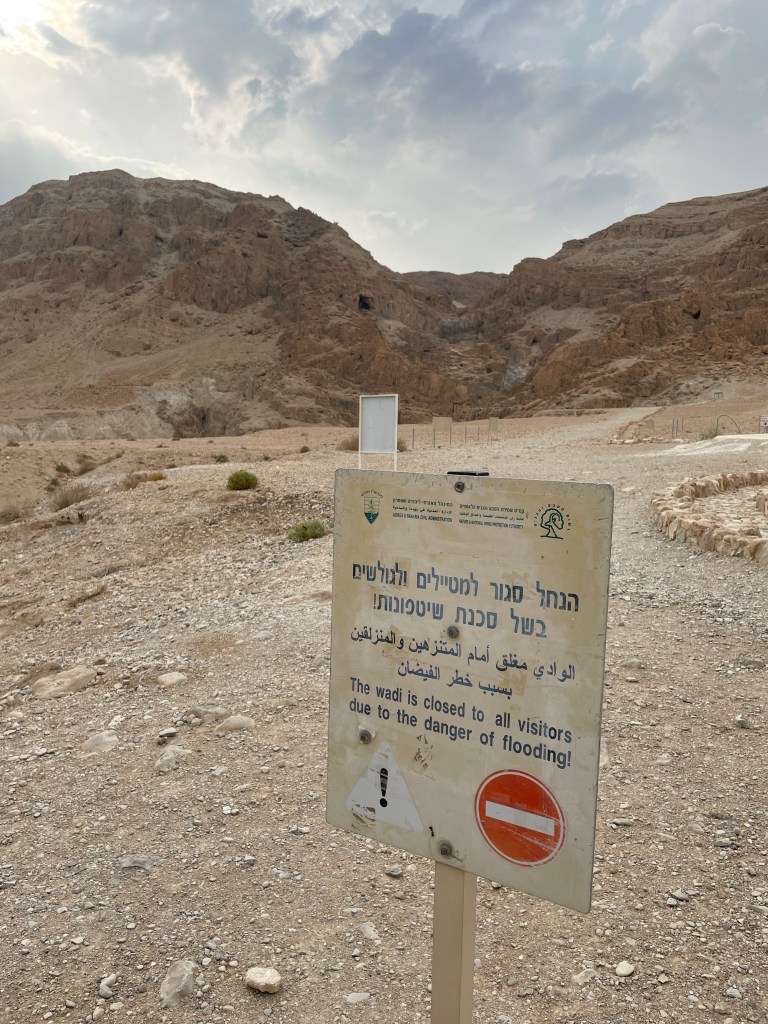
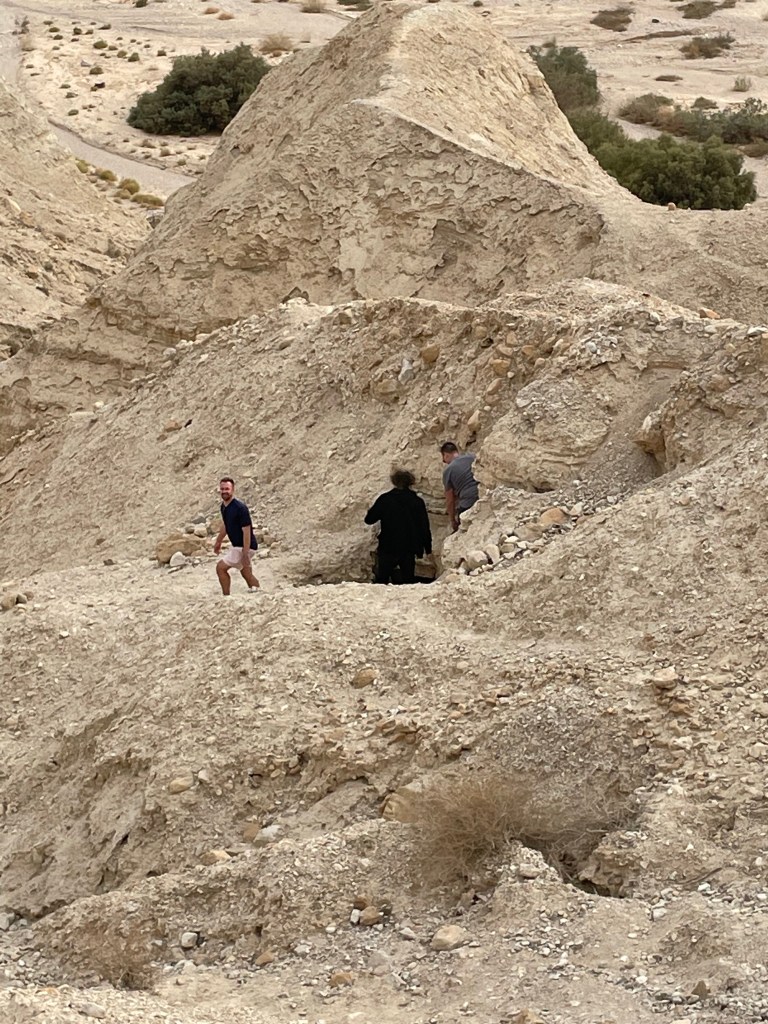
Daniel returns, huffing and puffing, “Oh, wow… that was a workout!” I dare say he’s had his adventure for the day. They found nothing in the five-foot deep niche – although it’s not like they expected anything. Anyway, I’m proud of him for even trying to follow Jordan and Hayden down that slope into the cave – and I’d be willing to bet that you would have been, too (if you wouldn’t have slid on down right beside him – that seems like the sort of thing you would have tried to do, to be honest).

Such is what happens when they close the trail; these are the things people do when they’re bored. It’s probably how the shepherd happened to find the scrolls in the first place; an errant throw breaking something within a cave where nothing was expect to be that one could break in the first place. Amazing the things people can accomplish from sheer boredom.
Anyway, I’m going to have to wrap this up for now, as we need to be back on the road. Keep an eye on us, honey, and wish us luck. We’re going to need it.

 Letters to Rachel
One thought on “Not Going South Just Yet”