Dearest Rachel –
Sunday dinner
On the shore of Galilee
At a… Chinese restaurant?
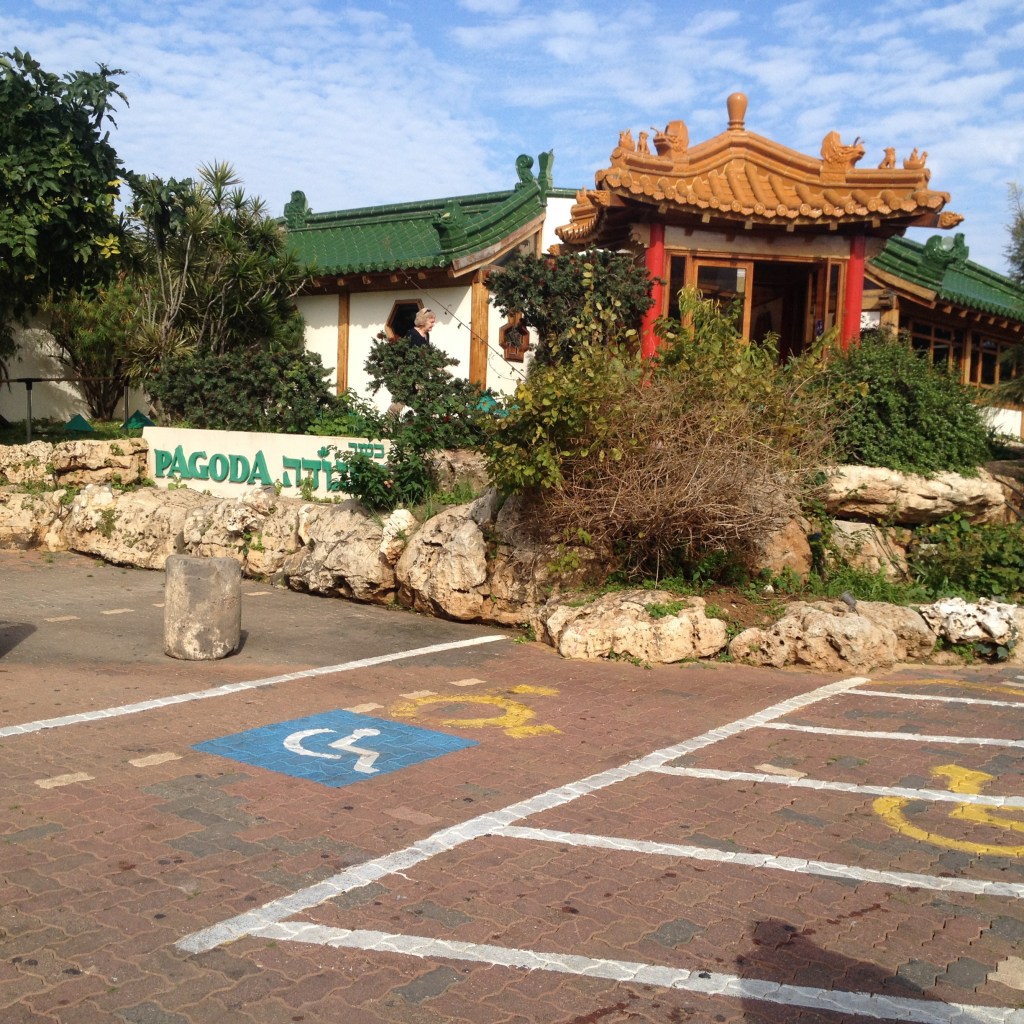
Actually no, we’re not eating at the Pagoda this time. But, we find ourselves eating outdoors in November – another unfamiliar combination of concepts for a group of Chicago natives. But as time wears on, and the sun beats down on us, even the bamboo ceiling, meant to serve as shade, doesn’t feel quite sufficient.

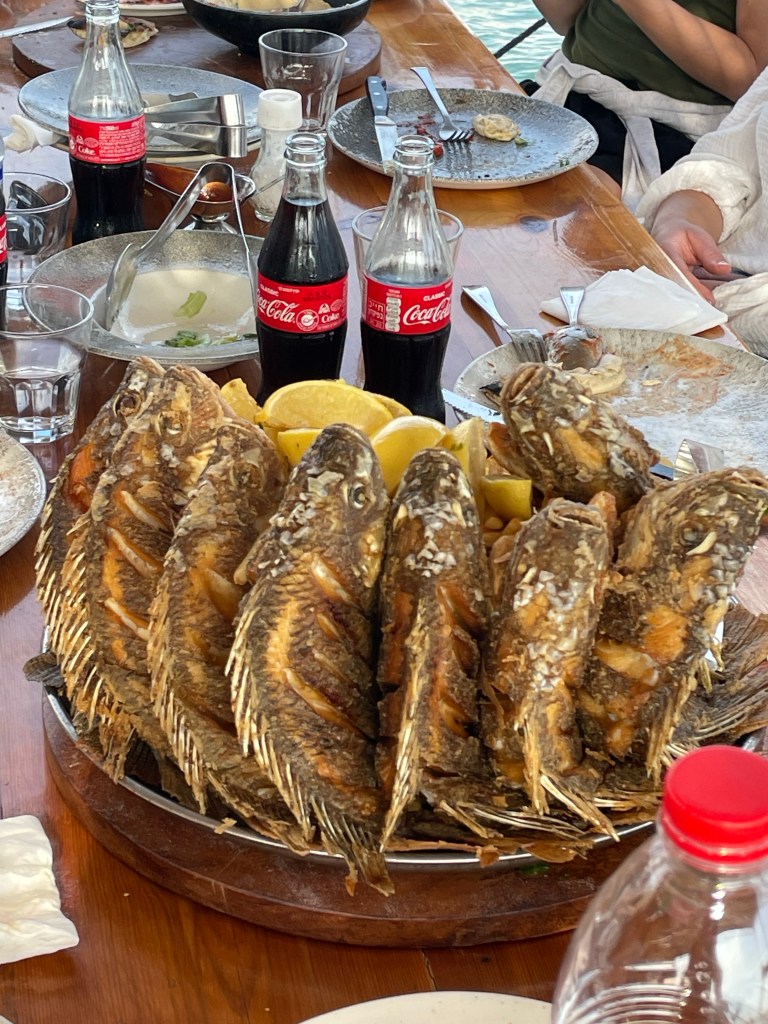
I must seem to the others like I keep my nose buried in my iPhone to an inordinate degree, but I try to avoid it during the meal. Technology is great for recording one’s thoughts as they happen, but it’s death for conversation. I may mention a few things that were said here a little later on this week, but for now, there are other places to visit, and things to see, however quickly.
***
Our first stop this afternoon is in Magdala, which is referenced after the feeding of the four thousand. After accomplishing that miracle, it’s perhaps no wonder that Jesus found Himself exasperated by the Jewish leaders’ request for a sign, and His refusal to perform one (after just having done so elsewhere) is almost understandable. What’s the Son of God got to do to impress people, after all?
On our way there, Yael talks about the mikvah, and the need for running water to use it. In particular, it was used to ritually cleanse a woman after her monthly period. She stresses, that the mikvah was not so much a bathtub for cleaning one’s body, as it was meant for cleaning one’s soul. Often, the vessel itself included seven step to descend into the water, seven being the number of completion, or perfection. And in reference to our earlier dip in the Jordan, she claims that baptism is essentially a form of mikvah – or at least, the practice’s elder sister.
Along those lines, and as we’re disembarking from the bus, Junior hands out certificates of baptism, jokingly referring to them as ‘your ticket into heaven,’ while prefacing that ‘if you don’t want one, that’s okay.’ Good thing, too – I don’t recall these being handed out last time, and I’d hate for you to have been locked out of heaven for not having your ‘ticket.’
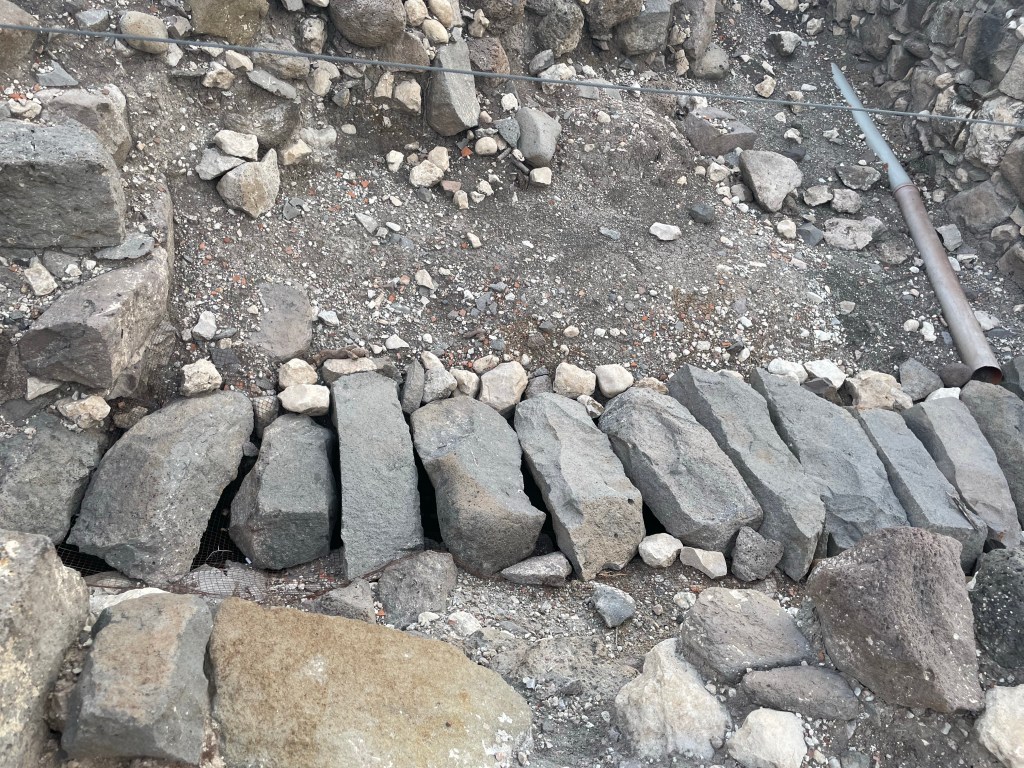
The really interesting thing about Magdala is that, after being destroyed in the first century, it lay completely undisturbed all this time, a well-preserve time capsule of Jesus’ own time (or at least, within a lifetime after His ministry). Only when a Mexican investor attempted to build a hotel in 2009 – and uncovered a massive stone lectern on the first day of excavation – did the place surface, starting with the synagogue.
Two things about synagogues; it’s not meant as a place of sacrifice, like the temple. While it’s meant for learning, they don’t function like churches, where one person lectures and everyone else listens, but people discuss the scriptures among themselves, which means that seats will be facing each other, rather than all toward the single speaker.



Yael talks about how the mikvah and the lighting of the Shabbat candles were the only responsibilities for Jewish women, compared to the long list of requirements for men. According to her, one could look at it in two different ways: you could either grumble about chauvinism, or interpret it as a sign that women are more intrinsically spiritual, and thus not so much in need of rules as men.

***
Our other stop before visiting Omer’s house is in Capernaum (Kfar Naḥum – the home of Nahum, the prophet who pronounced final judgement on Ninevah). Omer actually joins us here, and takes over the lecture duties from Yael. He talks about how Magdala and Capernaum are referred to as ‘A’ sites, while Peter’s house is considered a ‘B’ site.
A word about site categories, and how I remember them:
A sites are ones we are absolutely sure of; these places exist, right where archologists expected them to be. They’re authentic.
B sites are the ones we believe were where they have them placed; oftentimes, there are Byzantine churches marking the spot (and since they were not as far removed, temporally speaking, we generally accept their judgement. In the case of Peter’s house, for instance, while it clearly belonged to a fisherman – since nearly everyone in Capernaum were fishermen – aside from a sign reading ‘Peter’s house,’ we can’t be certain)
C sites are those where something could have been, but we can’t be sure. We only have tradition to go on, and rough approximation, like the Mountains of Precipice or Beatitudes.
D sites are places where, archeologically speaking, we doubt it happened here, but tradition has an event placed here for some reason, such as the church at Tabgha, where it is claimed that the five thousand were fed.
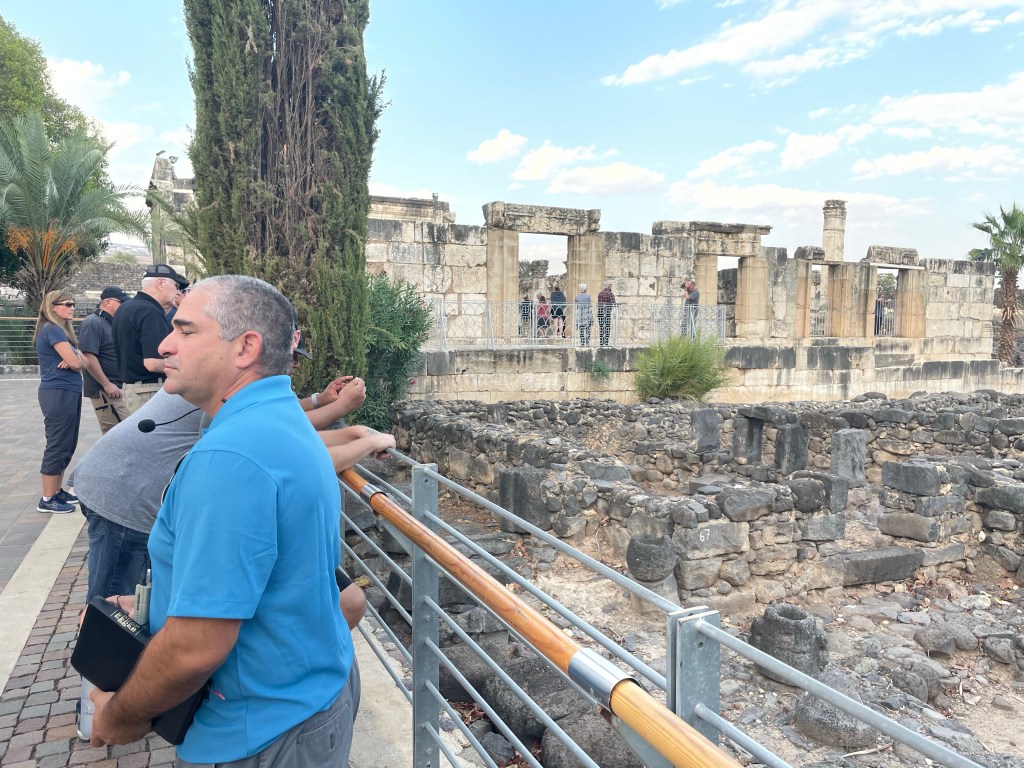
Omer goes on to define the word ‘synagogue’ as a community of the faithful. When Jesus told Peter that “upon this rock,” the foundation stone of his profession that He was the Christ, “I will build My…” not ‘church,’ because that word hadn’t been invented yet; rather, “I will build My community.”
As a building, the synagogue was a place to study the scripture, and to be in community with fellow worshippers. It doesn’t need to be big (in fact, the synagogue in Omer’s own town is one of the smallest buildings there).
Of course, to address a crowd as large as our group (and several others besides elsewhere in the complex) it helps to be a bit on the largish side, as we settle in to listen to Omer expound. And while we have no record of Jesus ever doing so, he begins as many modern speakers do, with a joke: imagining Jesus instructing his disciples, “Now, listen carefully; I don’t want four different versions of what I said showing up.”
He talks about some of Jesus’ first miracles. Not the one in Cana, written about by John, but the ones described in the earliest gospel, Mark. He starts out by pointing out that the first act with both Jews (in chapter 1) and non-Jews (in chapter 5) were exorcisms, driving out evil directly. But from there, he describes the scene in chapter two, where the community was gathered to hear him speak, only to be disturbed by the flaking of thatch, and suddenly a hole in the roof, big enough to drop a man on his stretcher down.
I’d never noticed this before, honey, but it seems we don’t know the relationship between the paralytic and his bearers. Were they relatives? Friends? You would think the Bible would mention it, if it was important. Presumably, all that mattered was that they had faith, enough that Jesus admired and thus chose to heal the man. Not that the paralytic was without faith, either, as he had to make the effort to get up when Jesus eventually told him to.
Omer discusses the story of the blind man, as told in John 9. Even the disciples were under the assumption that his condition had to be due to some sin – either his own (which seemed odd, as he had been born blind, before he could have sinned) or his parents. Of course, Jesus refutes either argument, saying it was so God’s glory could be shown… by His healing him. And this is one of the cases where the leaders of the Jews took issue with Jesus, especially since this happened (as it so often did) on the Sabbath, and healing, to them, was considered to be ‘work,’ and thus forbidden. Of course, in their worldview, holiness was polluted by contact with uncleanness, but Jesus would also touch those He healed, thereby theoretically contaminating Himself – but then, He had an infinite supply of holiness within Him; it could not be sufficiently contaminated to diminish His power.
His statement to them about “If your lamb falls in a pit on Shabbat, won’t you save it?” wasn’t really talking about a lamb, either.
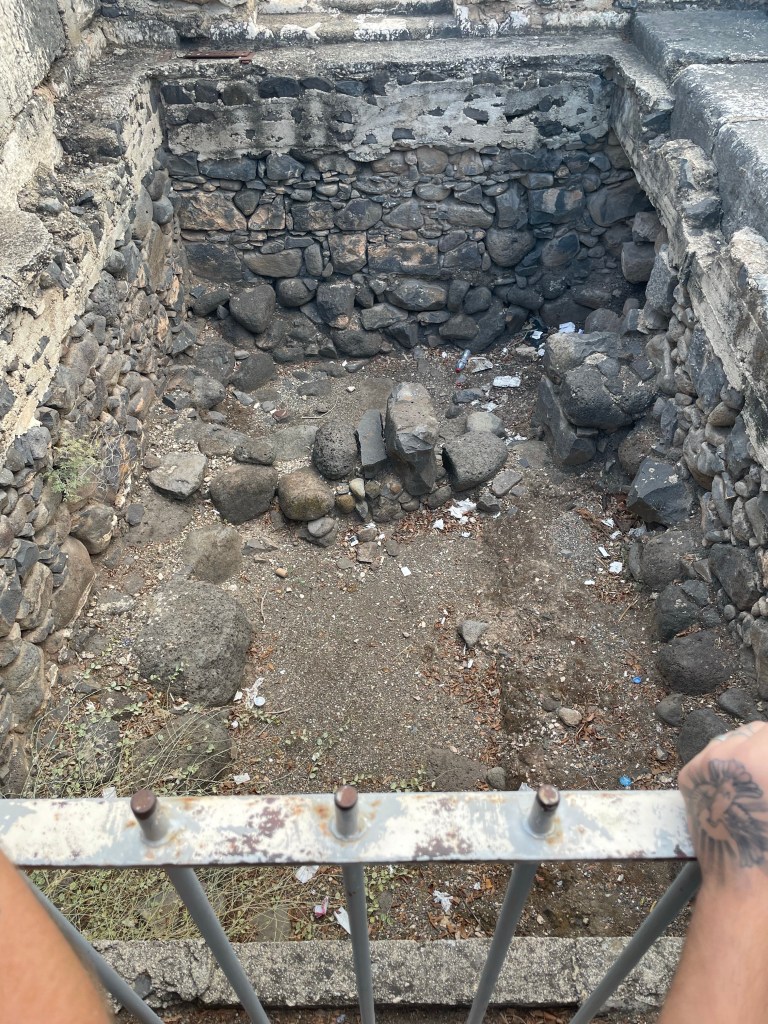
The church above ‘Peter’s house’ is closed for indeterminate reasons; we proceed instead to the shoreline. As we do so, Omer recommends a sitcom called ‘The Jews Are Coming!’ and in particular, a sketch about how Jesus ‘broke the market,’ involving bargaining for the price of sins, similarly to indulgences.

I think I’ve said enough about the places we visited for now, and we’re going to be off to Omer’s house for dinner, so I think I’ll let you go for now.
Keep an eye on me, honey, and I’ll talk to you again soon.

 Letters to Rachel