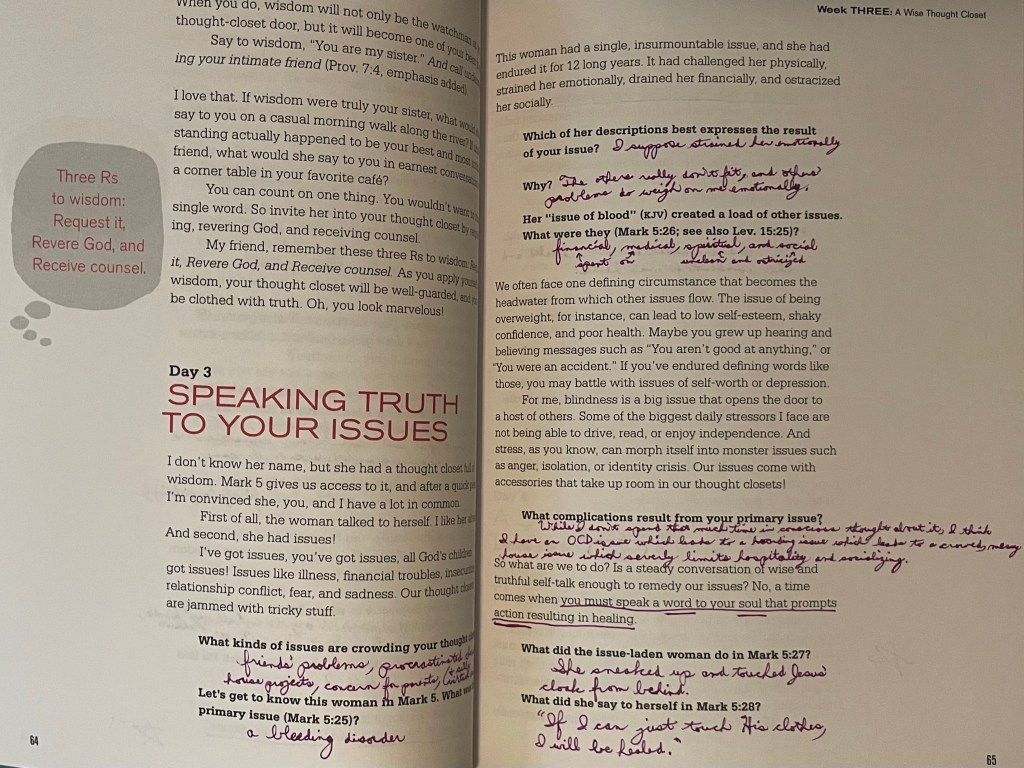

What kinds of issues are crowding your thought closet?
“friends’ problems, procrastinated chores/house projects, concern for parents, and silly virtual deadlines”
Let’s get to know this woman in Mark 5. What was her primary issue (Mark 5:25)?
“a bleeding disorder”
Which of her descriptions best expresses the result of your issue?
“I suppose strained her emotionally”
Why? “The others really don’t fit, and others’ problems do weigh on me emotionally.”
Her “issue of blood” (KJV) created a load of other issues. What were they (Mark 5:26; see also Leviticus 15:25)?
“financial – spent on – medical, spiritual (unclean), and social (ostracized)”
What complications result from your primary issue?
“While I can’t spend that much time in conscious thought about it, I think I have an OCD issue which leads to a hoarding issue which leads to a crowded, messy house issue which severely limits hospitality and socializing.”
[underlined for emphasis] You must speak a word to your soul that prompts action resulting in healing.
What did the issue-laden woman do in Mark 5:27?
“She sneaked up and touched Jesus’ cloak from behind.”
What did she say to herself in Mark 5:28?
“‘If I can just touch His clothes, I will be healed.’”
[underlined for emphasis] She encouraged, counseled, and advised her soul.
What does Mark 5:29 tell us about her encounter with Christ?
“She immediately felt healed and she immediately was healed”
What brought her healing (Mark 5:30–34)? “Her faith”
[starred for emphasis] Jesus never said her soul talk made her well. He said it was her faith. Her faith invited healing. Her soul talk contributed to her faith, but it didn’t replace her faith.
[underlined for emphasis] Soul talk is faith’s companion, not it’s replacement.
Dearest Rachel –
Sorry that this letter from you is coming out as late as it is; I’d forgotten to copy the images before leaving for camp. And, of course, I got distracted by everything else that’s been going on…
Now, obviously, what the woman in this story was dealing with was different than your own issues, but in your responses, it was clear that you knew what yours were. I don’t know if you ever tried to speak a word to your soul about them – or even if you determined what you needed to tell your soul in the first place – but I’m afraid that, even if you did, it never led to the action that the situation required. Of course, since you went through this study, so many other things happened to complicate matters, and lead to you collecting more stuff in this house even as (or ‘if’? Any headway you might have made never really showed, since it was usually overtaken by the additions) you tried to divest yourself of the odd thing here or there.
It really is a pity that these study chapters constantly remind me of the imperfections you had and the struggles you engaged in to overcome them. I would much rather think of you as the gregarious, bubbly girl that I married and brought up here to the suburbs of Chicago, where there were so many more people you could unleash your charm onto than in your hometown of Macomb, as opposed to the harried housewife drowning in clutter that was as much self-inflicted as thrust upon you.
But I suppose that the studies are meant to focus on what’s broken, in order to build up and strengthen the parts of your self that need work. If everything about you was perfect, these sorts of studies would be unnecessary. Besides, it’s not healthy for me to imagine you as some perfect saint, either. If nothing else, I might dismiss Megumi out of hand in comparison if I did.
Interestingly, your comments suggest that it wasn’t simply physical clutter that absorbed you. If I understand them correctly, you were also trying to deal with other people’s issues as well. I don’t know if it distracted you from dealing with your own problems (certainly, some of them may have left you feeling better about them, as you didn’t seem to have the drama in your own life that some of your friends did – admittedly, I though their issues were every bit as much self-inflicted as yours could be), but it did tend to preclude you from dealing with them.
I wonder what difference it would have made if you had been able to accept Jan’s help with your parents’ place, or ours. Would we have made more progress before your departure? Could I be more confident that you would be satisfied with what I’ve done since?
I guess it’s all hypothetical at this point.
At least it’s all behind you now.

 Letters to Rachel