
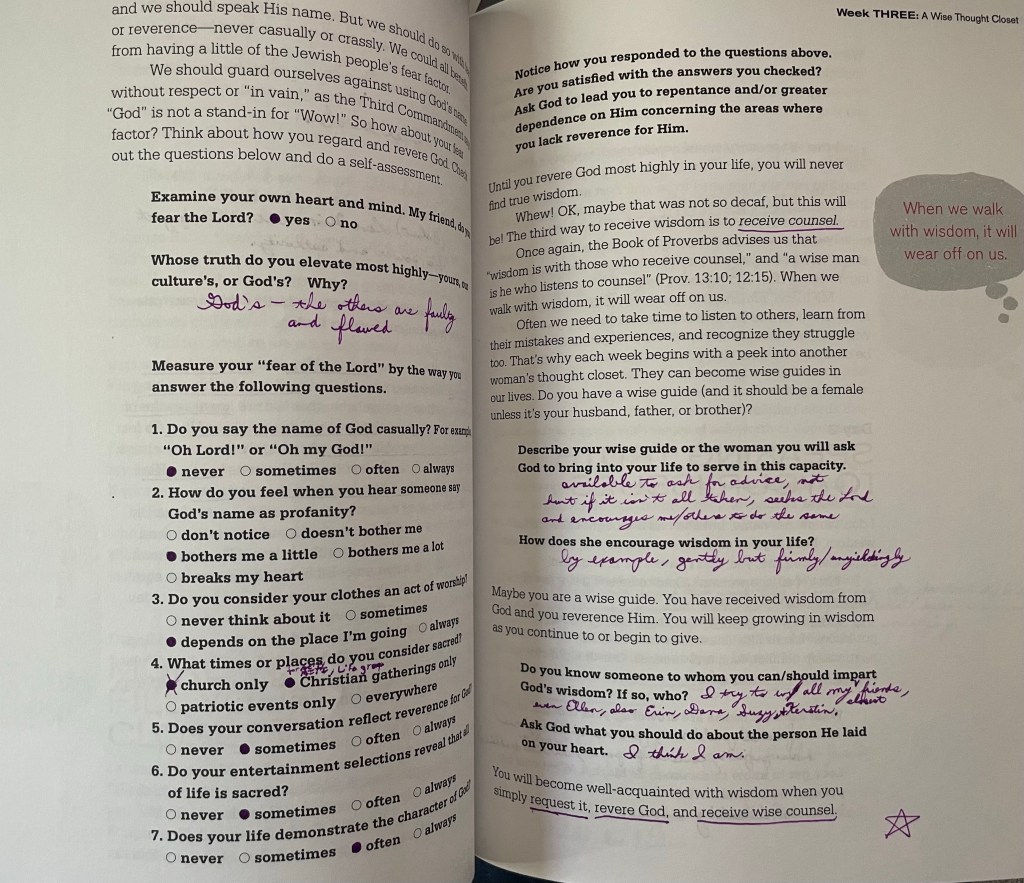
Look in Proverbs 9:10 and write the second way you can receive the wisdom you need.
“Fear the Lord.”
What do you think it means to fear God?
“(Aslan) Love Him but still respect His power and authority.”
In the following paragraph underline key descriptions of the meaning of fearing God.
To fear the Lord means we revere Him and show deference and respect. It’s acting toward God as if approaching a King who invited us into His royal chamber. We are keenly aware of God’s high position and the honor of approaching him! To fear God means we esteem His truth more highly than our feelings or perceptions of truth. To fear the Lord means holding His knowledge and truth in higher regard than our own.
Examine your own heart and mind. My Friend, do you fear the Lord? “yes”
Measure your “fear of the Lord” by the way you answer the following questions.
- Do you say the name of the Lord casually? For example, “Oh Lord!” or “Oh my God!” “never”
- How do you feel when you hear someone say God’s name as a profanity? “bothers me a little”
- Do you consider your clothes an act of worship? “depends on the place I’m going”
- What times or places do you consider sacred? “Christian gatherings – church, Moms in Touch, Life groups”
- Does your conversation reflect reverence for God? “sometimes”
- Do your entertainment selections reflect reverence for God? “sometimes”
- Does your life demonstrate the character of God? “often”
Describe your wise guide or the woman you will ask God to bring into your life to serve in this capacity.
“Available to ask for advice, not hurt if it isn’t all taken, seeks the Lord and encourages me/others to do the same.”
How does she encourage wisdom in your life?
“by example, gently but firmly/unyieldingly”
Do you know someone to whom you can/should impart wisdom? If so, who?
“I try to with all my closest friends, even Ellen, also Erin, Dana, Suzy and Kerstin”
Ask God what you should do about the person He laid on your heart. “I think I am.”
[starred for emphasis] You will become well-acquainted with wisdom when you simply request it, revere God and receive wise counsel.
Dearest Rachel –
I recall you telling me numerous times about how the women’s Bible study had something of a rule; if you didn’t fill out the daily homework, you weren’t permitted to contribute to the discussion when you got together every week. As a result, there were some days – usually the day before the meeting – when you would be feeling in multiple days in a single sitting (I say ‘sitting’: from what I could remember on those sort of days, I would often see you sprawled out on our bed as you worked on your answers to each question).
Some studies required a considerable amount of contribution on your part, but even in those sort of books, there were days that weren’t as demanding as others in terms of required writing. This particular day seems to be one of those. Most of the questions required simply checking a box, rather than spelling out your answer in a matter of sentences.
And yet, even with as few unique replies as this day demanded, you were able to add your little touches. You related to the idea of ‘fearing the Lord’ as though you were one of the Pevensie sisters in The Lion, The Witch and The Wardrobe, one of a number of literary works that you often wished you could have been a part of (your treasured purple car sported the license tag ‘ASLAN 21,’ after all). The great Lion who served as an obvious allegory of Jesus, the Lion of the tribe of Judah, was no one to be trifled with (“Safe?” as Mr. Beaver described him, “Who said anything about him being safe? ‘Course he’s not safe! But he’s good.”), but at the same time, to those he considered his friends, he was no one to be afraid of, as such.
It was he who served as your example of how to ‘fear’ God; one must understand His power and authority, but be able to love Him as a Friend as opposed to being in terror of Him.
In terms of wise counsel, I don’t know who you turned to, specifically. It may be that you didn’t wish to name names of others in your study group, lest they consider themselves as having ‘arrived.’ I could name a few possibilities (few, if any, of whom participated in these particular studies), but whether my observations would correctly divine who you had in mind with your description, I’ll never know. You might agree with my guesses, or you might say something to the effect of oh ‘yeah, I did rely on her, but that’s not who I was thinking of when I wrote this,’ so I won’t presume to know who – if anyone in particular – you had in mind with your description.
I can’t even confirm whether or not you were able to dispense wise counsel of your own; I’d probably have to check with the girls at my next opportunity. They might even be able to offer examples, but I don’t know. You did say that you tried; that doesn’t necessarily mean you succeeded. Still, I imagine the effort is sometimes the important thing, in any event.

 Letters to Rachel